
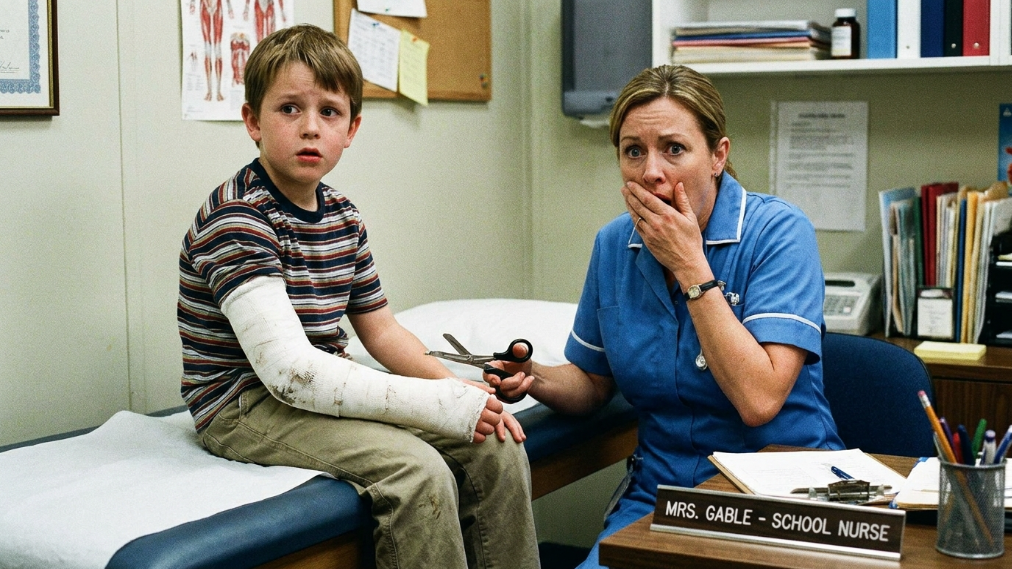
NEXT PART – THE EIGHT-YEAR-OLD BOY TREMBLED EVERY TIME THE SCHOOL PRINCIPAL’S NAME WAS MENTIONED AFTER HIS FALL — BUT THE CLINIC NURSE STOPPED BREATHING WHEN SHE CUT OPEN HIS DIRTY ARM CAST
I have cut off thousands of casts in my twelve years as a pediatric orthopedic nurse.
I know exactly what a terrified child looks like. I know the way they squeeze their eyes shut when I turn on the oscillating saw. I know how they try to pull their arm away because they think the blade is going to slice through their skin.
But eight-year-old Leo was not afraid of the saw.
He was afraid of the cast coming off.
He sat on the edge of Exam Room 4, his small frame rigid against the crinkling paper of the treatment table. He was cradling his right arm against his chest like it was a fragile glass sculpture.
The fiberglass cast was originally bright neon green. After six weeks, it had faded to a muddy, scratched olive color. The edges were frayed, and the whole thing looked heavily worn.
I rolled my stool closer and offered him a reassuring smile.
“Alright, Leo,” I said, keeping my voice low and steady. “Today is the big day. We get to take this heavy thing off and see your new, healed arm.”
Leo didn’t smile back. He didn’t even look at my face.
His eyes were locked completely on the door of the exam room. His left hand, his good hand, was gripped so tightly around the wrist of the cast that his knuckles were entirely white.
“I don’t want it off,” he whispered.
His voice was barely a breath. It was rough, scratching at the back of his throat.
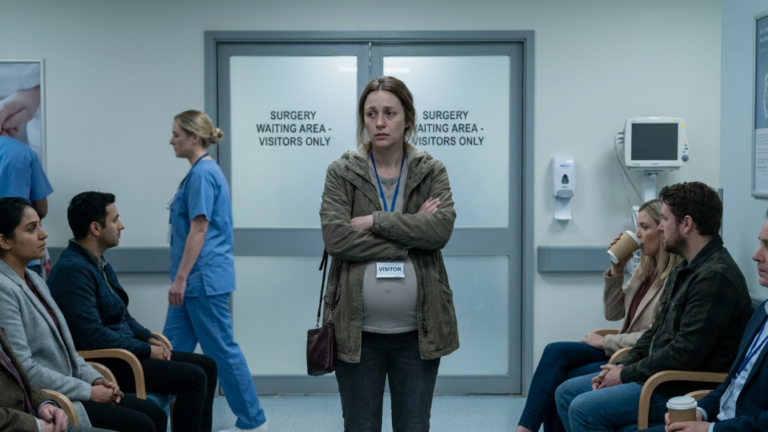
His mother, Elena, sighed heavily from the corner chair. She was wearing a faded blue uniform from the postal distribution center, her badge still clipped to her collar. She looked exhausted, the kind of deep, bone-weary tired that comes from working double shifts and managing a household entirely alone.
“Leo, we’ve talked about this all morning,” Elena said, rubbing her temples. “The doctor said it comes off today. You can’t wear it forever.”
“It has to stay,” Leo repeated.
He pulled his knees up toward his chest, trying to make himself smaller. He tucked the casted arm deeper into the fold of his body.
I paused. I didn’t reach for my tools yet.
As a nurse, you learn to read the room before you ever touch a patient. There was a specific, heavy tension here that didn’t match the standard anxiety of a cast removal.
I looked at the monitor clipped to Leo’s left index finger. His pulse was sitting at 115 beats per minute. That was high, even for a nervous kid.
“Leo,” I said softly, holding up the cast saw. “I promise this doesn’t hurt. The blade doesn’t spin. It just vibrates back and forth. It can cut the hard shell, but it can’t cut your skin.”
I pressed the blade gently against the palm of my own hand and turned it on to demonstrate. The loud buzzing filled the small clinic room. I let it vibrate against my skin to show him it was completely safe.
Leo didn’t even blink. He wasn’t looking at the saw.
“I know it doesn’t cut,” he said quietly. “I just need to keep it. Please.”
I turned the saw off. The sudden silence in the room felt heavy.
I looked over at Elena. “Was he this nervous when you left the house today?”
Elena shook her head, shifting her weight in the small plastic chair. She looked at the stack of discharge paperwork she was holding in her lap.
“He’s just being stubborn,” she said, her voice strained. “He’s been acting strange for weeks. Ever since the accident at school.”
I pulled up Leo’s digital chart on the tablet mounted to the wall. Distal radius fracture. A clean break of the forearm bone.
“He fell on the playground?” I asked, reading the initial intake notes from the emergency room six weeks ago.
“No, on the indoor stairwell,” Elena corrected. “During the morning assembly. He was running late and tripped.”
I nodded, scrolling down. “Kids take tumbles on those stairs all the time. Concrete steps are entirely unforgiving.”
“I know,” Elena said. She offered a tired, appreciative smile. “We were incredibly lucky Mr. Vance was there.”
The moment the name left her lips, Leo flinched.
It wasn’t a small movement. His entire body jerked violently, as if a physical shock had traveled up his spine. His pulse oximeter began to beep rapidly.
His heart rate spiked to 135.
I kept my eyes on the screen, but I was suddenly hyper-aware of the boy sitting two feet away from me.
“Mr. Vance?” I asked, keeping my tone casual. “Is that his teacher?”
“The principal,” Elena said. “He’s been absolutely wonderful about the whole thing.”
Leo was breathing fast now. Small, shallow gasps. His eyes were darting around the room, tracking every shadow.
“He was the only one in the stairwell when Leo fell,” Elena continued, entirely missing her son’s panic. “He carried Leo all the way to the nurse’s office himself. He even rode in the ambulance with him because I was stuck at work.”
I looked at Leo’s chart again. There was a note from the ER admitting nurse.
Patient accompanied by school official. Mother arrived 45 minutes later.
“That’s very dedicated,” I murmured.
“He is,” Elena agreed. “He calls every single Friday to check on Leo’s arm.”
I stopped scrolling. My hand hovered over the tablet.
I have worked in pediatrics for over a decade. I have seen countless school-related injuries. Teachers and principals check in, certainly. They send get-well cards.
They do not call the parent every single Friday for six weeks straight.
“Every Friday?” I asked.
“Yes,” Elena said. She checked her phone as it buzzed in her lap. “He’s very invested. He specifically wanted to know the exact date the cast was coming off.”
Leo let out a tiny, stifled whimper. He bit his lower lip hard enough that it turned white.
“In fact,” Elena added, looking up from her screen. “Mr. Vance just texted me. He asked if I could bring the empty cast to the school tomorrow morning.”
I spun my stool around to face her. “He wants the empty cast?”
“He said he wants to hang it on the safety bulletin board in the main hallway,” Elena explained, smiling slightly. “As a reminder for the other kids not to run on the stairs. He said it would be a great teaching tool.”
A cold, heavy knot formed at the bottom of my stomach.
I looked at Leo. The eight-year-old boy was staring at me.
His eyes were filled with an absolute, crushing terror. It was a look I rarely saw in my clinic. It was the look of a child who was trapped in a corner with no way out.
He was gripping the top opening of his cast so tightly that his small fingers were digging into the dirty cotton stockinette.
A principal wanting a dirty, smelly, six-week-old piece of fiberglass for a bulletin board was not just unusual. It was completely bizarre. Most schools have strict sanitation rules about biological waste.
A cast is full of dead skin, sweat, and bacteria. Nobody hangs them on a wall.
“Leo,” I said softly, leaning closer to him. “Is your arm hurting today?”
He shook his head in sharp, jerky motions.
“Okay,” I said. “I need to take this off so the doctor can take an X-ray. It’s the only way we know the bone is completely strong again.”
“No X-ray,” Leo pleaded. “Leave it.”
I put on my protective plastic glasses. I handed a pair of noise-canceling headphones to Leo.
“These will block out the buzzing sound,” I told him.
He refused to take them. He just kept his hand clamped over the top opening of the cast.
I had to proceed. I picked up the medical marker and drew a straight white line down the side of the green fiberglass. This was my cutting guide.
“Here we go, buddy,” I said. “Just a lot of loud vibration.”
I turned the saw on. The high-pitched whine filled the room again.
I pressed the vibrating circular blade into the fiberglass near his wrist. White dust immediately plumed into the air.
Leo let out a sharp cry and squeezed his eyes shut.
I moved the blade up his forearm, cutting a clean channel through the hard resin. I could smell the familiar, sour odor of the old cast escaping as the shell opened up.
I finished the first cut near his elbow. I turned the saw off and moved to the inside of his arm to make the second cut.
“Halfway done,” I told him.
Leo wasn’t looking. He was staring at the ceiling, tears silently leaking from the corners of his eyes and tracking down his pale cheeks.
I powered the saw back up and made the second cut, dragging the blade smoothly down the inside of his forearm. The fiberglass yielded easily.
I turned the saw off and set it down on the metal tray.
“Okay,” I announced. “The loud part is entirely over.”
Elena stood up and walked over to the table to watch. “See? That wasn’t so bad.”
I picked up the cast spreaders. They look like heavy metal pliers with wide, flat grips on the end. I slid the metal edges into the cut I had just made.
I squeezed the handles together. The fiberglass cracked loudly as the shell split apart into two halves.
Underneath the hard shell was a thick layer of white cotton padding, wrapping Leo’s arm in a soft cocoon. The cotton was gray and matted with sweat.
“Now I just snip the cotton,” I explained, picking up my blunt-nosed bandage scissors.
I slid the lower blade under the cotton near his elbow. I began to cut downward, moving carefully over his pale, thin skin.
As my scissors reached the middle of his forearm, I hit a snag.
The blades wouldn’t cut. There was something hard embedded inside the layers of cotton batting.
Kids shove things down their casts all the time. They use pencils, plastic rulers, and Lego bricks to scratch the terrible itches they can’t reach. Usually, the objects just fall out when the cast is opened.
“Did you lose a toy in here, Leo?” I asked lightly.
Leo didn’t answer. He stopped breathing entirely.
I gently pulled the cut cotton apart with my gloved fingers to see what was blocking my scissors.
It wasn’t a toy.
It was a lump of thick, dark material, deliberately wedged deep into the padding, pressed flat against his skin. It had been pushed down so far that there was no way Leo could have retrieved it himself.
I set my scissors down. I grabbed a pair of long medical tweezers from my tray.
“Let’s see what we have hiding in here,” I murmured.
I gripped the edge of the dark material with the tweezers and began to pull. It was stuck to the cotton. I wiggled it gently, pulling upward toward the wrist opening.
Elena leaned in over my shoulder. “What on earth did he put in there?”
I kept pulling. The object slowly slid out from the matted padding.
It was a heavy, woven nylon strap. It was dark blue.
As I pulled the rest of it free, a thick metal clip emerged from the cast. The metal clinked sharply against my tweezers.
Attached to the metal clip was a jagged, broken piece of hard white plastic.
The room went completely silent.
I stopped breathing.
I stared at the object clamped in my tweezers. My mind struggled to process what I was looking at.
It was the bottom half of a school staff lanyard.
The thick blue nylon had the district’s logo printed on it in white letters. The broken piece of plastic was the bottom edge of an official identification badge.
The top half of the badge was snapped off. But the bottom half remained.
Printed clearly in bold black letters across the surviving plastic was a single name.
PRINCIPAL VANCE
There was no physical way this object fell into the cast by accident. It had been intentionally stuffed deep inside the protective padding.
I looked up at Leo.
He was staring at the broken badge. His face was completely bloodless.
He leaned forward, his mouth hovering just inches from my ear.
“He said if I ever gave it back,” Leo whispered, his voice trembling so hard I could barely hear the words, “he would tell the police my mom hurt me, and I would never see her again.”
CHAPTER 2
The words hung in the sterile air of the exam room, vibrating against my eardrums.
Leo was still leaning forward, his pale lips trembling. His good hand was clamped so tightly over his mouth that his fingertips were turning blue.
He was entirely rigid. He had just handed me a live grenade, and he was waiting for the explosion.
My heart hammered against my ribs, but my face remained perfectly blank. Twelve years in pediatric nursing teaches you how to build a wall behind your eyes. You never let a panicked child see your own fear.
I looked over my shoulder. Elena was still sitting in the corner plastic chair.
She was distracted, scrolling through a digital schedule on her phone. She was rubbing her temples with her free hand. She hadn’t heard a single word.
“Everything okay?” Elena asked, looking up at the sudden silence. “Did you get it off?”
I had a fraction of a second to make a decision.
If I held up the broken plastic badge right now, the room would detonate. Elena would demand answers. Leo would panic.
And if Mr. Vance had groomed this mother as thoroughly as I suspected, she might not even believe her own son. She might call the school immediately to ask him what happened.
I needed time. I needed to lock this piece of evidence away before anyone else saw it.
I kept my body angled, blocking Elena’s line of sight. I smoothly closed my gloved fingers around the broken plastic badge and the blue nylon strap.
“Almost done,” I said, my voice perfectly level. “Just a piece of hardened cotton batting that got stuck to the fiberglass shell.”
I dropped my hand into the deep front pocket of my scrub top. I let the heavy plastic badge fall to the bottom of the fabric.
It sat against my thigh, a heavy, jagged secret.
I picked up the cast spreaders again. I used them to pry the two halves of the green fiberglass completely apart.
The sour, musty smell of the old cast filled the small room. I carefully lifted the top shell away and set it on the stainless steel tray.
“Alright, Leo,” I murmured. “Let’s get this cotton off.”
I used my bandage scissors to snip the remaining soft padding. I peeled the gray, damp cotton away from his skin.
His right arm finally saw the light of day. It was pale, thin, and covered in a layer of dry, flaky skin.
This was completely normal after six weeks in a cast. But what wasn’t normal was the way Leo was holding the arm.
Even without the heavy fiberglass weighing him down, he kept his wrist pinned tightly against his ribs. His shoulder was hunched forward. It was a purely defensive posture.
“It smells terrible,” Elena said, wrinkling her nose as she stood up. “I’m so glad that thing is off.”
“It’s just dead skin cells and sweat,” I explained automatically. “Completely standard. We’ll get it washed up right now.”
I turned on the small sink in the corner of the exam room. I adjusted the water until it was lukewarm.
I grabbed a stack of soft, textured hospital washcloths and a bottle of mild baby shampoo. I walked back to the exam table.
“Elena, could you do me a favor?” I asked, keeping my tone light.
She stopped typing on her phone. “Of course. What do you need?”
“There are two release forms at the front desk that need your signature before we can send him to X-ray,” I lied smoothly. “Could you grab them from Lisa? It will save us some time.”
Elena sighed, pocketing her phone. “Sure. Just the front desk?”
“Yes,” I said, offering a warm smile. “Take your time. We’re just going to do a little spa treatment in here.”
Elena walked out of the room, pulling the heavy wooden door shut behind her. The latch clicked loudly.
We were alone.
I immediately dropped the washcloths onto the tray. I stepped closer to the exam table and knelt down so I was exactly at Leo’s eye level.
He flinched backward, hitting the wall behind the table. His eyes were wide and tracking my every movement.
“Leo,” I said, keeping my voice barely above a whisper. “Look at me.”
He shook his head frantically. He wrapped his good arm around his newly freed wrist, protecting it.
“Leo, I have the badge,” I whispered. “It is in my pocket. Nobody is going to see it.”
He stopped shaking his head. He looked down at my scrub pocket, his chest heaving with shallow, panicked breaths.
“He said he would take my mom away,” Leo choked out, tears finally spilling over his eyelashes. “He said the police would lock her in a cage.”
My stomach turned over. It was a sick, twisting sensation.
This wasn’t just bullying. This was calculated, predatory psychological torture.
“Listen to me very carefully,” I said, making sure my voice was absolute iron. “Your mom is not going anywhere. The police are not going to take her.”
“He has a picture,” Leo cried softly, burying his face in his good shoulder. “He showed me.”
I froze. “A picture of what, buddy?”
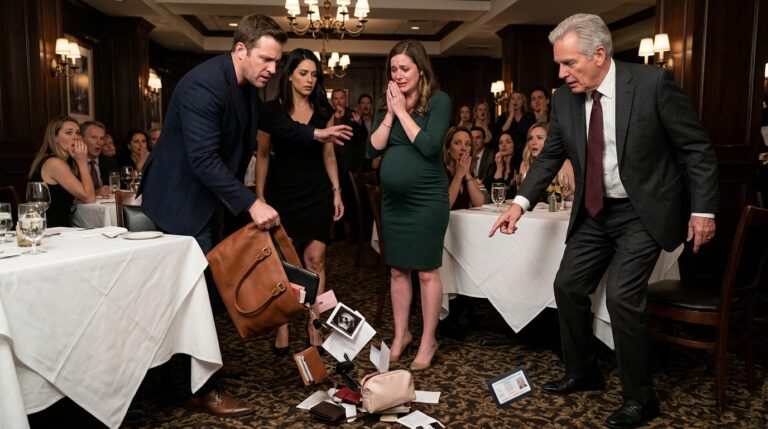
“A picture of the bruises,” Leo whispered. “From when I fell off my bike last summer. He said it looks like she hit me.”
The trap was so perfectly constructed that it took my breath away.
Vance hadn’t just threatened a child. He had built a plausible, documented narrative. He had leveraged an old, innocent injury to enforce silence about a new, terrible one.
He was holding Elena hostage without her even knowing it. And he was using her son as the lock.
“Leo, that man is a liar,” I said firmly. “I am a nurse. I know what bike bruises look like. And I know what other bruises look like.”
Leo looked up at me. His eyes were red and swollen.
“He’s coming,” Leo said, his voice dropping to a terrified rasp. “He said he was coming today to get the cast.”
“He is not getting this cast,” I promised him. “I am going to throw it into a locked biohazard bin. He will never touch it again.”
I stood up and grabbed the washcloths. I soaked them in the warm water and added a pump of soap.
I needed to act normal. Elena would be back in a minute. I couldn’t let her walk into a room thick with panic.
“I’m going to wash your arm now,” I told him. “It might tickle a little bit.”
I gently took his right wrist. His muscles were tight, fighting my grip.
As I ran the warm, soapy cloth over his forearm, the dead skin began to slough away. The pale, sensitive skin underneath was finally visible.
I washed carefully, my eyes scanning every inch of his arm. I was looking for older marks. Faded fingerprints. Fingernail scratches.
There were none. The arm was completely unmarked, aside from the slight swelling around the healed fracture site.
Whatever happened on that stairwell six weeks ago, Vance had been careful. He hadn’t left surface evidence. He had simply broken the bone.
The door handle clicked. I quickly wiped the remaining soap away with a dry towel.
Elena walked back in, holding a clipboard. “Lisa said she didn’t know what forms you were talking about.”
I mentally cursed myself. I should have texted the front desk to play along.
“Oh, she must not have printed them yet,” I said, turning around with a breezy smile. “My mistake. I’ll print them from my terminal later.”
Elena looked annoyed, but she sat back down in her chair. “His arm looks so skinny.”
“Muscle atrophy,” I explained, tossing the wet towels into the laundry hamper. “It will bulk back up in a few weeks of normal use.”
I walked over to the stainless steel tray. The two halves of the dirty green cast were sitting there, staring at me.
“Alright,” I said briskly. “I’m going to take this mess to the disposal room. Then we’ll walk down the hall for the X-ray.”
I picked up the two fiberglass shells. I gathered up the pile of dirty cotton padding.
I made sure to squeeze the padding tightly in my fist, hiding the fact that there was a massive, rectangular hole cut into the middle of it.
“Wait,” Elena said suddenly.
I stopped halfway to the door. My hand tightened around the jagged fiberglass.
“Mr. Vance really wanted that cast,” Elena said, standing up. “He asked specifically. I should probably just put it in my car now.”
I turned slowly. I kept my face relaxed, forcing a polite, professional smile.
“I’m so sorry, Elena,” I said. “I can’t let you do that.”
She frowned, looking confused. “Why not? It’s just a piece of plastic.”
“It’s a biological hazard,” I lied, invoking the heaviest bureaucratic tone I could muster. “Once a cast is removed in a clinical setting, it is classified as medical waste.”
“But it’s his cast,” Elena argued mildly. “We paid for it.”
“You paid for the application,” I corrected gently. “The removal protocol is strictly governed by OSHA regulations. It’s full of human cellular material and bacteria.”
Elena looked completely baffled. “Schools do this all the time. They hang them on walls. Kids sign them.”
“They sign the outside while it’s still on the patient,” I explained, keeping my voice smooth and authoritative. “Once it’s removed, the interior lining is exposed. It has to go into the red incineration bags.”
Elena sighed in frustration. “Mr. Vance is going to be so disappointed. He really wanted it for the safety display.”
“You can tell him the mean clinic nurse wouldn’t allow it,” I offered, smiling. “Blame it entirely on me.”
I didn’t wait for her to argue further. I pushed the heavy door open with my shoulder and stepped out into the busy clinic hallway.
The bright fluorescent lights overhead hummed loudly. Nurses and medical assistants were rushing past, carrying charts and supplies.
I walked quickly down the corridor toward the dirty utility room. My heart was still racing.
I punched the security code into the keypad on the utility room door. The lock clicked, and I pushed it open.
The room was quiet and smelled strongly of bleach. Several large, red plastic bins marked with the biohazard symbol lined the far wall.
I walked over to the nearest bin and stepped on the foot pedal. The heavy lid popped open.
I looked down at the two halves of the green cast in my hands.
Before I threw them away, I examined the interior cotton lining one last time. I wanted to see exactly where the badge had been hidden.
The hollowed-out pocket in the cotton was located right near the bend of the elbow. It was the deepest part of the cast, the hardest place to reach.
I looked closer. There was something else inside the hollow pocket.
It wasn’t another object. It was a dark, reddish-brown stain on the white cotton.
It was dried blood.
I pulled the broken plastic badge out of my pocket and held it up to the light. The jagged, snapped edge of the plastic was stained with the exact same reddish-brown color.
The plastic hadn’t just broken off. It had cut someone.
A sharp, cold realization washed over me. The blood wasn’t Leo’s. Leo had no cuts or scratches on his arm.
The blood belonged to Principal Vance.
During the struggle on the stairwell, Leo must have grabbed the lanyard. The plastic badge had snapped. The jagged edge had cut Vance’s hand.
Vance hadn’t noticed the broken piece was missing until the paramedics were already arriving. He couldn’t search the scene. He couldn’t risk being seen looking for it.
He didn’t know where it was. Until the cast went on.
Leo had hidden it. He had shoved it deep into the padding of his own cast while sitting in the ER, terrified and alone, securing the only piece of evidence he had.
That was why Vance called every Friday. That was why he was obsessed with the cast removal date.
He wasn’t trying to be a hero. He was trying to retrieve the bloody plastic that placed his hands directly on the child he had just broken.
I dropped the cast halves into the red bin and let the lid slam shut.
I took a deep breath, steadying my shaking hands. I needed a medical paper trail. I needed documentation that could stand up in court.
I walked out of the utility room and headed straight for the radiology department.
David, our senior X-ray technician, was sitting behind the lead-lined glass of the control booth. He was a quiet, meticulous man who had seen every type of broken bone in the city.
“Hey, Dave,” I said, leaning into the open doorway. “I’m bringing the kid from Room 4 down in a minute. Distal radius follow-up.”
David tapped his keyboard, pulling up the schedule. “Leo. Eight years old. Got it.”
“Do me a favor,” I said, keeping my voice low. “Pull up his original ER films from six weeks ago.”
David looked up, his brow furrowing. “I usually just look at the current alignment.”
“I know,” I said. “But look at the original break. Tell me what you see.”
David frowned, but he clicked a few buttons. The large, high-definition monitors on his desk flashed to life.
Two stark black-and-white images appeared on the screen. The fragile, ghostly bones of an eight-year-old boy.
In the middle of the right forearm, the two long bones—the radius and the ulna—were visibly fractured.
“Ouch,” David murmured, leaning closer to the screen. “That was a nasty hit.”
“What kind of hit?” I asked quietly.
David traced the line of the fracture with his pen. “Well, it’s not a standard FOOSH.”
FOOSH. Fall On Out-Stretched Hand. It was the most common playground injury in the world. Kids trip, they put their hands out to catch themselves, and the wrist bone snaps under the weight.
“Look at the angle of the break,” David explained, pointing to a jagged white line on the screen. “It’s not a compression fracture at the wrist joint. It’s a mid-shaft transverse fracture.”
“Meaning what?” I pressed.
“Meaning the force didn’t come from his hand hitting the ground,” David said, turning his chair to face me. “The force came from a direct, horizontal impact to the middle of the forearm.”
A nightstick fracture.
It was the clinical term for a break that happens when a person raises their arm to block a heavy, swinging blow.
“Are you sure?” I asked, feeling a cold sweat break out on the back of my neck.
“I’m a tech, not a radiologist,” David cautioned immediately. “But yeah. You don’t usually get a clean mid-shaft transverse break from tripping on a stairwell. Unless he fell sideways and hit his arm perfectly across the edge of a concrete step.”
“Is it possible?” I asked.
“Possible? Sure,” David said with a shrug. “Physics is weird. But if I had to bet my paycheck, I’d say something hit his arm. Hard.”
I stared at the glowing white bones on the monitor. The evidence was right there, permanently recorded in calcium and radiation.
The ER doctor had missed it because the narrative had already been set. The principal was standing in the room, wearing a suit, performing the role of the caring administrator, feeding the doctor a perfectly plausible story.
“Keep those films up,” I told David. “I’ll be right back with the patient.”
I practically jogged back to Exam Room 4.
When I pushed the door open, Elena was standing by the window, looking out at the parking lot. Leo was sitting exactly where I had left him, clutching his bare arm.
“Ready for pictures?” I asked with fake cheerfulness.
“Yes,” Elena said, grabbing her purse. “Let’s get this over with.”
We walked down the hallway to the radiology suite. Leo walked slightly behind his mother, his head down, his right arm still pinned defensively to his chest.
I led them into the X-ray room. The massive, heavy machinery hummed quietly.
“Alright, Elena,” I said, pointing to the hallway. “You can wait right outside. The heavy lead door has to be closed during the exposure.”
Elena nodded, looking tired. She stepped out into the hall.
I closed the heavy door, sealing Leo and myself inside with David.
“Okay, buddy,” David said gently. “I just need you to lay your arm flat on this black square.”
Leo hesitated. He looked at me, his eyes wide and panicked.
I stepped closer and placed my hand gently on his uninjured shoulder. “It’s completely safe, Leo. No pain. Just a picture.”
He slowly uncurled his right arm and placed it on the digital receptor plate.
David stepped behind the lead glass booth. “Hold perfectly still.”
The machine clicked loudly. A bright red light flashed for a fraction of a second.
“Got it,” David called out. “One more, from the side.”
I helped Leo turn his wrist ninety degrees. The machine clicked again.
“All done,” David said, stepping out of the booth. He looked at his monitors and gave me a subtle, tight nod. The bone was healing perfectly. The cast was no longer needed.
I opened the heavy door. Elena was leaning against the wall, looking at her phone again.
“Perfect healing,” I announced, smiling at her. “He’s officially cast-free.”
Elena let out a massive sigh of relief. “Thank God. Thank you so much.”
“You guys can head back to Room 4,” I said. “I’ll be there in two minutes with the discharge paperwork.”
Elena took Leo’s good hand and led him down the hallway.
I waited until they turned the corner. Then, I walked quickly to the nearest nurses’ station and sat down at an empty computer terminal.
I swiped my badge and logged into the hospital’s electronic medical record system. I pulled up Leo’s file.
I needed to see the original ER admitting notes from six weeks ago. I needed to see exactly how Vance had controlled the narrative from the very first minute.
I clicked on the clinical history tab. The digital notes populated on the screen.
08:14 AM – Incident reported at school. 09:02 AM – EMS dispatched to school. 09:21 AM – Patient arrives at ER via ambulance. Accompanied by Principal Thomas Vance.
I stared at the timestamps. Forty-eight minutes.
For forty-eight minutes, Leo had been sitting in the school with a broken arm before anyone called 911.
What were they doing? Why the delay?
I scrolled down to the triage nurse’s intake notes.
Patient visibly distressed. Guarding right arm. Non-verbal. Principal Vance reports patient tripped on North Stairwell while running to assembly. Principal states he was the only witness.
I kept reading.
Principal Vance provided patient demographics and insurance information from school files. Principal requested mother not be contacted immediately to “prevent unnecessary maternal panic while assessing severity.”
My blood ran completely cold.
He had intentionally delayed the call to Elena. He had kept her away from the hospital until the cast was already being applied.
He had locked in the medical narrative with the doctors before the mother even knew her son was hurt.
I scrolled further down, looking for the social worker’s assessment. In any pediatric fracture, a standard safety screening is usually performed.
I found the note.
Safety screening deferred. Patient accompanied by trusted school official. Mother arrived at 10:45 AM. Family dynamic appears stable. Principal Vance highly supportive.
The system hadn’t failed because it was broken. The system had failed because Vance knew exactly how to bypass its alarms.
He wore the badge of authority. He spoke the language of concern. He had essentially blinded the entire medical staff with his professional credentials.
I logged out of the terminal. My hands were shaking again, but this time, it was from pure, unadulterated anger.
I reached into my pocket and touched the broken plastic badge.
I couldn’t just call CPS right now. Vance had already insulated himself. He had a documented history of being the “helpful” principal. He had Elena convinced he was their savior.
If I made an accusation without undeniable proof, Vance would simply pivot. He would claim I was crazy. Or worse, he would claim Elena had caused the injury, and he was just trying to protect the boy.
He had the photos of the bike bruises. He had the power.
I needed a trap of my own.
I stood up from the computer and walked back toward Exam Room 4.
As I approached the door, I heard Elena’s voice. She was speaking loudly, clearly on speakerphone.
“Yes, it’s completely off,” Elena was saying. “The nurse just took it to the trash.”
I stopped dead in my tracks, my hand hovering over the door handle.
A man’s voice echoed from the phone speaker. It was deep, resonant, and dripping with artificial warmth.
“That’s wonderful news, Elena,” Principal Vance said. “How is our brave guy holding up?”
“He’s quiet,” Elena replied. “You know how he gets.”
“I do,” Vance said softly. “Listen, Elena. I know you’re headed to your shift at the postal center right after this. You don’t have time to take him all the way home.”
“I know,” Elena sighed. “My sister is supposed to pick him up from the clinic lobby in twenty minutes.”
“Nonsense,” Vance said smoothly. “Cancel your sister. I’m actually in my car right now. I just left a district meeting down the street from the hospital.”
My stomach plummeted.
“I can swing by the clinic, pick Leo up, and take him back to school for the rest of the day,” Vance offered. “He shouldn’t miss the afternoon math block just because of a doctor’s appointment. And it saves you the stress.”
It was a masterclass in manipulation. He was solving a problem for a stressed, overworked single mother. He was being the hero.
“Oh, Mr. Vance, I couldn’t ask you to do that,” Elena said, her voice softening with genuine gratitude.
“You aren’t asking, Elena. I’m offering,” Vance insisted gently. “Besides, I really want to see his new, healed arm. I’ve been worried sick about him.”
Inside the room, I heard a sharp, terrified intake of breath. Leo.
“Okay,” Elena relented. “If you’re sure it’s not too much trouble.”
“It’s my pleasure,” Vance said. “I’m pulling into the hospital parking garage right now. I’ll be up to the clinic waiting room in five minutes.”
“We’ll see you in a few,” Elena said, ending the call.
I stood in the hallway, completely paralyzed.
Vance was here. He was physically in the building.
He wasn’t coming just to give Leo a ride. He was coming to secure his proximity to the boy. He was coming to make sure Leo hadn’t spoken a single word during the appointment.
And he was coming for the cast.
I took a deep breath, forcing my heart rate to slow down. I pushed the door open and stepped into the room.
Elena was packing her purse, looking relieved. Leo was sitting on the edge of the table, his face the color of wet ash.
He was staring at the door. He looked like a small animal caught in a snare, watching the hunter approach.
“Good news,” Elena said to me, smiling brightly. “Mr. Vance is actually going to pick Leo up and take him back to school. It saves me a huge headache with my sister.”
“That’s very convenient,” I said neutrally. I walked over to the supply cabinet and grabbed a rolled-up ACE bandage.
“I’m going to wrap his wrist for a few days,” I told Elena. “Just for some extra support while the muscles wake up.”
I walked over to Leo. I unrolled the beige elastic bandage.
“Leo,” I said softly.
He didn’t look at me. He was staring blankly at the wall, completely dissociated. His mind was shutting down to protect itself from the impending terror.
I took his small, trembling hand. I began to wrap the bandage securely around his wrist and forearm.
I leaned in close, keeping my back to Elena.
“I am not going to let him take you,” I whispered directly into his ear.
Leo blinked slowly. A single tear escaped and tracked down his cheek, but he didn’t move. He didn’t believe me. He believed the monster was stronger than the nurse.
“All set,” I said loudly, taping the end of the bandage down. “You guys are good to go.”
Elena grabbed her coat. “Thank you again for everything. You’ve been wonderful.”
“My pleasure,” I said. “Let’s walk out to the lobby together.”
I followed them out of the exam room and down the long, bright corridor toward the main clinic waiting area.
The lobby was crowded with parents and children. The television in the corner was playing a muted cartoon.
As we walked through the double glass doors into the waiting room, a man stood up from one of the chairs near the entrance.
He was tall, maybe six-foot-two, with perfectly styled graying hair and a tailored navy blue suit. He looked like a politician. He radiated a calm, authoritative confidence.
“Elena,” he called out, his voice rich and warm.
Elena smiled and waved. “Mr. Vance! Thank you so much for doing this.”
I stopped a few feet behind Elena. I watched as Vance approached.
He didn’t look at Elena first. His eyes locked instantly onto Leo.
It was a microscopic shift, a brief flash of cold, calculating assessment before his face melted into a practiced, loving smile.
“Look at this brave guy,” Vance said, crouching down slightly to be closer to Leo’s level. “No more green cast. You look like a brand new man.”
Leo shrank back until his small body hit my legs. He hid entirely behind me, using my scrubs as a physical shield.
Vance’s smile didn’t waver, but his eyes flicked up to my face.
“He’s a little shy today,” Elena apologized, embarrassed. “He’s had a long morning.”
“That’s perfectly fine,” Vance said smoothly, standing back up to his full height. He offered me his hand. “Thomas Vance. I’m the principal at Leo’s school.”
I looked at his outstretched hand. The cuff of his crisp white shirt was visible beneath the navy suit jacket.
I reached out and shook his hand. His grip was firm, dry, and strong.
“Nice to meet you,” I said, my voice deliberately flat. “I’m the clinic charge nurse.”
“Elena tells me you had to throw the cast away,” Vance said. He kept his tone conversational, light, almost joking. “I was really hoping to use it for our safety presentation next week.”
“Hospital policy,” I replied, holding his gaze. “Biohazard regulations are very strict.”
“Of course,” Vance nodded reasonably. “Safety first. I suppose it’s already in the incinerator bags?”
He was testing me. He was trying to find out exactly where the physical object was.
“It goes straight into the locked red bins in the utility room,” I confirmed, my voice entirely professional. “Medical waste disposal picks them up daily.”
Vance held my stare for a fraction of a second longer than was socially normal.
He was a predator trying to read my micro-expressions. He wanted to know if I had seen the lining. He wanted to know if I had found his bloody plastic badge.
I kept my face as smooth and unreadable as a sheet of glass.
“Well,” Vance said, finally breaking the eye contact and turning back to Elena. “It’s a shame, but we’ll survive. Are we ready to head back to school, Leo?”
Elena gently pushed Leo forward. “Go ahead, honey. Say thank you to the nurse.”
Leo refused to move. He gripped the fabric of my scrub pants so tightly I could feel his fingernails through the material.
“Come on, Leo,” Vance said gently. He reached his hand out toward the boy.
It was the same hand I had just shaken. The right hand.
As Vance reached forward, his suit sleeve pulled back slightly, exposing his wrist.
My eyes locked onto his forearm.
Just above his gold wristwatch, barely visible beneath the edge of his white cuff, was a thick, angry red scar.
It was perfectly straight, about two inches long. It looked exactly like a healed laceration from a jagged piece of hard plastic.
The blood in the cast. The broken badge. The scar.
The physical evidence was standing right in front of me.
“Actually,” I said loudly, my voice cutting through the noise of the crowded waiting room.
Vance stopped. His hand hovered in the air.
Elena looked back at me, surprised.
“I’m afraid Leo can’t go back to school today,” I said, stepping smoothly in front of the boy, placing my body entirely between him and the principal.
Vance’s eyes darkened instantly. The warm smile completely vanished.
“Excuse me?” Vance asked, his voice dropping an octave.
“Clinic protocol,” I lied effortlessly, my mind racing to construct a medical barrier. “He had an elevated heart rate during the removal. We need to keep him here for a standard two-hour cardiac observation before we can officially discharge him.”
Elena frowned, looking instantly worried. “His heart? Is he okay?”
“He’s perfectly fine,” I assured her quickly. “It’s just standard procedure after a panic response. We hook him up to a monitor, let him watch a movie, and make sure his vitals settle down.”
Vance took a half-step forward. He used his height to try and physically intimidate me.
“I really think he’d be more comfortable back in his familiar classroom,” Vance said, his voice hard and quiet. “I can monitor him in my office.”
“I’m sorry, Mr. Vance,” I said, meeting his dark stare without blinking. “Are you a licensed medical professional?”
The question hung in the air, sharp and unavoidable.
Several parents in the waiting room turned their heads to look at us. Vance noticed the sudden audience. He instantly reined in his aggression.
“No, of course not,” Vance said, forcing a tight, unnatural smile. “I just want what’s best for the student.”
“As do we,” I replied coldly. “Which is why he’s staying here.”
I looked at Elena. “You should go ahead to your shift, Elena. I know you can’t be late. Your sister can pick him up here in two hours when the observation is done.”
Elena looked torn, glancing between Vance and me. “Are you sure?”
“Absolutely positive,” I said. “He’s safe with us.”
Vance realized he had lost the immediate battle. If he pushed harder, he would look suspicious in a room full of witnesses.
He took a slow step back. He adjusted his suit jacket, his eyes fixed on me with a terrifying, cold intelligence.
“Very well,” Vance said. “I’ll let his teacher know he won’t be returning today.”
He looked past me, straight at the little boy hiding behind my legs.
“Feel better, Leo,” Vance said softly. “I’ll see you tomorrow morning. Bright and early.”
It wasn’t a well-wish. It was a promise.
Vance turned on his heel and walked toward the exit.
As he walked away, I watched his back.
He was wearing a dark blue nylon lanyard around his neck. It looked brand new.
But as he reached the glass doors, he pulled a set of keys from his pocket. The heavy metal keys jingled loudly in the quiet lobby.
He didn’t attach the keys to the lanyard. He just held them in his hand.
I realized what I was looking at.
The broken badge in my pocket had a thick metal clip attached to it. The kind of clip designed to hold heavy objects.
Vance hadn’t just lost his ID badge on that stairwell six weeks ago.
He had lost something else. Something attached to that specific metal clip. Something he still hadn’t gotten back.
I looked down at Leo. The boy was staring at Vance’s retreating figure, his small chest heaving.
Vance wasn’t coming back tomorrow just to threaten Leo. He was coming back because Leo still had something Vance desperately needed.
And whatever it was, it wasn’t in the cast.
CHAPTER 3
The heavy glass doors of the clinic lobby slowly slid shut behind Principal Thomas Vance.
I stood completely still on the polished linoleum floor. The ambient noise of the waiting room—ringing phones, crying babies, the low murmur of daytime television—faded into a dull, distant static. My entire focus was locked on the empty space where the man in the navy suit had just been standing.
He had held his car keys in his right hand. He had not attached them to his brand-new lanyard.
I shoved my hand deep into the pocket of my scrub pants. My fingertips traced the jagged, broken edge of the plastic ID badge I had pulled from Leo’s cast.
I felt the thick nylon strap attached to it. Then, I found the metal clip at the bottom of the strap.
It was a heavy-duty, spring-loaded steel carabiner. It was the kind of clip designed to hold significant weight, not just a lightweight piece of plastic. It was built to hold something heavy, metallic, and important.
Vance hadn’t just lost the bottom half of his badge in the struggle on the stairwell. He had lost whatever was attached to that steel clip.
I looked down at Leo.
The eight-year-old boy was still pressed tightly against my legs. He was trembling so violently that the vibration transferred through my scrub pants. His eyes were wide, unblinking, and fixed on the glass doors.
He looked exactly like a cornered animal waiting for the final, fatal strike.
“Leo,” I said softly, crouching down so we were eye to eye. “He’s gone. He drove away.”
Leo didn’t relax. He just shook his head, a tiny, rapid movement.
“He’s going to tell them,” Leo whispered, his voice cracking with dry panic. “He said if he didn’t get it back today, he would call the police on my mom.”
“He doesn’t have the cast,” I reminded him gently. “And he doesn’t know what we found inside it.”
“He knows I have it,” Leo choked out. “He knows I took it when he hit me.”
The words landed like a physical blow to my chest.
When he hit me.
The truth was finally spoken out loud, stripping away the entire carefully constructed narrative of the stairwell accident. Principal Vance hadn’t just been the only witness to a clumsy fall. He was the cause of the shattered bones in this little boy’s arm.
Before I could ask another question, the automatic doors slid open again with a loud mechanical hum.
Leo flinched violently, burying his face in my shoulder. I wrapped my arms around him defensively, looking up to see who had entered.
It was a woman in her late twenties, wearing a faded green barista apron over a black t-shirt. She looked remarkably like Elena, just a few years younger and carrying the same exhaustion around her eyes.
“Leo!” the woman called out, rushing across the lobby.
She dropped to her knees beside us, reaching out to touch his uninjured shoulder. “Hey, buddy. It’s Aunt Sarah. Your mom called and said the cast was finally off.”
Leo slowly lifted his head. He looked at his aunt, his chest heaving, but he didn’t move away from me.
“Is he okay?” Sarah asked, looking up at me with deep concern. “Elena said he had a little panic attack during the removal.”
I stood up, keeping one hand resting reassuringly on Leo’s back.
“He was just very overwhelmed,” I explained smoothly, carefully selecting my words. “The saw is loud, and the sudden change can be terrifying for a kid. We wrapped his wrist in an ACE bandage for some extra support.”
Sarah let out a sympathetic sigh. “Poor guy. He’s been so jumpy lately.”
“Has he?” I asked casually, steering the conversation. “Just since the accident?”
“Ever since,” Sarah confirmed, shaking her head. “He used to love school. Now, getting him out the door in the morning is a massive fight. Elena thinks he’s just embarrassed about falling.”
He wasn’t embarrassed. He was terrified of walking back into the building where his abuser held absolute authority.
“Well, he needs to rest today,” I told Sarah. “I strongly recommend keeping him home in a quiet environment. No loud noises, no visitors.”
“I’m taking him straight back to my apartment,” Sarah promised. “Elena gets off her postal shift at six tonight.”
I looked down at Leo. I needed to know exactly where he was going to be.
“You live in the same complex as Elena?” I asked.
“No, I live two blocks away from her,” Sarah said, pulling a set of keys from her apron pocket. “But we’re going to Elena’s place. All his toys are there, and I need to do a load of laundry anyway.”
I nodded, committing the information to memory. I knew Elena’s address from the hospital intake forms.
“Alright, Leo,” I said, leaning down one last time. “You go with Aunt Sarah. I promise you, everything is going to be okay.”
Leo looked at me. His dark eyes were swimming with tears. He didn’t believe a single word I said.
Sarah took his good hand and gently led him toward the exit. I stood in the lobby and watched them walk out to a rusted silver sedan in the parking lot.
As soon as their taillights disappeared onto the main road, the clinic’s overhead paging system chimed loudly.
“Charge Nurse to the Director’s Office,” a robotic voice announced. “Charge Nurse to the Director’s Office.”
A cold spike of dread shot through my stomach.
I didn’t go straight to the office. I walked rapidly down the hallway to the staff breakroom. I locked the heavy wooden door behind me.
I reached into my pocket and pulled out the broken plastic badge and the heavy steel clip. I held them under the bright fluorescent light above the sink.
The blood on the jagged plastic edge was completely dry, turned the color of rust. But the steel clip was completely clean.
Whatever had been attached to that clip had been forcefully ripped away during the struggle. Leo had taken it.
He had hidden the broken badge in the deep padding of his fiberglass cast to keep it safe. But the cast was small, and the padding was tight. There wasn’t room for anything else.
If Leo had taken the missing object, he had hidden it somewhere else. And Vance knew it.
I wrapped the badge and the clip securely in a clean paper towel. I shoved the small package deep into the bottom of my locker, buried under my spare pair of running shoes.
I locked the metal door, spun the combination dial, and walked out of the breakroom.
I took the elevator up to the third floor. The administrative offices were quiet, lined with thick beige carpet and abstract watercolor paintings.
I knocked twice on the heavy glass door of the Director of Nursing’s office.
“Come in,” a sharp voice called out.
I pushed the door open. Director Miller was sitting behind her massive mahogany desk. She was a stern, brilliant woman who had spent thirty years navigating hospital politics and liability law.
She did not look happy.
“Close the door,” Miller instructed, gesturing to the chair across from her. “Sit down.”
I sat. I kept my posture perfectly straight and my hands folded in my lap.
“I just received a very disturbing phone call from the principal of Oak Creek Elementary,” Miller said, lacing her fingers together on the desk. “A Mr. Thomas Vance.”
My jaw tightened. Vance hadn’t wasted a single minute. He had launched his counter-attack from the parking garage.
“He called to express his deep concern regarding your professional conduct today,” Miller continued, reading from a notepad. “He claims you were overtly hostile to him in the waiting room.”
“I was protecting a patient’s privacy,” I replied evenly. “He was attempting to take a child from the clinic without the mother present.”
“The mother had already verbally consented,” Miller countered sharply. “Mr. Vance stated he had her permission to transport the boy back to school.”
“Verbal consent to a third party over the phone does not override clinic discharge protocols,” I said, leaning into the bureaucratic rules I knew by heart. “The patient was experiencing tachycardia. I mandated a standard observation period.”
Miller sighed, rubbing her forehead. “I looked at the chart. His heart rate was elevated, yes. But Vance claims you escalated the situation intentionally.”
“Why would I do that?” I asked quietly.
“Because, according to Mr. Vance, you have developed an inappropriate, emotionally volatile attachment to this specific patient,” Miller said, looking me directly in the eye.
The sheer audacity of the lie literally took my breath away.
Vance was building a firewall. He was painting me as an unstable, overstepping nurse.
“He also claims you illegally withheld the patient’s property,” Miller added, flipping a page on her notepad. “He said you refused to return the removed fiberglass cast to the family.”
“It’s biological waste,” I stated, my voice turning hard. “It goes in the red bins. That is federal OSHA policy. Since when do we give medical waste to elementary school principals?”
“We don’t,” Miller conceded. “But we also don’t usually have principals calling the hospital administration to complain about a charge nurse acting like a vigilante.”
“I am not a vigilante,” I said, forcing my voice to remain calm. “I am a mandated reporter.”
Miller stopped. The atmosphere in the room shifted instantly.
“Are you making a formal allegation of abuse?” Miller asked, her tone dropping into a deadly serious register.
I hesitated. I thought about the blood-stained plastic hidden in my locker. I thought about Leo’s terror.
But I also thought about the photos Vance claimed to have. The photos of Leo’s old bike bruises.
If I filed a CPS report right now, Vance would instantly pivot. He would show the authorities those photos. He would claim Elena was the abuser. He would claim I was a hysterical nurse who had fallen for the mother’s lies.
He had the institutional authority. I just had a broken piece of plastic that I had technically stolen from medical waste.
“Not yet,” I said finally. “I don’t have enough clinical evidence.”
Miller let out a long, slow breath. “Then you need to step back. Immediately.”
“The child is terrified of that man,” I insisted.
“You are a nurse, not a detective,” Miller warned, pointing a pen at me. “If you cross the line without proof, Vance will sue this hospital for defamation. He is highly respected in this district.”
“Respected men have hidden behind their titles before,” I shot back.
“This is a formal verbal warning,” Miller said, ignoring my comment completely. “Do not contact the school. Do not contact Mr. Vance. You treat the patient medically, and you let the system handle the rest.”
“Understood,” I said stiffly.
I stood up and walked out of the office. My blood was boiling, but my mind was completely clear.
Vance’s phone call had proven one critical thing. He was terrified. He was using every piece of institutional power he had to build a wall around himself before I could expose him.
He was escalating because he was out of time.
I took the stairs back down to the first floor. I didn’t go to my desk. I went straight back to the radiology suite.
David was still sitting in the dark control booth, eating a sandwich and reviewing a chest X-ray.
“Dave,” I said, stepping into the booth and closing the door. “I need another favor.”
David paused mid-bite. “You look like you’re about to rob a bank.”
“I need you to pull up Leo’s ER intake file again,” I said. “Not the X-rays. The clinical photographs taken by the trauma nurse before the splint was applied.”
David set his sandwich down and wiped his hands on a napkin. “Those are restricted. You need an attending physician’s sign-off to view trauma photos post-discharge.”
“Dave, please,” I begged, leaning over the counter. “There is something fundamentally wrong with this case. I need to see what he was wearing.”
David stared at me for a long moment. He sighed, turned to his keyboard, and bypassed the secondary security screen.
“You owe me a massive coffee,” David muttered.
A grid of high-resolution color photographs populated the screen. They were taken in Trauma Room 2, six weeks ago.
They showed Leo sitting on a gurney. His face was tear-streaked and pale. His right arm was visibly deformed, swelling rapidly above the wrist.
But I wasn’t looking at his arm. I was looking at his clothes.
He was wearing dark blue jeans and a plain white t-shirt. But bunched around his waist, half-hanging off the gurney, was a heavy winter coat.
“Can you zoom in on the jacket?” I asked, pointing to the screen.
David clicked the mouse. The image enlarged.
It was a thick, dark blue winter parka with a faux-fur hood. It was heavily padded and looked incredibly warm.
“Look at the right sleeve,” I noted.
The sleeve of the parka wasn’t just pulled down. It had been sliced completely open from the cuff to the shoulder.
“Standard trauma protocol,” David explained. “The arm was too swollen to pull the sleeve off normally. The ER nurses took trauma shears and cut the coat off him.”
“Where do the clothes go after they’re cut off?” I asked.
“If they’re ruined, they usually go in the biohazard trash,” David said. “Unless the family specifically asks to keep them.”
I stared at the shredded blue parka on the screen.
When a child’s arm is broken on a concrete stairwell, the principal usually gathers their belongings. Their backpack, their lunchbox, their coat.
But the coat had been physically on Leo when he arrived at the hospital. Vance hadn’t been able to search it. The nurses had cut it off and bagged it while Vance was busy talking to the doctors.
If Leo had taken a heavy metal object from Vance’s broken clip, he couldn’t have put it in his backpack. He had dropped his backpack when he fell.
He couldn’t have put it in the cast, because the cast wasn’t on yet.
He would have hidden it on his body.
“Thanks, Dave,” I said, turning and sprinting out of the booth.
I ran back to the nurses’ station and grabbed my cell phone from my bag. I scrolled through the patient contact directory until I found Elena’s cell phone number.
I dialed the number and walked into a quiet supply closet to avoid being overheard.
The phone rang four times. Finally, a breathless voice answered.
“Hello?” Elena said. The loud, mechanical roar of sorting machines echoed in the background.
“Elena, hi, it’s the clinic nurse,” I said, pitching my voice to sound friendly and casual. “I’m so sorry to bother you at work.”
“Is everything okay?” Elena asked instantly. “Is Leo alright? Sarah said they were at the apartment.”
“Leo is perfectly fine,” I reassured her quickly. “I actually just realized I forgot to give you his school medical clearance form. He needs it to return to class.”
“Oh, right,” Elena sighed. “Can you just email it to the school office?”
“I’m afraid it requires an original wet signature from the parent,” I lied smoothly. “But I get off my shift in twenty minutes. I drive right past your apartment complex on my way home. I could just drop it off with Sarah.”
Elena paused. “You really don’t have to do that. I can swing by the clinic tomorrow.”
“It’s honestly no trouble at all,” I insisted cheerfully. “It saves you a trip. Plus, I can do a quick visual check on the swelling in his fingers, just to be safe.”
The mention of a medical check worked perfectly.
“Okay,” Elena relented. “Thank you. That’s incredibly kind of you. Sarah is in apartment 4B.”
“See you soon,” I said.
I hung up the phone. I took a deep breath, inhaling the smell of sterile gauze and rubbing alcohol in the supply closet.
I was violating at least three hospital policies. I had been expressly ordered by the Director of Nursing to stay away from the case.
If Vance found out I was going to the apartment, my career would be over before the sun set.
But I couldn’t stop. I had seen the absolute, paralyzing terror in that little boy’s eyes. I had seen the blood on the plastic.
I grabbed my jacket, clocked out of the computer system, and walked out the back staff exit of the clinic.
The afternoon air was thick and humid. The sky was an overcast, bruised gray.
I got into my car, locked the doors, and typed Elena’s address into my GPS. It was a fifteen-minute drive across town to a neighborhood bordered by industrial warehouses and old chain-link fences.
The apartment complex was a sprawling, brutalist concrete structure. The paint was peeling in large strips off the exterior walls, and the parking lot was riddled with deep, water-filled potholes.
I parked my car near a cracked sidewalk. I grabbed a blank medical form and a clipboard from my backseat to complete my disguise.
I walked up two flights of concrete exterior stairs. The wind whipped through the open breezeway, carrying the smell of stale cooking oil and wet asphalt.
I found door 4B. The painted number was fading.
I knocked three times.
A moment later, the deadbolt clicked. Sarah opened the door, wiping her hands on a dish towel. She looked surprised to see me.
“Hi,” I said, holding up the clipboard. “I’m the nurse from the clinic. I spoke to Elena. I just needed to drop off a form and check Leo’s fingers.”
“Oh, right! Come in,” Sarah said, stepping back to let me pass.
The apartment was small, cramped, and impeccably clean. The furniture was worn, but everything was arranged with careful pride.
Leo was sitting on a faded brown sofa in the living room. The television was on, playing a loud cartoon, but he wasn’t watching it.
He was staring blankly at the coffee table. He looked small, fragile, and utterly exhausted.
“Hey, Leo,” I said cheerfully, walking over to the couch. “Just doing a quick house call.”
He didn’t respond. He just pulled his knees tighter to his chest.
I sat down on the edge of the coffee table, facing him. I took his wrapped right wrist gently in my hands. I checked the capillary refill in his fingertips, pressing the nail beds and watching the pink color return.
“Circulation looks perfect,” I announced.
I turned to look at Sarah. She was hovering nervously near the small kitchenette.
“Sarah,” I said, putting on my most professional, apologetic face. “I am so parched. Is there any way I could trouble you for a glass of ice water?”
“Of course,” Sarah said instantly. “Let me grab some ice from the freezer.”
She turned her back and started wrestling with a plastic ice tray in the small refrigerator. The clattering sound was loud enough to cover my voice.
I leaned forward. I put my face inches from Leo’s ear.
“Leo,” I whispered, my voice sharp and urgent. “I know about the badge.”
Leo froze. His eyes darted to my face.
“I have the plastic piece with his name on it,” I whispered rapidly. “I took it out of the cast. I hid it. He doesn’t have it.”
Leo’s breathing hitched. He looked terrified.
“But the clip was empty,” I continued, keeping my eyes locked on his. “Something was attached to that clip when he hit you. And you took it.”
Leo shook his head, squeezing his eyes shut. A tear leaked out and rolled down his cheek.
“He’s going to hurt my mom,” Leo sobbed silently, his voice barely a breath. “He said he has pictures. He’s going to send her to jail.”
“He is lying to you,” I promised him, gripping his good hand. “Those pictures mean nothing. But whatever you took from him means everything. It’s the only way we can stop him.”
I glanced back at the kitchen. Sarah was filling a glass from the tap. I had ten seconds.
“Leo, where is it?” I pleaded. “Where did you hide it in the hospital?”
Leo opened his eyes. He looked at the closed door of the hallway closet.
“In my coat,” he whispered. “The blue one. In the hole in the pocket.”
My heart hammered against my ribs. David the X-ray tech had been right.
“Here you go,” Sarah said, turning around with a tall glass of ice water.
I instantly sat back, letting go of Leo’s hand. I smiled brightly, taking the glass.
“Thank you so much,” I said, taking a long sip. “That hits the spot.”
I set the glass down on a coaster. I looked at Sarah.
“Sarah, I noticed Leo’s arm is a little chilly,” I said casually. “Do you have a sweater or a jacket I could drape over his shoulders? Just to keep the muscles warm.”
“Oh, sure,” Sarah said. She walked toward the small hallway. “His good winter coat is in the bedroom. I’ll go grab it.”
“Actually,” I said, standing up quickly. “Elena mentioned his old blue parka from the accident was in the hall closet. I just need something thick to prop his arm on.”
Sarah stopped. “The blue one? The hospital cut that one right up the arm. It’s ruined.”
“That’s perfect,” I lied smoothly. “I can just roll up the ruined sleeve to make a soft elevation wedge. Would you mind grabbing it?”
Sarah shrugged, clearly thinking I was a very particular nurse. She opened the hallway closet door.
She pulled out a large black plastic trash bag.
“Elena threw it in here,” Sarah said, untying the plastic knot. “She was going to use the good fabric for sewing patches.”
Sarah reached into the bag and pulled out the heavy blue winter parka. The right sleeve hung open, sliced cleanly from wrist to shoulder.
She handed the heavy coat to me.
“Thanks,” I said.
I walked back to the couch. I sat down next to Leo. I draped the heavy blue coat across my lap, carefully positioning it so Sarah couldn’t see my hands from the kitchen.
I slid my left hand into the deep right-side pocket of the parka.
The fleece lining felt soft against my fingers. I pushed deeper. At the very bottom corner of the pocket, my finger found a jagged, torn hole in the fabric.
I pushed my fingers through the hole, sliding down into the empty space between the inner fleece lining and the waterproof outer shell.
My fingers brushed against something hard. Something heavy and metallic.
I closed my fist around it. I pulled it up through the hole in the lining and into the palm of my hand.
I kept my hand hidden under the folds of the blue coat. I slowly opened my fingers just enough to see what I was holding.
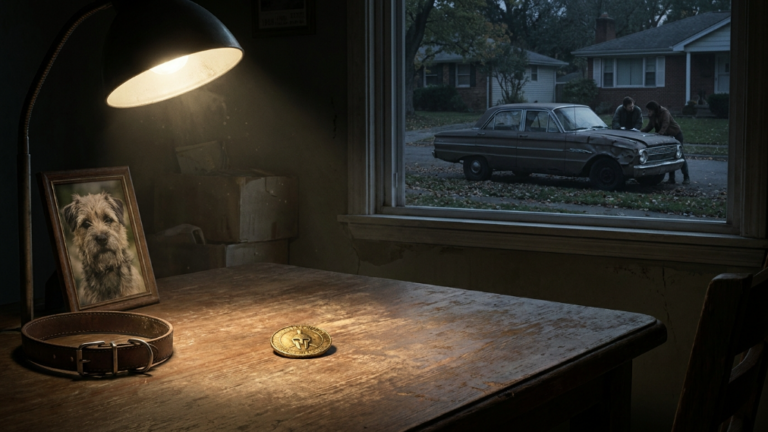
It was a key.
It was a thick, heavy brass key, the kind used for industrial commercial locks. It was distinctly different from a standard house key or an office key.
Attached to the top of the brass key was a hard, rectangular piece of red plastic. It was a restricted-access tag.
Printed on the red plastic in deeply engraved white letters were two lines of text.
OAK CREEK ELEMENTARY RESTRICTED ACCESS – BOILER ROOM 4
I stared at the heavy brass key resting in my palm. The pieces of the puzzle suddenly slammed together with terrifying clarity.
Principal Vance hadn’t just broken an eight-year-old boy’s arm on a public stairwell. You don’t break an arm on a crowded stairwell during the morning rush. There are too many witnesses. There are too many cameras.
The accident hadn’t happened on the stairs at all.
It had happened in Boiler Room 4. A restricted, soundproof, isolated space in the basement of the school.
Vance had taken Leo down there. For what reason, I didn’t know yet. But something had gone terribly wrong. In the struggle, Vance had used physical force. He had broken the boy’s arm.
And in that same desperate struggle, Leo had grabbed the lanyard around Vance’s neck. The plastic badge had snapped. The heavy clip holding the restricted boiler room key had come loose.
Leo had hidden the badge in his cast. And he had shoved the brass key deep into the lining of his winter coat before the ambulance arrived.
Vance had dragged Leo out of the basement and up to the north stairwell. He had staged the fall. He had controlled the narrative from the very first second.
He had to get the key back. If anyone found a restricted basement key hidden in the coat of an eight-year-old boy, the entire stairwell lie would instantly collapse.
I closed my fist tightly around the brass key. I slipped my hand out of the coat and slid the key silently into my own scrub pocket.
“This is perfect,” I said loudly, rolling up the sliced blue fabric. I placed the rolled coat gently under Leo’s wrist. “Keep it elevated like this, buddy.”
Leo looked at me. He knew I had found it.
“You’re safe now,” I whispered to him, my voice completely steady.
Before I could stand up, a sudden, heavy pounding echoed through the small apartment.
It wasn’t a polite knock. It was the loud, authoritative hammering of a closed fist against the front door.
Sarah jumped, nearly dropping her glass in the sink.
“Who on earth is that?” Sarah muttered, drying her hands on her apron.
She walked to the front door and looked through the small glass peephole.
Sarah froze. Her shoulders instantly went rigid.
She slowly turned the deadbolt and pulled the door open.
Standing in the breezeway were three people.
The first was a woman in a sharp gray business suit, holding a thick metal clipboard. She wore a blue identification lanyard around her neck.
Behind her stood two uniformed city police officers. Their hands were resting casually near their heavy duty belts.
“Sarah Martinez?” the woman in the suit asked. Her voice was cold, flat, and entirely devoid of emotion.
“Yes?” Sarah answered, her voice trembling slightly. “Can I help you?”
“My name is Agent Caldwell,” the woman said, holding up a badge. “I’m an investigator with the Department of Child and Family Services. We received an emergency priority hotline report regarding an eight-year-old boy named Leo.”
The air in the room vanished. I couldn’t breathe.
“An emergency report?” Sarah stammered, stepping back. “From who? What happened?”
“The caller is anonymous,” Agent Caldwell stated, stepping firmly over the threshold and into the apartment. The two police officers followed her, their heavy boots thudding against the cheap laminate floor.
“We received a tip twenty minutes ago,” Caldwell continued, her eyes scanning the room like a hawk. “The report alleges severe, ongoing physical abuse by the primary custodial parent, Elena Martinez.”
“That is insane,” Sarah gasped, her voice rising in panic. “Elena works sixty hours a week to provide for him. She has never laid a hand on him in her life!”
“The reporter provided photographic evidence,” Caldwell said sharply. “Images of severe bruising across the child’s torso and back.”
The bike bruises.
Vance hadn’t just used the photos to threaten Leo. He had weaponized them.
When I refused to let him take Leo from the clinic lobby, Vance realized he was losing control. He realized I might be a threat.
So he went nuclear.
He called CPS. He submitted the old photos. He knew that an allegation of severe physical abuse, backed by photographic evidence, would trigger an immediate, emergency response.
“Where is the mother?” one of the police officers asked, stepping further into the living room.
“She’s at work,” Sarah cried, tears welling in her eyes. “She’s at the postal facility.”
“We have units en route to her workplace right now to conduct an interview,” Caldwell said dismissively.
My stomach bottomed out. Vance was having Elena arrested at her job.
Caldwell’s eyes finally landed on the couch. She saw Leo sitting there, pale and trembling. Then she saw me sitting next to him, wearing my blue hospital scrubs.
“Who are you?” Caldwell asked, her eyes narrowing suspiciously.
“I’m the charge nurse from the pediatric clinic,” I said, standing up slowly. I kept my voice perfectly calm and professional. “I am conducting a home-care follow-up on a recently removed cast.”
Caldwell looked surprised. “You’re a medical professional?”
“Yes,” I confirmed.
“Then you can appreciate the severity of this situation,” Caldwell said, looking down at her clipboard. “The report states the child is in imminent danger. Given the photographic evidence and the mother’s absence, I am executing an emergency 48-hour protective removal.”
“You’re taking him?” Sarah screamed, rushing forward. One of the police officers stepped in her path, holding up a large, warning hand.
“Ma’am, step back,” the officer ordered gruffly.
“He is going into temporary state custody tonight,” Caldwell announced, her voice completely detached from the human tragedy unfolding in the room. “He will be placed in an emergency foster facility until a family court judge can review the case on Monday.”
I stared at Agent Caldwell in absolute horror.
Vance’s plan was a masterpiece of institutional manipulation.
If Leo went into emergency state custody tonight, he disappeared into the system. Elena would be locked in a jail cell, fighting criminal abuse charges. Sarah had no legal standing to stop it.
And Vance? Vance was the highly respected, concerned school principal who had originally reported the “accidental” broken arm.
Once Leo was in the system, Vance would have unlimited access. He would be the trusted educator called in to consult on the boy’s welfare. He would be the one the social workers turned to for advice.
He would have absolute, uninterrupted control to ensure Leo never, ever spoke a word about Boiler Room 4.
“You can’t do this,” Sarah sobbed, covering her face with her hands. “Please, he’s just a little boy.”
Caldwell ignored her. She walked directly over to the couch.
She looked down at Leo.
“Leo,” Caldwell said softly, using a practiced, gentle tone. “My name is Agent Caldwell. I’m here to make sure you’re safe. We’re going to go for a ride in my car, okay?”
Leo didn’t look at her. He didn’t look at the police officers.
He looked at me.
His eyes were wide, dark pools of absolute despair. The final light of hope was extinguishing behind them. The monster had won. The system was taking him away, exactly as Vance had promised.
I felt the heavy brass key burning like a hot coal in my pocket.
If I handed the key to CPS right now, they wouldn’t understand it. They were here for a completely different case. They were here because of photos of bruises. A random key wouldn’t stop an emergency removal order. They would just log it as evidence and take the boy anyway.
I needed to prove what the key opened. I needed to prove that Vance had lied about the location of the injury.
I needed to see the inside of Boiler Room 4.
“Agent Caldwell,” I said loudly, stepping between the social worker and the child.
Caldwell frowned, irritated by the interference. “Nurse, I need you to step aside. I have legal authority here.”
“I understand that,” I said, keeping my ground. “But as a licensed medical professional, I have a duty of care. This child is currently experiencing acute clinical tachycardia. His heart rate is dangerously elevated.”
I looked directly at the two police officers. “If you forcibly remove him from this environment right now, you risk triggering a severe cardiac event. Are either of you medics?”
The officers exchanged a hesitant look. Nobody wants the liability of a medical crisis during a removal.
Caldwell’s jaw tightened. “What are you suggesting?”
“I am suggesting,” I said, my voice cold and hard, “that I need one hour to properly stabilize his vitals before he is transported anywhere.”
Caldwell looked at her watch. She clearly hated delays, but she couldn’t argue with a medical professional invoking a health crisis.
“One hour,” Caldwell agreed sharply. “We will wait in the hall. But nobody leaves this apartment.”
She turned and walked out the door, the two officers following her. The door clicked shut.
Sarah collapsed onto the kitchen floor, sobbing uncontrollably.
I turned back to Leo. I reached into my pocket and pulled out the heavy brass key with the red tag.
I held it up so only he could see it.
“Leo,” I whispered, my voice trembling with a terrifying, absolute resolve. “I am leaving right now. I am going to the school.”
Leo’s eyes widened in sheer panic.
“I am going to open that door,” I promised him. “And I am going to find what he is hiding.”
I turned and walked toward the apartment’s sliding glass balcony door. We were on the second floor.
I didn’t have an hour. I barely had twenty minutes before the sun went down.
CHAPTER 4
The heavy glass door of the apartment slid shut behind me, sealing the sound of Sarah’s terrified sobbing inside.
I stood on the wet concrete breezeway of the second floor. The afternoon sky had bruised into a dark, stormy purple, and a cold wind was ripping through the open air corridors of the complex. My heart was hammering a frantic, irregular rhythm against my ribs.
I pulled my cell phone from my pocket. I looked at the bright digital numbers on the lock screen.
It was 4:12 PM. I had exactly forty-eight minutes before Agent Caldwell’s deadline expired.
If I wasn’t back at this apartment with undeniable, physical proof by five o’clock, the state of clinical observation would end. Caldwell would sign the emergency order. She would take Leo out of his mother’s home and drop him into a sprawling, faceless foster care system.
And Thomas Vance, the monster who broke an eight-year-old’s arm and staged a fake accident, would win completely.
I shoved my phone back into my pocket and sprinted down the concrete stairs. My rubber-soled nursing shoes slipped slightly on the wet metal edges of the steps, but I caught my balance on the rusted handrail.
I reached my car, ripped the door open, and threw myself into the driver’s seat. I jammed the key into the ignition. The engine roared to life.
My hands were shaking violently as I gripped the steering wheel. I was a pediatric charge nurse. My entire professional life was governed by strict clinical boundaries, liability protocols, and the absolute mandate to stay in my lane.
The Director of Nursing had explicitly ordered me to drop this. I was risking my license, my pension, and my freedom.
But I could still see the absolute, suffocating terror in Leo’s dark eyes. I could still feel the heavy brass key pressing against my thigh through the thin fabric of my scrub pocket.
A child had done the impossible. He had survived a violent attack, hidden the evidence under the nose of his attacker, and protected his mother in complete silence for six weeks. I was not going to let him fight this final battle alone.
I threw the car into drive and slammed my foot on the accelerator. The tires squealed against the wet asphalt of the parking lot.
I pulled out onto the main road, weaving aggressively through the heavy afternoon traffic. The first fat drops of rain began to hit my windshield, smearing the view of the brake lights ahead of me.
Oak Creek Elementary was exactly four miles away. Under normal conditions, it was a ten-minute drive. Today, every red light felt like an intentional, malicious trap.
I kept my right hand resting over my pocket, feeling the hard outline of the heavy brass key.
RESTRICTED ACCESS – BOILER ROOM 4.
The red plastic tag attached to the key told the entire story. Vance hadn’t broken Leo’s arm on the crowded north stairwell during the morning rush. There were too many teachers, too many parents, too many cameras in the main halls.
Vance had taken Leo down into the basement. Into an isolated, soundproof utility room.
I didn’t know why they were down there. I didn’t know what Vance was trying to hide. But whatever it was, it had led to a violent struggle.
In that struggle, Vance used horizontal force to snap the boy’s forearm. And in his desperate panic, little Leo had grabbed the lanyard around Vance’s neck. He broke the plastic ID badge and ripped the restricted key off the heavy metal clip.
Vance couldn’t call for help immediately. He had to drag an injured, crying child up the stairs and stage a fake accident to cover his tracks.
The rain began to fall in heavy, blinding sheets. I turned my wipers on maximum speed, squinting through the gray downpour.
I hit the final intersection and saw the sprawling brick campus of Oak Creek Elementary appearing through the trees. It was a classic 1970s municipal building, surrounded by high chain-link fences and empty athletic fields.
The final bell had rung hours ago. The yellow school buses were gone.
I pulled my car into the main visitor parking lot. There were only a dozen vehicles scattered across the wet blacktop. Most of them belonged to the custodial staff and after-school administrators.
Parked in the spot marked PRINCIPAL, just twenty feet from the front doors, was a pristine silver luxury sedan.
Vance was here. He had returned to his fortress.
I turned my engine off and sat in the quiet cab for five agonizing seconds. I needed to control my breathing. I needed to lower my pulse.
If I walked into that building looking panicked, sweating, and frantic, the office staff would immediately flag me as a threat. Vance would be alerted. He would lock the basement doors and call the real police to have me arrested for trespassing.
I had to be invisible. I had to be nothing more than a boring, overworked healthcare professional running a mundane errand.
I reached into my backseat and grabbed a blank clinical clipboard. I clicked a blue pen to the top metal bracket.
I stepped out of the car and into the freezing rain. The cold water hit my face and instantly soaked my thin hospital scrubs, but I didn’t run. I walked at a brisk, purposeful, utterly normal pace toward the glass double doors of the main entrance.
I pulled the heavy door open and stepped into the vestibule.
The school smelled of industrial floor wax, wet paper, and stale cafeteria food. The main office was located immediately to the right, sitting behind a wall of thick safety glass.
I walked into the office. A single administrative assistant was sitting at the front reception desk. She was an older woman, wearing a thick cardigan, quietly packing her purse for the day.
She looked up, startled by the sudden appearance of a wet nurse in blue scrubs.
“Can I help you, honey?” the secretary asked, her tone polite but cautious.
“Hi, yes, I’m so sorry to interrupt,” I said, pitching my voice into a flat, exhausted register. “I’m the charge nurse from the county pediatric clinic. I have a medical clearance form for a student named Leo Martinez.”
The secretary nodded slowly. “Oh, little Leo. His mother usually handles his paperwork.”
“She was supposed to,” I lied effortlessly, offering a tired, sympathetic smile. “But she had to rush to her postal shift. The form requires a counter-signature from the school administrator who witnessed his injury before he can be cleared for physical education.”
It was a completely fabricated policy. But school secretaries dealt with arbitrary medical bureaucracy all day long.
The woman sighed, totally accepting the lie. “Well, Mr. Vance is still in the building. But he’s not in his office right now.”
My stomach tightened. “Do you know where he is?”
“He told me he was going down to the basement to do a maintenance check on the new HVAC units,” she said, looking at the clock on the wall. “He likes to inspect the contractor’s work himself. He might be down there a while.”
Vance wasn’t inspecting HVAC units. He was searching the basement.
He knew the key was missing. He knew Leo didn’t have it at the clinic. He was tearing Boiler Room 4 apart, desperately hoping the key had fallen into a dark corner during the struggle six weeks ago.
“I really can’t wait,” I said, tapping my pen against the clipboard in feigned annoyance. “My shift ended twenty minutes ago. Is there any way I can just leave this on his desk?”
“Sure, honey,” the secretary said, gesturing toward the interior hallway. “His office is right down the main corridor, second door on the left. Just leave it in his wooden inbox.”
“Thank you so much,” I said. “Have a great evening.”
I walked past the reception desk and pushed through the heavy wooden door that led into the main academic hallway.
The corridor was massive. It was lined with hundreds of blue metal lockers and brightly colored bulletin boards displaying construction-paper art. The silence in the empty hall was heavy, broken only by the squeak of my wet rubber shoes against the linoleum.
I walked past the second door on the left. The gold plaque read THOMAS VANCE – PRINCIPAL. The lights inside were off.
I didn’t stop. I kept walking.
I needed to find the basement access stairs. Every public school built in this era followed the same basic architectural blueprint. The heavy utility zones—the boilers, the electrical mains, the industrial water heaters—were always clustered near the rear of the building, usually behind the cafeteria or the gymnasium.
I followed the overhead signs pointing toward the cafeteria.
The deeper I walked into the school, the dimmer the emergency lighting became. The happy, colorful posters faded away, replaced by bare cinderblock walls and heavy fire doors.
My pulse began to race again. Every shadow stretched out. Every distant clank of the heating pipes sounded like footsteps approaching.
At the very end of the cafeteria hallway, tucked into a dark, dead-end alcove, I found a heavy steel door. It was painted a dull industrial gray.
Next to the metal frame was a small, scratched plastic plaque.
UTILITY ACCESS – AUTHORIZED PERSONNEL ONLY.
I reached out and pushed the heavy metal crash bar. The door swung open smoothly, revealing a steep flight of poured concrete stairs leading down into the darkness.
A single, flickering fluorescent bulb illuminated the landing at the bottom.
I stepped onto the top stair and let the heavy door swing shut behind me. The lock clicked loudly. The ambient hum of the school above vanished, replaced by the deep, vibrating rumble of heavy machinery below.
I pulled my cell phone from my pocket. I checked the top corner of the screen. I still had two bars of cellular service.
I opened my recent calls list. I tapped the icon next to Agent Caldwell’s number, pulling up her direct contact card.
I didn’t press the dial button yet. I kept the screen awake and held the phone tightly in my left hand.
I began the slow, quiet descent down the concrete stairs. The air grew instantly colder as I dropped below ground level. It smelled of damp earth, hot metal, and old grease.
When I reached the bottom landing, I stepped into a long, narrow subterranean corridor. Thick pipes wrapped in silver foil insulation ran along the low ceiling, hissing faintly with steam.
There were four doors lining the corridor. They were heavy, windowless steel fire doors, each marked with a painted white number.
Door 1. Door 2. Door 3.
At the very end of the hall, plunged deep into the shadows, was Door 4.
I walked toward it. My mouth was completely dry. My hands were slick with cold sweat.
Above the handle of Door 4 was a massive, solid brass deadbolt lock. It looked heavy, ancient, and incredibly secure. It was not the kind of lock a student could accidentally wander through.
I pulled the heavy brass key from my scrub pocket.
My hand was shaking so badly I could hear the metal teeth of the key clicking against the brass faceplate of the lock. I forced myself to stop, take a deep breath, and steady my wrist.
I slid the key into the cylinder. It glided in perfectly.
I turned my wrist to the right. A loud, heavy mechanical clack echoed like a gunshot through the empty corridor as the deadbolt retracted.
The door was unlocked.
I raised my left hand. I pressed the green dial button on my phone screen, calling Agent Caldwell. The second the call connected, I hit the mute button on my microphone, ensuring no sound would escape my end of the line.
I slipped the active phone back into my deep front pocket.
I grabbed the cold metal handle of Door 4 and pulled. The heavy steel hinges groaned in protest as the door swung outward.
The room beyond was pitch black. A wave of stifling, suffocating heat rolled over me, carrying the sharp, metallic scent of ozone and burning dust.
I reached inside and ran my hand flat against the rough cinderblock wall. My fingers brushed against a heavy industrial toggle switch. I pushed it upward.
Three large, caged bulbs bolted to the ceiling flickered to life. They cast harsh, yellow, overlapping shadows across the massive space.
Boiler Room 4 was enormous. Two gigantic, humming steel furnaces dominated the center of the room, radiating intense waves of heat. The walls were lined with metal wire shelving units, piled dangerously high with boxes of forgotten maintenance supplies, old air filters, and gallon jugs of industrial floor cleaner.
The concrete floor was filthy, stained black with years of old grease and hard water leaks.
I stepped over the threshold and pulled the heavy steel door shut behind me. I did not turn the deadbolt.
I stood near the entrance, my eyes scanning the chaotic room. I didn’t know exactly what I was looking for. I just knew Leo had been trapped in this space.
If an adult man had violently snapped an eight-year-old boy’s forearm in this room, there had to be physical evidence. A struggle leaves a footprint. Violence always leaves a mark.
I began a slow, methodical grid pattern, moving quietly between the massive steel furnaces. I kept my eyes fixed on the dirty concrete floor.
I walked past a stack of rotting wooden pallets. I checked behind a row of empty blue chemical drums. Nothing.
I moved to the far back corner of the room, behind the second roaring furnace. The lighting here was incredibly dim, the shadows stretching long and dark.
There was a small, rusted metal desk pushed against the back cinderblock wall. It looked like a makeshift workstation for a janitor, covered in old work orders and a thick layer of dust.
On the floor, right near the front left leg of the desk, I saw a smudge of dark color.
I knelt down, dropping my blank clipboard onto the concrete. I leaned in close to the floor.
It was a small, circular stain, roughly the size of a dime. It was a deep, rusty brown.
I looked slightly to the left. There was another drop. And another.
A tiny, unmistakable trail of dried blood led away from the desk, moving toward a narrow gap between the cinderblock wall and the massive steel casing of the furnace.
It was the exact same color as the blood I had found on the broken plastic badge in the cast.
I grabbed the small medical penlight from my scrub pocket and clicked the button. A sharp, bright beam of LED light cut through the gloom. I shined the light directly into the narrow, dark gap behind the furnace.
Wedged tightly against the hot metal casing, covered in a thick layer of gray dust, was a bright yellow backpack.
My breath caught in my throat. I couldn’t move for three seconds.
I recognized that bright yellow canvas. Elena had specifically mentioned it during the initial intake process at the hospital six weeks ago. She had been frustrated because Vance claimed Leo had left his backpack on the playground before he fell on the stairs, and it had been stolen.
It hadn’t been stolen. Vance had hidden it here to cover his tracks. He couldn’t let anyone see the backpack, because the backpack proved Leo was in the basement, not the stairwell.
I squeezed my arm into the narrow gap. The metal casing of the furnace burned against my bare forearm, but I ignored the searing heat.
I grabbed the heavy canvas strap and pulled hard. The backpack popped free, sending a cloud of dust into the air.
I dragged the bag out into the open light. The top zipper was half-open.
I knelt on the floor and pulled the yellow fabric apart. Inside were a few crumpled spelling worksheets, a plastic box of broken crayons, and a crushed apple juice box.
But shoved into the very bottom of the bag, wrapped tightly in a child’s blue winter beanie, was a heavy metal object.
I pulled the bundle out. I unwrapped the blue fleece fabric with trembling fingers.
It was a thick, solid steel lockbox. The kind used by small businesses for cash deposits. It had the Oak Creek Elementary PTA logo painted cleanly on the lid.
The heavy brass padlock on the front of the box was completely shattered. It looked like it had been repeatedly struck with a heavy steel hammer until the locking mechanism gave way.
The lid was slightly ajar. I flipped it open.
Inside, tightly banded stacks of twenty and fifty-dollar bills filled the box to the brim. It was thousands of dollars in untraceable cash.
The pieces of the puzzle slammed together with horrifying, pathetic clarity.
Principal Thomas Vance wasn’t a monster born of pure malice. He was something much more common. He was a thief.
He was embezzling from his own school. He was stealing the cash raised by the parents and teachers of the very children he was supposed to protect. He was using Boiler Room 4 to break open the lockboxes where the school’s surveillance cameras couldn’t see him.
And six weeks ago, a terrified, anxious eight-year-old boy looking for a quiet place to hide before the morning assembly had stumbled right into the middle of a felony.
Leo had seen the principal smashing the lockbox. Vance had panicked.
Vance grabbed the boy to silence him. In the violent struggle, Vance twisted the child’s arm with so much force that the bone simply snapped in half.
Leo fought back. He grabbed the lanyard around Vance’s neck, breaking the badge and tearing the restricted key off the clip.
Vance had to drag the injured boy up two flights of stairs to the north stairwell. He staged the fall. He controlled the narrative from the very first second.
I stared at the stacks of stolen cash. I needed a picture of this. I needed to document the lockbox and the blood trail before Vance returned.
I reached down toward my pocket to retrieve my phone.
Before my fingers could touch the fabric, the heavy steel door of Boiler Room 4 groaned loudly.
The sound of the deadbolt clicking shut echoed like a bomb blast through the cavernous space.
I froze instantly. My hand remained hovering inches from my pocket.
“You know,” a deep, smooth, resonant voice echoed from the front of the room. “My secretary just texted me. She said a very wet nurse was looking for me.”
I stood up slowly. I kicked the yellow backpack slightly behind my legs, attempting to shield the open lockbox from view.
Principal Thomas Vance stepped out from behind the first massive furnace. He was silhouetted against the harsh yellow light of the caged bulbs.
He had taken off his navy suit jacket. His crisp white dress shirt was unbuttoned at the collar, the sleeves rolled up to his elbows. He looked incredibly large, physically imposing, and entirely comfortable in the subterranean heat.
“I assumed you were just an overzealous healthcare worker dropping off a form,” Vance said, walking slowly toward me. His heavy leather shoes clacked rhythmically against the concrete floor. “But then I checked the security feed on my phone.”
I didn’t speak. I kept my face entirely blank, forcing my rising panic down into a tight, hard knot in the center of my chest.
“I watched you walk straight past my office,” Vance continued, stopping about fifteen feet away from me. “I watched you walk right to the basement stairs.”
He tilted his head. A cold, empty, terrifying smile spread across his face.
“How did you get in here, Nurse?” Vance asked softly.
“I found a key,” I said. My voice was steady. It didn’t shake at all.
Vance’s smile vanished instantly. The mask of the caring, professional educator completely dissolved, leaving only a hard, desperate panic underneath.
“Where is it?” Vance demanded, holding out his right hand.
I looked down at his outstretched arm. Just below the rolled-up white sleeve, right above his wrist, I saw the thick, angry red scar.
“It’s in a very safe place,” I lied smoothly, keeping my eyes locked on his face. “Just like the broken piece of your plastic ID badge.”
Vance let out a sharp, ragged exhale. He ran a hand through his perfectly styled gray hair, messing it up. He looked around the room, his eyes darting to the shadows, calculating his next move.
“You have absolutely no idea what you are doing,” Vance said, his voice dropping into a dangerous, gravelly register. “You are trespassing in a restricted municipal facility. You broke into a secured area.”
“And you are a coward who breaks the bones of children,” I fired back, refusing to give an inch of ground.
Vance laughed. It was a dry, ugly, humorless sound.
“He shouldn’t have been down here,” Vance snapped, the anger finally bleeding through his composed facade. “Students are expressly forbidden from entering the utility corridors. It is a massive liability.”
“So that gave you the right to attack him?” I asked, keeping my voice loud and clear. I prayed the phone in my pocket was still transmitting clearly to Agent Caldwell.
“I didn’t attack him,” Vance spat defensively, taking a step closer. “I caught him sneaking around in the dark. I grabbed his arm to march him back upstairs to the main office for discipline.”
“You grabbed him hard enough to snap his radius perfectly in half,” I corrected him, using my clinical authority as a weapon. “A mid-shaft nightstick fracture. That takes massive, horizontal, blunt-force trauma.”
The heat from the furnace behind me was oppressive. It was making it hard to breathe, but I didn’t break eye contact.
“The little rat bit me,” Vance snarled, raising his scarred right wrist and pointing to the red mark. “He clamped his teeth down on my arm like a feral dog. I pushed him off. He fell backward against the boiler casing.”
“And when he fell, he grabbed your lanyard,” I deduced aloud, intentionally summarizing the events for whoever was listening on the open phone line. “The plastic badge snapped. The key fell.”
“He snatched the key right off the floor,” Vance said, his face contorting with arrogant rage. “He shoved it into his stupid winter coat before I could grab it from him.”
“So you dragged an injured, terrified child all the way up to the north stairwell,” I said, my voice thick with pure disgust. “You staged an accident to cover up your theft.”
Vance stopped. He looked at me, his eyes dead and cold.
“I didn’t steal anything,” Vance lied effortlessly, wrapping himself in his institutional authority. “I am the principal of this school. I have full authorization to manage, move, and deposit PTA funds.”
“Using a hammer to open the metal lockbox?” I challenged. I stepped slightly to the side, kicking the yellow backpack over.
The heavy steel lockbox spilled out onto the concrete, the stacks of cash visible in the dim light.
Vance’s eyes locked onto the money. His face drained of all color.
“You found it,” Vance whispered.
“I found the cash, Thomas,” I said firmly. “I found the backpack you hid. I found the blood you left on the floor by the desk.”
Vance stared at the money. I could practically see the math running through his head. The physical evidence sitting in this room was enough to send him to a federal penitentiary for a decade. The theft alone was a felony. The assault on a minor would end his life as he knew it.
He looked back up at me. The panic in his eyes hardened into something much worse. It hardened into cold, calculating violence.
“Nobody knows you’re down here,” Vance said softly.
“My clinic director knows,” I lied without missing a single beat. “I filed a formal safety report before I left the hospital.”
“You’re lying,” Vance said, taking another heavy step toward me. He flexed his hands. “You didn’t have the proof until five minutes ago.”
He lunged forward.
I didn’t try to fight him. I knew I couldn’t win a physical altercation against a man twice my size.
Instead, I dropped to the dirty floor and rolled hard to the left, diving behind the massive steel leg of the furnace.
Vance’s hand grazed my shoulder as I moved. He cursed loudly, his foot catching on the heavy yellow backpack. He stumbled forward, catching his balance on the metal desk.
“Give me the key!” Vance roared, his voice echoing off the cinderblock walls. He grabbed a heavy metal pipe wrench off the desk and turned toward me.
I scrambled to my feet, putting the massive bulk of the boiler between us.
“It’s over, Vance!” I yelled across the hissing machinery. “CPS is already at the apartment. When I show them what’s in this room, they are going to arrest you.”
“CPS is at the apartment because I called them,” Vance laughed cruelly, moving slowly around the right side of the boiler. He tapped the wrench against his palm. “I sent them pictures of bruises the mother gave him last summer.”
He was confessing. He was giving me exactly what I needed.
“You staged those photos too?” I asked, backing away toward the front door.
“I didn’t stage them. The kid fell off a bike,” Vance scoffed, sounding entirely bored by the accusation. “I just pulled them from his old medical file in the school server. I told the hotline the mother beat him. They ate it right up because they are incompetent bureaucrats.”
I kept backing up. My shoulder blades hit the heavy steel of the exit door.
“Once he’s in state foster care, he’s a traumatized, unreliable witness,” Vance explained smoothly, stepping out from behind the machinery. He blocked my only path to the stairs. “And you? You’re just an unstable nurse who broke into my school and tampered with evidence.”
He raised the heavy iron wrench.
I reached behind my back and grabbed the handle of the steel door. I pulled down hard.
The door didn’t budge.
“It locks from the outside, sweetheart,” Vance smiled darkly. “I turned the deadbolt when I came in.”
My heart slammed against my ribs. I was completely trapped.
“Put the wrench down,” I ordered, trying to project a calm, medical authority I absolutely did not feel.
“Hand over the key,” Vance demanded, taking a final step closer. “And the broken piece of my badge.”
I reached into my scrub pocket. My fingers wrapped around the smooth glass of my cell phone.
I pulled the phone out. The screen was brightly lit in the dim basement.
The call timer on the screen showed exactly twelve minutes and fourteen seconds.
Vance stopped moving. He stared at the glowing screen, his eyes narrowing in confusion.
“What is that?” Vance asked, his voice suddenly faltering.
I used my thumb to hit the speakerphone icon. I unmuted the microphone.
“Agent Caldwell,” I said loudly, keeping my eyes locked on the principal. “Are you still there?”
For two agonizing seconds, there was only the hiss of the boiler.
Then, the crisp, cold, furious voice of the CPS investigator echoed out of the small phone speaker, filling the dark room.
“I am here,” Caldwell’s voice rang out. “And so are three units from the municipal police department.”
Vance dropped the metal wrench. It hit the concrete floor with a deafening, ringing clang.
“Mr. Vance,” Caldwell’s voice continued through the speaker, dripping with absolute contempt. “We have recorded every single word of your confession regarding the fraudulent hotline tip, the embezzlement of funds, and the severe physical assault of a minor.”
Vance stumbled backward, his hands coming up to his head in pure shock. The blood drained completely from his face, leaving him looking like a ghost.
“We are currently pulling up to the front entrance of Oak Creek Elementary,” Caldwell stated clinically over the speaker. “Officers are entering the building now. Remain exactly where you are.”
Vance looked frantically at the heavy steel door behind me. Then he looked up at the narrow, barred ventilation windows near the ceiling. There was nowhere to run. There was no story left to spin.
The arrogant, powerful man who had terrorized an eight-year-old boy simply collapsed.
His knees hit the dirty concrete. He covered his face with his trembling hands, letting out a pathetic, whimpering groan that echoed off the cinderblock walls.
I didn’t say a single word to him. I just leaned back against the heavy steel door, closed my eyes, and waited.
Less than a minute later, heavy fists pounded violently against the outside of the door.
“Police! Open the door!” a loud, commanding voice shouted.
I stepped aside. The heavy deadbolt clicked loudly, turned by a master key from the outside.
The door swung open, flooding the dark basement alcove with the blinding white beams of three heavy police flashlights.
Two uniformed officers pushed past me immediately, their hands resting firmly on their holstered weapons. They moved straight toward Vance, grabbing him by the arms and pulling him roughly to his feet.
“Thomas Vance, you are under arrest,” one of the officers barked, spinning him around and slamming heavy metal handcuffs onto his wrists.
Agent Caldwell walked into the boiler room slowly behind them. She looked at the cuffed principal, her face tight with professional disgust.
Then, she turned to me. She looked at my wet, dirt-stained scrubs and the shaking phone still in my hand.
“You took a massive, reckless legal risk,” Caldwell said quietly.
“I took a clinical risk to stabilize my patient,” I corrected her without blinking. “Did you hear enough to drop the emergency removal order?”
“I heard him admit to falsifying a federal abuse report,” Caldwell confirmed, shaking her head. “I heard him admit to snapping an eight-year-old’s radius. The removal order is entirely void.”
I pointed a shaking finger toward the yellow backpack sitting in the dust near the furnace.
“The stolen PTA funds are in the lockbox inside that bag,” I told the nearest crime scene officer. “And there’s a trail of dried blood on the floor near that metal desk.”
The officer nodded, pulling out a radio to call for a forensics technician.
I reached into my pocket and pulled out the heavy brass key with the red tag. I handed it to Agent Caldwell.
“This is the key he was looking for,” I said quietly.
Caldwell took the key. Her stern, bureaucratic expression softened by a fraction of a millimeter.
“I’ll have my regional supervisor call your clinical director in the morning,” Caldwell offered softly. “To make sure your job is protected from any retaliation.”
“Thank you,” I said, letting out a long, exhausted breath. “Where is Leo?”
“He’s still at the apartment with his aunt and his mother,” Caldwell said. “My partner stayed behind to ensure they were safe until this was officially resolved.”
I didn’t wait for permission to leave the crime scene. I walked out of the hot, stifling boiler room, past the arresting officers reading Vance his rights, and climbed the steep concrete stairs back into the main hallway.
The storm outside had finally broken. The heavy rain had slowed to a light, misty drizzle as I drove the fifteen minutes back across town.
When I walked up the exterior stairs to apartment 4B, the front door was already wide open.
Elena was sitting on the faded brown sofa in the center of the living room. She was still wearing her blue postal uniform, her hair damp with rain.
She was holding Leo. She was holding him so tightly it looked like she was trying to protect him from the entire world. She was rocking back and forth, crying silently into his dark hair, pressing kisses against his forehead.
Sarah stood near the kitchenette, wiping tears from her face with a paper towel. A uniformed police officer stood quietly near the door, keeping a respectful distance.
I stood in the doorway. I didn’t want to step inside. I didn’t want to intrude on the most private, fragile moment of their lives.
Leo shifted slightly in his mother’s arms. He looked over Elena’s shoulder and saw me standing there in my ruined scrubs.
The absolute, suffocating terror was completely gone from his eyes. The heavy, invisible weight that had been crushing his small chest for six weeks had finally evaporated into the air.
He didn’t look like a cornered animal anymore. He just looked like an eight-year-old boy who finally felt safe in his own home.
Leo pulled his good hand free from his mother’s tight embrace. He looked at me, and he offered a small, hesitant, grateful wave.
I smiled back. I gave him a gentle nod, acknowledging the incredible, terrifying secret we had carried together.
I turned around and walked back out into the cool evening air. My scrubs were ruined, my shoes were covered in industrial grease, and my hands were still shaking slightly from the fading adrenaline.
But as I walked down to my car, I took a deep, clean breath.
The heavy, muddy green cast was gone. The monster was locked in a cage he could not manipulate his way out of. And the brave little boy who had refused to let go was finally allowed to heal.