
NEXT PART – THEY THOUGHT THEY HAD ONLY HURT A LONELY MAN’S DOG AND BROKEN AN OLD CAR IN THE SUBURBS — BUT THE GOLD COIN ON HIS TABLE TOLD THE UNDERWORLD HE HAD BEEN WOKEN
The safety glass was still settling on the driveway asphalt when I dropped to my knees.
My dog, a twelve-pound terrier mix named Barnaby, was wedged tight behind the rear tire of my 1969 Mustang. He was shaking so violently that his small body vibrated against the rubber tread. He wasn’t bleeding, but his eyes were wide with a blank, white-rimmed terror that made my chest instantly tight.
I reached under the chassis. “Come here, buddy,” I kept my voice low and flat. “You’re okay. I’ve got you.”
He crawled into my hands, pressing his wet nose against my leather riding jacket. I stood up slowly, holding him to my chest, and looked at the damage. The driver’s side window of the Mustang was completely gone.
Shattered glass covered the front seat, the floorboards, and the driveway. It wasn’t a stray baseball or a falling branch. The impact point was dead center, struck with something heavy and deliberate.
Then I looked down at the ground near the door.
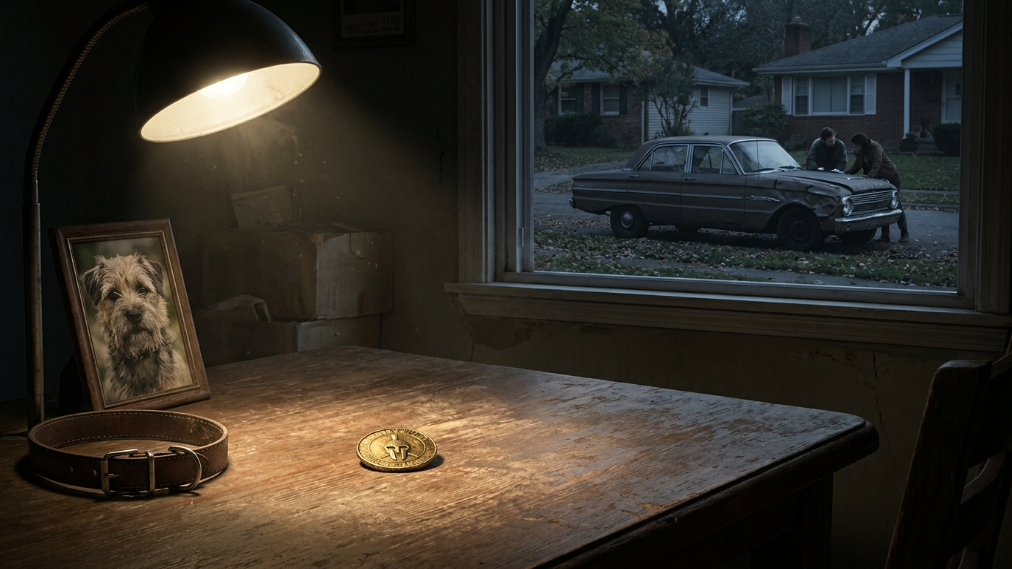
Lying in the center of the shattered glass was Barnaby’s collar. It was a custom braided leather band, worn soft from years of use. It had been pulled off his neck by force.
I knelt back down, keeping one arm wrapped tightly around the shaking dog. With my free hand, I reached for the collar. I stopped before my fingers touched the leather.
Right over the center of the braid was a muddy shoe print. It wasn’t a work boot or a sneaker. It was the distinct, narrow tread pattern of an expensive Italian loafer.
I stared at that print for a long time. I didn’t shout. I didn’t throw a punch at the garage wall.
My grief and my shock evaporated in a span of three seconds. What replaced it was a silent, controlled fury that I hadn’t felt in a very long time. I knew exactly who wore those custom loafers.
Preston Sterling had stood on my property line just twenty-four hours ago, wearing those exact shoes.
Preston was twenty-six, loud, and entirely convinced that his father’s money made him untouchable. His father, Arthur Sterling, was the biggest commercial developer in the county. Arthur had spent the last two years buying up every house in our quiet suburban New York neighborhood, bulldozing them to make way for a luxury gated community.
Everyone else on the block had taken the buyout. They took the inflated checks and moved away. I had refused.
I didn’t want their money. This house was the only thing I had left of my wife, Maggie. We had bought it twenty years ago, back when my beard was still brown and my back didn’t ache when the weather turned cold.
Maggie passed away four years ago from a sudden heart defect. The braided collar lying in the glass was the last gift she had ever bought for Barnaby. It was just a piece of leather to anyone else, but to me, it was a piece of her.
Preston Sterling didn’t care about any of that. When he came to my driveway yesterday, he looked at my worn boots, my faded jeans, and the motorcycle parked in the open garage. He looked at me like I was an insect.
“You’re holding up thirty million dollars of progress, old man,” Preston had said, his hands resting on his hips. “My father is losing patience. You’re just a biker living in a ghost town. Take the check before things get uncomfortable.”
I had told him to get off my property. I didn’t raise my voice. I just told him he was trespassing.
Preston had sneered, looking down at Barnaby, who was barking at his expensive shoes. “Accidents happen around construction zones,” Preston had muttered. “Would be a shame if something happened to your dog. Or your cars.”
Now, twenty-four hours later, the warning had been executed. Preston thought he was dealing with an isolated, broken widower. He thought the leather jacket and the gray beard meant I was uneducated, helpless, and easily intimidated.
He had no idea what he had just done.
I picked up the crushed collar, sliding it into my jacket pocket. I carried Barnaby into the house and locked the front door. I walked into the kitchen, got a warm damp towel, and carefully wiped the dirt and grease off his paws.
I poured him a fresh bowl of water. I sat on the linoleum floor with him until his shaking finally stopped. He curled into a tight ball against my knee, exhausted from the fear.
“Nobody is going to hurt you,” I whispered. “I promise.”
I stood up and walked down the hallway. I didn’t pick up the phone to call the local police. Arthur Sterling practically owned the local precinct.
Filing a vandalism report would just result in a bored officer taking notes and losing the file. Preston would get a slap on the wrist, if that. He would laugh it off over drinks at the country club.
That wasn’t going to happen. I wasn’t going to play their game in their rigged arena. I was going to change the rules completely.
I opened the heavy wooden door at the end of the hall and flipped on the basement light. The stairs creaked under my boots. The basement was cool, smelling of old concrete, motor oil, and dust.
It was a large space, filled with forgotten shadows and the remnants of a life I had quietly packed away. Along the back wall was a massive steel workbench. It was covered in wrenches, socket sets, and parts for my vintage motorcycle.
Tucked into the far corner of the bench, hidden under a grease-stained canvas cloth, was a small steel lockbox.
I walked over to the bench. I pulled the canvas cloth away. The steel box was heavy, bolted directly to the table frame.
I reached up to the overhead exposed beams and ran my hand along the wood until I found the small brass key I had taped there years ago. I pulled the key down, inserted it into the lock, and turned it. The heavy lid popped open with a solid metallic click.
Inside the box rested a single, heavy gold coin.
It was slightly larger than a silver dollar, cast in solid brass and plated in gold. On the front, it bore the insignia of a winged wheel wrapped in chains. On the back, it bore a single word: FOUNDER.
Preston Sterling thought I was just a nobody who rode a motorcycle on the weekends. He assumed the leather and the grit meant I was a low-class holdout.
He didn’t know that twenty-five years ago, I had founded the Iron Vanguard.
We weren’t an outlaw gang. We were a massive, legally chartered riding brotherhood made up of military veterans, off-duty law enforcement, trial attorneys, and blue-collar tradesmen. I had spent two decades building the Vanguard into the most disciplined, organized network in the state.
When Maggie got sick, I stepped down as National President. I handed the gavel to my vice president, quietly retired to this suburban street, and focused entirely on my wife. The brotherhood had respected my need for distance.
They gave me my space to grieve. They let me fade into the background. But I had never surrendered my charter coin.
The coin wasn’t a symbol for violence. The Vanguard didn’t operate outside the law. The coin was an emergency beacon for collective, overwhelming presence.
When a Founder’s coin was activated, it meant the entire weight of the brotherhood—every lawyer, every private investigator, every active rider in a five-hundred-mile radius—was summoned. It meant we were going to war, but we were going to do it in the courtroom, in the press, and in the public square.
I picked up the gold coin. It felt heavy and cold against my palm. I stared down at the winged wheel, the metal reflecting the dim basement light.
I reached into my pocket and pulled out Barnaby’s crushed collar. I placed the ruined leather next to the steel box. I set the gold coin gently on the wooden workbench.
It made a sharp, metallic ring that echoed off the concrete walls. It sounded like a signal from a past I had tried to leave behind. A past that Preston Sterling had just arrogantly dragged into the present.
I pulled my cell phone from my jacket pocket. I didn’t dial the police. I dialed a local number that I hadn’t called in four years.
It was the direct line to Marcus Vance. He wasn’t a club member. He was Arthur Sterling’s chief legal counsel and primary fixer.
Marcus was the man who handled all of Sterling’s dirty work, quietly making problems disappear before they reached the press. But Marcus and I went back a long time. Before he sold his soul to a real estate developer, Marcus had been a junior prosecutor, and he knew exactly who I was.
The phone rang three times before Marcus picked up. “Marcus Vance speaking.”
“Marcus,” I said. My voice was completely calm. “It’s Jack Mercer.”
There was a long, heavy silence on the other end of the line. I could hear the faint sound of city traffic through his office window. “Jack,” Marcus finally said, his voice dropping an octave. “It’s been a long time. I heard about Maggie. I’m sorry.”
“Save it,” I replied. “I’m calling about Arthur’s son.”
I heard the squeak of a leather office chair as Marcus sat up straight. “Preston? What did Preston do, Jack?”
“He came to my house yesterday. He told me to sell. Today, he came back while I was out. He put a brick through my Mustang’s window, and he nearly crushed my dog trying to send a message.”
“Jack, listen to me,” Marcus said quickly, his professional polish cracking. “Preston is an idiot. He doesn’t know who you are. He just sees an old guy on the block holding out. Let me talk to Arthur. We will write you a check for the car today. We will triple the buyout offer on the house. Just stay calm.”
“I am perfectly calm, Marcus.”
“Jack, please,” Marcus pleaded. “Don’t escalate this. You’ve been out of the game for years. Don’t bring the Vanguard down on this kid. He’s just stupid.”
“He stepped on my wife’s collar,” I said, staring at the muddy print on the workbench. “He threatened my dog. The time for writing checks expired about twenty minutes ago.”
“What do you want me to do?” Marcus asked, his voice trembling slightly.
“Nothing,” I said softly. “I just wanted to extend a professional courtesy. Call your boss. Tell Arthur to clear his schedule.”
“Jack…”
“Tell him his son just woke up Jack Mercer.”
I hung up the phone. I didn’t wait for Marcus to respond. I set the phone down next to the gold coin.
I knew exactly what was happening on the other side of the city right now. Marcus was running down the hallway of their corporate high-rise, bursting into Arthur Sterling’s office. He was about to explain to a billionaire developer that his spoiled son had just kicked a sleeping bear.
I picked up the gold coin again. I closed my hand around it tightly.
I was going to dismantle Arthur Sterling’s entire empire. I was going to expose every fraudulent permit, every bribed inspector, and every illegal eviction he had ever ordered. And I was going to do it with five hundred motorcycles parked legally outside his front doors.
Preston wanted to see what a real biker looked like. I was going to show him. I picked up my phone and opened my contacts, scrolling down to the number for the Vanguard’s current National President.
I pressed dial. It was time to ride.
CHAPTER 2
The phone pressed against my ear felt like a block of ice. I listened to the steady, rhythmic ringing on the other end of the line. It had been four years since I last dialed this specific number.
I knew Thomas Henderson would answer on the third ring. He always did. Thomas, known to everyone in the Iron Vanguard simply as “Brick,” was a creature of absolute habit.
Before he became the National President of the Vanguard, Brick had been a senior auditor for the Department of Defense. He approached leading a motorcycle brotherhood the same way he approached finding missing federal funds. He was methodical, emotionless, and devastatingly precise.
“Henderson,” the gruff voice answered right on cue.
“Brick,” I said softly. “It’s Jack.”
The line went completely dead for five full seconds. I could hear the faint sound of a television playing in the background of his house. I could hear the sharp intake of his breath.
“Jack,” Brick finally said, his voice stripped of its usual commanding bark. “Brother. It is damn good to hear your voice.”
“It’s good to hear yours, Brick.”
“We’ve given you your space, just like you asked,” Brick said, his tone turning cautious. “We all miss Maggie every single day. I hope you know the chapter still rides past the cemetery on her birthday.”
I swallowed hard, feeling a sudden tightness in my throat. The Vanguard had always respected my boundaries. “I know, Brick. I appreciate it more than I can say.”
“So, what brings you out of the radio silence?” Brick asked. “Tell me you’re ready to come to the Sunday breakfast. Your chair at the head of the table has been empty too long.”
I looked down at the heavy gold Founder’s coin resting on my workbench. The metal caught the harsh light of the exposed basement bulb. “I’m not calling about breakfast, Brick.”
The silence returned, heavier this time. Brick was a smart man. He heard the shift in my tone, the coldness that had replaced the nostalgia.
“What happened, Jack?”
“I am activating my coin,” I said.
I heard a physical thud on the other end of the line, like a heavy coffee mug being slammed onto a wooden desk. “Say that again,” Brick demanded. His voice was suddenly razor-sharp.
“I am activating the Founder’s coin,” I repeated clearly. “The house is green. The flag is up. I need the network.”
In the twenty-five years since I founded the Iron Vanguard, a Founder’s coin had only been activated twice. It was not a call for a social gathering. It was not a request for a charity ride.
It was the ultimate distress signal, a total mobilization order. Activating the coin meant the founder was under direct, catastrophic threat. It required every active chapter member to drop whatever they were doing and respond immediately.
“Who did it?” Brick asked. There was no hesitation, no questioning my judgment. The brotherhood did not ask for proof when the coin was invoked.
“Arthur Sterling,” I said. “And his son, Preston.”
Brick exhaled a long, slow breath. “The real estate developer. The one trying to pave over your neighborhood.”
“Preston Sterling came to my house today while I was out,” I explained. “He put a brick through the window of the Mustang. He nearly killed Barnaby.”
“Is the dog okay?” Brick asked instantly.
“He’s physically fine, just terrified,” I said, my grip tightening on the phone. “But Preston stepped on Maggie’s collar. He left his shoe print right on the leather.”
That was all Brick needed to hear. Maggie had been the mother of the Vanguard. She had cooked for the prospect classes, sat with the widows, and held the club together during its hardest years.
“Where are you right now?” Brick asked. The auditor was gone; the National President had taken over.
“I’m in my basement,” I said. “The house is secure.”
“Do not call the local police,” Brick ordered. “Sterling owns the precinct captain, and they will spin this against you before the ink is dry on the report.”
“I know,” I replied. “I already called Sterling’s fixer, Vance. I told him he just woke me up.”
Brick let out a low, dangerous chuckle. “You gave them a warning. That’s more courtesy than they deserve.”
“I wanted them to know it was coming.”
“I am initiating protocol,” Brick said, his voice moving into a rapid, tactical cadence. “I’m pulling Sarah from her trial prep. I’m pulling Harrison from the lab.”
Sarah Jenkins was our lead legal counsel, a terrifyingly effective trial attorney who rode a custom Indian Scout. David Harrison was our forensics expert, a retired state investigator. This was the true power of the Iron Vanguard.
We weren’t a street gang swinging chains. We were an army of credentialed professionals who knew exactly how to dismantle an opponent legally, financially, and publicly. We wore leather, but our weapons were subpoenas, audits, and overwhelming presence.
“Get a perimeter set up,” I told him. “Sterling is going to panic when Vance delivers the message. They will try to control the narrative immediately.”
“I will have the first wave at your house in forty-five minutes,” Brick promised. “Sit tight, Jack. The Vanguard is coming home.”
The line clicked dead. I lowered the phone and stared at the basement wall. The quiet isolation of my widowhood was officially over.
I picked up the Founder’s coin and slipped it into the breast pocket of my riding jacket. I grabbed Barnaby’s crushed collar, being extremely careful not to smudge the muddy shoe print. I found a clear plastic zip-top bag in my toolbox and carefully sealed the collar inside.
I walked back up the wooden stairs to the main floor of the house. The silence of the empty rooms felt different now. It didn’t feel lonely; it felt like the deep breath before a hurricane.
I went into the living room and checked on Barnaby. He was still curled in a tight ball on his dog bed, his small chest rising and falling in exhausted sleep. I gently covered him with a fleece blanket.
I walked out to the kitchen and made a fresh pot of black coffee. I needed my mind sharp. I needed to be ready for the retaliation I knew was coming.
Arthur Sterling was a billionaire who had spent his entire life crushing anyone who stood in his way. He used lawsuits, intimidation, and corrupt city officials to force homeowners out of their properties. He was not going to simply apologize and walk away just because I made a threatening phone call.
He was going to escalate. He was going to try to paint me as the aggressor. That was the classic playbook of the powerful when they encountered unexpected resistance.
I walked out the front door and stood on the porch. The neighborhood was eerily quiet. Most of the houses on my street were already empty, their windows dark, waiting for Sterling’s bulldozers.
My house was the last one occupied on the block. The 1969 Mustang sat in the driveway, the shattered safety glass glittering in the afternoon sun like scattered diamonds. I walked down the driveway and grabbed a push broom from the garage.
I spent the next twenty minutes methodically sweeping the broken glass into a neat pile. I didn’t touch the car itself. I wanted the Vanguard’s legal team to document the damage exactly as it was.
As I was sweeping the last few shards, a sleek black Mercedes sedan turned onto my street. It was driving far over the residential speed limit. It screeched to a halt right at the end of my driveway, the tires leaving black marks on the asphalt.
The driver’s door flew open. Marcus Vance stepped out, looking panicked. He was wearing a three-thousand-dollar tailored suit, but his tie was loosened and he was sweating through his collar.
Vance slammed the car door and marched up the driveway. He looked at the shattered window of the Mustang, then looked at me. He stopped ten feet away, keeping a safe distance.
“Jack,” Vance said, holding his hands up in a placating gesture. “I came straight here from the office. Arthur sent me.”
I leaned against the handle of the push broom. I didn’t say a word. I just watched him sweat.
“Look at this mess,” Vance said, gesturing wildly at the car. “This is completely out of hand. Preston is a hothead, and he made a terrible mistake.”
“It wasn’t a mistake, Vance,” I said calmly. “A mistake is dropping your keys. Putting a brick through a classic car to intimidate a homeowner is a felony.”
Vance ran a hand through his expensive, graying hair. “Arthur is furious with him, Jack. I promise you, Preston is being dealt with. But we need to de-escalate this situation right now.”
“There is no de-escalation,” I replied. “The line was crossed.”
Vance reached into the inner pocket of his suit jacket. He pulled out a sleek leather checkbook and a silver fountain pen. He took a hesitant step closer.
“Arthur authorized me to end this today,” Vance said, his voice dropping to a conspiratorial whisper. “We will buy the house for double the appraised value. We will pay for the Mustang’s repairs, plus an extra fifty thousand for your trouble.”
I stared at the checkbook. It was the ultimate insult. They truly believed that every single thing in the world had a price tag.
“You think this is about money?” I asked.
“Everything is about money, Jack,” Vance pleaded. “You’re living in a ghost town. Take the massive payout. Move somewhere nice, somewhere quiet.”
“Put the checkbook away, Vance,” I said, my voice dropping to a dangerous rumble. “Before I make you swallow it.”
Vance flinched, snapping the checkbook shut. He shoved it back into his pocket. His eyes darted nervously up and down the empty street.
“You are making a massive mistake,” Vance said, his tone shifting from pleading to threatening. “You’ve been out of the loop for a long time, Jack. You don’t know the kind of power Arthur wields in this city.”
“I know exactly what he wields,” I countered. “He buys politicians and bullies working-class families. It’s a very old, very boring trick.”
Vance straightened his posture, trying to summon some of his courtroom bravado. “If you don’t take the deal, Arthur is going to destroy you. He’s already making moves.”
I raised an eyebrow. “Is that right?”
“Preston has already filed a police report,” Vance revealed, a smug edge creeping into his voice. “He went to the station an hour ago. He told them he came by to survey the property line, and you came out of the house with a shotgun.”
I let out a slow, dark laugh. It was so predictable. It was the exact false narrative I had expected.
“He claimed you were screaming like a lunatic,” Vance continued. “He said you smashed your own car window with the shotgun butt just to frame him. He said you threatened his life.”
“And you think the police are going to buy that?” I asked.
“They already did,” Vance sneered. “Arthur made a phone call to the chief. They see a biker with a beard who refuses to leave a condemned neighborhood. They see a crazy, bitter old man.”
Vance pointed a manicured finger at me. “The police are on their way right now, Jack. They are coming to arrest you for aggravated assault and terroristic threats.”
I didn’t panic. I didn’t raise my voice. I reached into my jacket pocket and pulled out the plastic bag containing Barnaby’s collar.
I held it up so the afternoon sun illuminated the muddy shoe print on the braided leather. Vance squinted at it, confused.
“Do you know what this is?” I asked.
“It looks like a piece of trash,” Vance said dismissively.
“It’s my dog’s collar,” I explained. “The dog that Preston tried to crush under my car tire. And that footprint belongs to a custom Italian loafer, size ten narrow.”
Vance’s face suddenly lost its smug expression. He stared at the print. He knew exactly what kind of shoes Preston wore.
“Preston said I smashed my own window,” I said softly. “But he didn’t realize he left his literal footprint at the scene of the crime. A footprint made by a shoe that only a handful of rich kids in this county can afford.”
Vance swallowed hard, his Adam’s apple bobbing. He was a lawyer; he understood physical evidence. He realized instantly that his boss’s son had lied to him about how clean the encounter was.
“That footprint places Preston right next to the driver’s side door,” I continued. “It proves he was on my property, destroying my property. It proves his police report is a complete fabrication.”
“Jack, give me that bag,” Vance said, taking a sudden step forward. “Let me take that to Arthur. We can work this out.”
I dropped the bag back into my pocket and stepped back. “You don’t get to manage the evidence, Marcus. The Vanguard manages the evidence.”
Vance stopped in his tracks at the mention of the club name. He had been a prosecutor twenty years ago when the Vanguard first made headlines. He remembered exactly how ruthless our legal teams could be.
“You didn’t really call them,” Vance whispered, his face going pale. “You retired, Jack. They won’t ride for you anymore.”
Before I could answer, a sound broke the silence of the neighborhood. It started as a low, distant rumble. It sounded like distant thunder rolling across the suburban hills.
Vance turned his head, looking down the street. The rumble grew louder, vibrating in my chest. It wasn’t thunder.
It was the synchronized roar of twenty heavy V-twin engines.
A tight, disciplined formation of motorcycles turned the corner onto my street. They didn’t rev their engines aggressively. They rode in perfect, staggered pairs, executing a flawless procession.
At the front of the pack was Brick, riding a massive black touring bike. He was wearing his full colors, the three-piece patch of the Iron Vanguard displayed proudly on his leather vest. Behind him was a sea of black leather, polished chrome, and cold, determined faces.
Vance took three rapid steps backward, pressing himself against the door of his Mercedes. His eyes were wide with genuine terror. He was witnessing a ghost story coming to life right in front of him.
The Vanguard didn’t park haphazardly on the lawn. They lined up along the curb in front of my house, cutting their engines in perfect unison. The sudden silence that followed was heavier than the engine noise.
Twenty men and women dismounted their bikes. They didn’t shout. They didn’t swagger.
They moved with absolute military precision. They unbuckled their helmets and hung them on their handlebars. Then, as one collective unit, they walked up my driveway.
Brick led the way. He walked right past Marcus Vance without even looking at him. Brick stopped in front of me and extended his hand.
I took his hand, pulling him into a brief, hard embrace. “Brother,” I said.
“We got your back, Jack,” Brick said loudly enough for Vance to hear. “Always.”
Sarah “Gavel” Jenkins stepped forward next. She was a striking woman in her late forties, wearing sharp business slacks under her Vanguard cut. She carried a thick leather briefcase instead of a weapon.
“It’s good to see you, Jack,” Sarah said with a warm smile. “Sorry it took a smashed window to get a reunion.”
“You’re a sight for sore eyes, Gavel,” I replied.
David “Doc” Harrison walked up, adjusting his glasses. He was carrying a hard-shell Pelican case filled with forensics gear. “Show me the car, Boss,” he said simply.
I turned and looked at Marcus Vance. He was still pressed against his Mercedes, entirely surrounded by Vanguard members who were staring at him with silent, unblinking focus. The intimidation was profound because it was completely quiet.
“You should leave, Vance,” I advised him. “Before my legal counsel decides to charge you with witness tampering and attempted bribery.”
Sarah turned her head and locked eyes with Vance. “I have the blank check interaction recorded on my dashcam,” she said, tapping the camera mounted on her Indian Scout. “Attempting to buy off the victim of a felony before the police arrive is a bold strategy, Marcus.”
Vance didn’t say a word. He practically dove into his Mercedes. He started the engine, slammed it into reverse, and sped away down the street, nearly clipping the curb in his panic.
Brick watched the car disappear. “Sterling’s people are sloppy,” he noted.
“They rely on money and fear,” I replied. “When both of those fail, they don’t know what to do.”
“Let’s get to work,” Brick announced to the group. “Gavel, set up the war room in the living room. Doc, start processing the driveway.”
My house was instantly transformed. The Vanguard moved inside, turning my quiet living room into a tactical command center. Laptops were opened on the dining room table, connected to portable secure routers.
Whiteboards were brought in from saddlebags and propped up against the walls. Sarah Jenkins immediately began pulling up property records, police dispatch logs, and municipal court filings. She was a hurricane of legal efficiency.
I walked outside to where Doc Harrison was examining the Mustang. He had pulled out a high-resolution camera and was taking photos of the shattered glass from every conceivable angle. He used a small pair of tweezers to extract glass fragments that had embedded into the driveway asphalt.
“I have the primary evidence right here,” I said, pulling the plastic bag from my pocket.
Doc took the bag carefully. He held it up to the light, adjusting his glasses. His eyes narrowed as he studied the muddy shoe print on the braided leather.
“Italian loafer,” Doc muttered. “Expensive tread. But the mud is what’s interesting.”
“It rained two days ago,” I pointed out. “The ground here is mostly topsoil and gravel.”
“This isn’t topsoil,” Doc said, tapping the plastic bag. “Look at the color, Jack. It has a distinct reddish-brown tint, and it’s caked heavy. This is dense, industrial-grade clay.”
I frowned, looking closer at the bag. He was right. The mud didn’t match the dirt in my yard or anywhere on my street.
“Where did he pick that up?” I asked.
“That’s the million-dollar question,” Doc replied. “I’m going to take a sample and run it through the lab. Soil composition is like a fingerprint.”
Before we could discuss it further, the sound of wailing sirens pierced the quiet neighborhood. Two local police cruisers came tearing around the corner. They parked aggressively, blocking the end of my driveway, their red and blue lights washing over the Vanguard motorcycles.
Four officers stepped out of the cruisers. They had their hands resting heavily on their duty belts. They looked at the twenty patched bikers standing in my yard, and their expressions tightened with defensive hostility.
The lead officer, a burly sergeant with a shaved head, marched up the driveway. “Who owns this property?” he barked, trying to project authority over the crowd.
I stepped forward. “I do. Jack Mercer.”
“Mr. Mercer, place your hands behind your back,” the sergeant ordered, reaching for his handcuffs. “You are under arrest for aggravated assault with a deadly weapon.”
The Vanguard members didn’t flinch. They didn’t yell or step aggressively toward the police. They simply pulled out their cell phones and began recording from twenty different angles.
Before the sergeant could take another step, Sarah Jenkins walked smoothly out of the front door. She wasn’t wearing her leather cut anymore. She was wearing a perfectly tailored navy blazer over her slacks, looking every inch the high-powered corporate litigator she was.
“Sergeant,” Sarah said, her voice cutting through the tension like a scalpel. “I am Sarah Jenkins, lead counsel for Mr. Mercer. You will not be placing my client in handcuffs today.”
The sergeant stopped, looking confused by the sudden appearance of a lawyer. “We have a sworn statement from a victim. Mr. Mercer pulled a shotgun on a citizen.”
“You have a sworn statement from Preston Sterling,” Sarah corrected him smoothly. “A statement that was filed less than two hours ago, claiming my client brandished a weapon and smashed his own car window.”
“That’s right,” the sergeant said, trying to regain his footing. “And we are here to execute the arrest.”
“Where is your warrant?” Sarah asked, holding out her hand.
The sergeant blinked. “We don’t need a warrant. We have probable cause based on the victim’s statement.”
Sarah let out a short, patronizing laugh. “A single, uncorroborated statement from a man with a documented history of civil harassment against this specific homeowner does not meet the threshold for a warrantless arrest on private property, Sergeant. Especially when we have exculpatory physical evidence.”
“What evidence?” the second officer asked.
Sarah gestured toward Doc Harrison. “My investigator has just finished photographing the scene. The damage to the vehicle was caused by an external blunt force instrument, not a shotgun butt.”
Sarah took a step closer to the sergeant, lowering her voice so only he could hear the distinct threat. “Furthermore, we have physical evidence proving Preston Sterling was standing exactly at the point of impact. We have his shoe print.”
The sergeant frowned. “Shoe print?”
“If you arrest my client based on a false report orchestrated by Arthur Sterling, I will have your badge in federal court by Tuesday,” Sarah promised softly. “I will sue this department for malicious prosecution, civil rights violations, and false arrest. I will make sure your pension pays for my client’s new car.”
The sergeant looked at Sarah, then looked at the twenty silent bikers recording his every move. He realized very quickly that this was not a frightened old man he could bully. He had walked into a legal buzzsaw.
“We need to search the premises for the shotgun,” the sergeant tried weakly.
“No warrant, no search,” Sarah snapped. “If you want to investigate, start by asking Preston Sterling why his Italian loafers are covered in industrial clay. Now, get off my client’s property.”
The sergeant hesitated, his face flushing red with embarrassment. He knew he was beaten. He gave a sharp nod to his officers, and they backed away down the driveway.
They got into their cruisers and drove off, turning their sirens off in defeat. The Vanguard members lowered their phones. Brick walked over and clapped Sarah on the shoulder.
“Brilliant work, Gavel,” Brick praised her.
“They were fishing,” Sarah said dismissively, adjusting her blazer. “Arthur told them to put Jack in a cell to rattle him. It’s amateur hour.”
“They are going to come back,” I said, watching the cruisers disappear. “Arthur won’t let a public humiliation go unanswered.”
“Let him come,” Sarah said with a fierce smile. “I’ve been looking for a reason to depose Arthur Sterling under oath for five years.”
I walked back into the house with Brick and Sarah. The war room was fully operational. Three Vanguard members were digging through municipal databases, tracking every permit Arthur Sterling had ever filed.
Doc Harrison walked into the living room, holding his laptop. He looked intensely focused. “Jack, I ran an initial chemical analysis on the soil from the shoe print using my portable kit.”
“What did you find?” Brick asked, crossing his arms.
“It’s not just clay,” Doc explained, turning the laptop screen toward us. “It’s hydric soil. It specifically contains high levels of oxidized iron and anaerobic bacteria.”
I stared at the scientific readout on the screen. “Translate that for the rest of us, Doc.”
“It means this soil comes from a deep, saturated wetland,” Doc said. “And not just any wetland. The specific mineral markers match the protected ecological reserve on the north side of the county.”
Sarah leaned over the table, her eyes widening. “The north reserve? Arthur Sterling bought the land adjacent to that reserve six months ago.”
“Exactly,” Doc nodded. “He’s building a massive commercial shipping hub there. But he couldn’t build if the protected wetland extended onto his property line.”
“He filed an environmental impact report claiming his land was completely dry,” Sarah said, her fingers flying across her keyboard as she pulled up the public records. “He swore under penalty of perjury that there was no wetland overlap.”
“He lied,” I realized, feeling a sudden surge of clarity. “Preston has been out there surveying the site. He stepped in the deep wetland mud, got it on his shoes, and then drove straight here to intimidate me.”
“This isn’t just about zoning fraud,” Brick said, a slow, predatory grin spreading across his face. “This is a massive federal EPA violation. Sterling is destroying protected federal land to build his shipping hub.”
“If we can prove the mud on Preston’s shoe came from a site that Sterling swore was dry dirt, we can shut down his entire three-hundred-million-dollar project,” Sarah said. “We can trigger a federal injunction.”
I looked at the plastic bag resting on the table. Maggie’s collar. The last gift she ever gave Barnaby was about to be the exact piece of evidence that dismantled a billionaire’s corrupt empire.
It felt like a message from her. It felt like justice.
“Doc, secure that collar,” I ordered. “I want a full chain of custody established. Treat it like a murder weapon.”
“Already on it, Boss,” Doc said, placing the bag carefully into his hard-shell case.
Before we could strategize further, my cell phone buzzed violently on the table. It was an unknown number. I put the phone on speaker and answered it.
“Hello?”
“You think you’re clever, Mercer?” Arthur Sterling’s voice hissed through the speaker. It wasn’t the polished, arrogant voice of a billionaire. It was the frantic, panicked voice of a man losing control.
“I think I’m very thorough, Arthur,” I replied calmly.
“Your little biker circus scared my lawyer, but it doesn’t scare me,” Sterling snarled. “You want a war? I will grind you into dust.”
“You already started the war,” I reminded him. “I’m just finishing it.”
“Turn on your television, Mercer,” Sterling commanded. “Channel four. Look at what you’ve done to your precious neighborhood.”
The line went dead. I grabbed the TV remote and clicked it on, flipping to the local news channel. Brick and Sarah crowded around the screen.
The breaking news graphic flashed across the screen. The helicopter camera showed an aerial view of my street. My house was completely surrounded by Vanguard motorcycles.
But the headline scrolling across the bottom of the screen made my blood run cold.
“SUBURBAN TERROR: ARMED BIKER GANG OCCUPIES NEIGHBORHOOD TO EXTORT LOCAL DEVELOPER.”
The news anchor looked gravely into the camera. “We are receiving reports of a violent standoff in a local residential area. Representatives for Sterling Development claim they are being extorted by an organized motorcycle gang demanding millions of dollars to vacate a property.”
“He’s spinning it,” Brick growled, his fists clenching. “He’s trying to force the governor to send in state troopers.”
The broadcast cut to a live press conference. Arthur Sterling stood at a podium, looking somber and deeply concerned. Preston stood right behind him, wearing a neck brace and looking traumatized.
“My son was brutally assaulted today while simply doing his job,” Arthur lied smoothly to the cameras. “This gang of thugs, led by a man named Jack Mercer, has taken an entire street hostage. We are begging the authorities to intervene before someone is killed.”
Sarah slammed her hand on the table. “That son of a bitch is filing a federal RICO complaint against us on live television.”
“He’s trying to bury the evidence,” I realized. “If the state troopers raid this house under the guise of gang activity, they will confiscate everything. They will take Doc’s lab equipment. They will take the collar.”
“He wants to destroy the shoe print before we can test it,” Brick said, understanding the tactical play.
The sound of heavy diesel engines interrupted our thoughts. I ran to the front window and pulled back the curtain. A massive, yellow city bulldozer had just parked at the end of my driveway, blocking us in.
Behind the bulldozer, three dark SUVs with tinted windows pulled up. Men in tactical vests stepped out. They weren’t local police.
They were private security contractors, heavily armed and staring directly at my front door.
“Sterling isn’t waiting for the police,” I said, my voice dangerously quiet. “He sent his own people.”
I turned away from the window and looked at my brothers and sisters in the war room. The Vanguard members were already moving, stepping away from the windows and preparing to defend the evidence. The trap had been sprung, and the false narrative was closing in fast.
I looked down at the Founder’s coin resting on the table. The real fight hadn’t even begun.
CHAPTER 3
The heavy rumble of the city bulldozer vibrated through the floorboards of my living room. I watched through the front window as the massive yellow machine dropped its steel blade, scraping aggressively against the asphalt of my driveway. It ground to a halt exactly one inch from the front tire of Brick’s black touring motorcycle.
Three dark, unmarked SUVs parked in a tight V-formation directly behind the heavy machinery. The doors swung open in perfect unison. Twelve men stepped out onto the quiet suburban street.
They were not local police officers, and they certainly weren’t municipal construction workers. They wore black tactical pants, tight gray polo shirts, and exterior body armor carriers. They had private security logos stitched onto their shoulders, and their hands rested entirely too close to the sidearms strapped to their thighs.
“Sterling didn’t hire a neighborhood watch,” Brick said quietly. He stood shoulder-to-shoulder with me at the window, his arms crossed over his leather cut. “Those are high-end private military contractors.”
“They recruit out of tier-one infantry units and pay them six figures to forget their oaths,” I replied, watching the men fan out. “Arthur Sterling just brought a private army to a residential street.”
“They are here to bait a riot,” Sarah said. She didn’t look up from the laptop she had set up on my dining room table. “Arthur is currently broadcasting a hostage situation to the local news networks.”
Sarah pointed to the television screen in the corner of the room. The local channel four news chopper was hovering directly over my house. The aerial footage showed the twelve armed contractors forming a barricade around my property line.
“If his private army can provoke the Vanguard into throwing a single punch, Arthur has his justification,” Sarah explained, her fingers flying across her keyboard. “He can claim self-defense. He can claim his workers were attacked by a violent biker gang.”
“And the state police will roll in with armored tactical vehicles,” Brick finished grimly. “They want us to act exactly like the criminal stereotype they are selling on television.”
The lead contractor was a broad-shouldered man with a thick, graying beard and mirrored sunglasses. He walked past the idling bulldozer, his heavy boots crunching loudly on the shattered safety glass from my Mustang. He stopped precisely at the edge of my front lawn.
He unclipped a black megaphone from his tactical belt. “Attention, occupants of the Mercer residence,” his voice blared. The metallic, amplified sound echoed off the empty houses across the street.
I didn’t move from the window. The twenty Vanguard members inside my house didn’t make a sound. We just stood in the shadows and watched him perform for the news helicopters circling overhead.
“This is an official dispersal order from Sterling Security Solutions,” the contractor announced, his voice oozing arrogant authority. “You are unlawfully occupying a designated structural hazard zone. You have exactly ten minutes to vacate the premises.”
“He’s bluffing,” I said softly. “He doesn’t have a legal eviction notice, and he definitely doesn’t have a court order.”
“He doesn’t need a court order if he can manufacture an emergency,” Sarah replied. She pulled up a county municipal code on her screen. “He’s trying to claim the property is structurally unsafe to force an immediate evacuation.”
“If you fail to comply, we are authorized to secure the perimeter for emergency demolition,” the contractor’s voice boomed through the megaphone. “Leave the property immediately with your hands visible.”
I let out a slow, cold breath. Arthur Sterling was accelerating his timeline out of sheer panic. He knew Marcus Vance had failed to buy me off, and he knew the physical evidence of his son’s crime was currently sitting in my basement.
“He wants to bulldoze the house with the evidence inside,” Brick stated, reading the situation instantly. “If he knocks the structure down, the dog collar and the shoe print get buried in the rubble. The chain of custody is destroyed.”
“It’s worse than that,” Doc Harrison said. He walked into the living room, holding his hard-shell Pelican forensics case tightly against his chest. “If they breach those doors under an emergency hazard order, they are going to seize this entire house.”
I turned away from the window to look at Doc. “Can they legally do that?”
“Under the guise of securing a hazardous site, private contractors can deny access to the homeowner,” Sarah confirmed, her voice tight with anger. “Once they lock us out, the collar will conveniently disappear. Preston’s muddy shoe print will vanish.”
The broken braided leather wasn’t just a piece of vandalism anymore. It was the physical linchpin of a massive federal fraud case. It proved Preston Sterling had committed a felony on my property, and the mud proved Arthur Sterling was destroying protected federal wetlands.
“Doc, is the collar secure?” I asked.
“It’s sealed, tagged, and logged,” Doc assured me, patting the heavy black case. “I took a core sample of the hydric soil from the tread mark. I have enough chemical data to trigger an immediate Environmental Protection Agency audit.”
“But that data is useless if it stays trapped in this living room,” Brick noted. He looked back out the window at the armed men surrounding the yard. “We need to get Doc to a certified federal laboratory, and we need to do it now.”
“The street is completely blocked by a ten-ton bulldozer,” I pointed out. “And Sterling has twelve mercenaries with sidearms watching the front and side doors.”
Brick pulled a heavy black tactical radio from his belt. The Vanguard didn’t rely on cell phones during a crisis; cell towers could be jammed or monitored. We relied on encrypted, short-wave radio frequencies that Brick had set up years ago.
“I told you, Jack,” Brick said, a hard smile touching the corners of his mouth. “The house is green. The network is active.”
Brick pressed the transmit button on the side of the heavy radio. “Vanguard One to Outer Perimeter. Status report.”
The radio crackled with static for a brief second. “Outer Perimeter holding,” a gruff voice replied over the speaker. It was Dutch, our chapter’s Sergeant-at-Arms. “We have fifty riders staged two blocks east, out of sight of the news choppers.”
“Sterling thinks he has us trapped in a box,” Brick said, looking at me. “He forgot that the Vanguard doesn’t travel in packs of twenty. We travel in hundreds.”
“We need a distraction,” I said, formulating the plan in my head. “We need to pull the attention of those contractors away from the back fence line long enough for Doc to slip out.”
“Dutch, I need a noise complaint on the south side of the perimeter,” Brick ordered into the radio. “Make them look away from the house.”
“Copy that, Vanguard One,” Dutch replied. “Bringing the thunder.”
I turned back to the window. The lead contractor with the megaphone was checking his tactical watch. He was trying to look imposing, but I could see the slight nervous tension in his jaw.
These men were used to bullying frightened homeowners and breaking up protests. They were not used to facing twenty disciplined, silent bikers who refused to take their bait. The Vanguard members standing in my yard hadn’t flinched, hadn’t shouted a single curse word, and hadn’t made a single aggressive move.
Instead, they were standing at parade rest in front of their motorcycles. Every single one of them had a high-definition body camera mounted to their leather vest, recording every second of the standoff. It was a terrifying display of organized restraint.
A sudden, deafening roar shattered the quiet of the neighborhood. It came from two blocks away, but it sounded like it was right on top of us. Fifty heavy V-twin motorcycle engines revved simultaneously, creating a wall of sound that shook the windows.
The mercenaries jumped. Several of them instinctively dropped their hands to their holsters, looking wildly down the street toward the source of the noise. The lead contractor lowered his megaphone, his head snapping toward the southern intersection.
“Now,” Brick ordered, turning to Doc. “Go out the back kitchen door. Jump the chain-link fence. Iron is waiting in an unmarked sedan in the alleyway.”
Doc didn’t waste a second. He gripped his Pelican case like it was a newborn child and sprinted toward the back of the house. I heard the kitchen door open and close with a soft, quick click.
“The decoy is working,” Sarah said, watching the live feed from one of our exterior security cameras on her laptop. “The contractors are shifting their formation to the south. They think the rest of the club is about to charge the barricade.”
I watched the screen as Doc scrambled over my back fence. He hit the alleyway dirt, scrambled to his feet, and dove into the backseat of a waiting black Ford Taurus. The sedan immediately sped away, disappearing down the narrow service road before the news helicopters even knew it was there.
“Doc is clear,” I breathed, feeling a massive weight lift off my chest. “The evidence is out of Sterling’s reach.”
“Don’t celebrate yet,” Sarah warned, her eyes darting back to the television screen. “Arthur Sterling is escalating the media narrative. Look at channel four.”
I looked up at the television. The local news broadcast had cut away from the aerial footage of my house. The screen now showed a live press conference taking place on the steps of the county courthouse.
Arthur Sterling stood at a podium surrounded by microphones. He wore a flawless, dark gray suit. He looked perfectly composed, projecting the image of a deeply concerned community leader.
Standing directly behind him was Preston. The twenty-six-year-old was wearing a thick, white medical neck brace. He had his arm in a sling, and he was staring at the ground, playing the role of the traumatized victim to perfection.
“My fellow citizens,” Arthur Sterling said, looking gravely into the news cameras. “Today, my family was targeted by a violent, organized criminal enterprise. My son, Preston, was brutally assaulted while simply attempting to perform his job.”
I felt my jaw tighten so hard my teeth ached. Preston had put a brick through my car window and tried to crush my dog. Now, he was standing on television wearing a fake neck brace, claiming to be a victim.
“This gang of thugs, operating under the name Iron Vanguard, has taken an entire residential street hostage,” Arthur lied smoothly. “They are armed. They are dangerous. And they are attempting to extort my company for millions of dollars.”
“He is establishing a false motive for the public,” Sarah said, taking rapid notes on her legal pad. “If he claims we are extorting him, it invalidates any truth we try to bring forward. He’s painting us as domestic terrorists.”
The broadcast cut to a pre-recorded interview. I recognized the woman on the screen immediately. It was Mrs. Gable, a neighbor who had lived three doors down from me for fifteen years before taking Sterling’s buyout.
“Jack Mercer always worried me,” Mrs. Gable said to the reporter, clutching her purse nervously. “He kept to himself after his wife died. But those motorcycles were always coming and going at all hours. We never felt safe letting our grandchildren play outside.”
I stared at the television, feeling a sickening knot form in my stomach. Mrs. Gable used to bring Maggie freshly baked bread on Sunday mornings. I had shoveled her driveway every winter for a decade.
“Sterling paid her off,” Brick said, his voice flat and hard. “He probably offered her a bonus on her house sale to read that script for the cameras.”
“It doesn’t matter if it’s true,” Sarah said, shaking her head. “The public believes what they see on the screen. They see a sweet old woman afraid of the big, scary biker. The stereotype does the heavy lifting for him.”
The news anchor returned to the screen, looking suitably grim. “We are now hearing reports that the Iron Vanguard is affiliated with out-of-state drug trafficking organizations. Authorities are urging all remaining residents in the surrounding area to shelter in place.”
“Drug trafficking?” I repeated, my voice rising. “The Vanguard has never had a single narcotics charge in twenty-five years. Half our members hold federal security clearances.”
“Sterling’s PR firm is feeding the news desk unverified rumors,” Sarah said. “They are throwing every terrifying buzzword they can find against the wall. They want the public demanding our arrest before sunset.”
I walked away from the television, feeling the walls of my own house closing in on me. The isolation Sterling was trying to force on me was profound. He was turning my entire city against me with a few strategically placed microphones.
I walked down the hallway to my bedroom. Barnaby was still curled up on the rug at the foot of my bed. He looked up when I entered, his small tail giving a hesitant, nervous thump against the floor.
I sat down on the edge of the mattress. I reached down and stroked his coarse, wiry fur. He leaned his chin heavily onto my boot.
“I’m sorry, buddy,” I whispered to the dog. “I didn’t mean to bring a war to our front door.”
I looked over at the oak dresser against the far wall. Sitting in the center of the polished wood was a framed photograph of Maggie. It was taken on our twentieth anniversary, during a ride through the Blue Ridge Mountains.
She was wearing her riding leathers, smiling brightly behind a pair of aviator sunglasses. The wind was catching her hair. She looked entirely free, entirely alive.
Maggie had never cared about the stereotypes. When we founded the Vanguard, she was the one who insisted we draft a strict, zero-tolerance policy for criminal behavior. She wanted a brotherhood built on loyalty and honor, not on fear and violence.
“They don’t get to take this house, Mags,” I said softly to the photograph. “And they don’t get to take your memory.”
I stood up, feeling the cold, hard focus return to my chest. I wasn’t going to let Arthur Sterling turn my life’s work into a cheap, sensationalized gang story. I walked back out to the living room.
“Sarah,” I said, my voice cutting through the hum of the computers. “What is our legal counter-move? How do we stop the demolition order?”
Sarah looked up, pushing her glasses up her nose. “I am currently drafting an emergency federal injunction. I am filing it under the Racketeer Influenced and Corrupt Organizations Act.”
“You’re hitting Sterling with a RICO charge?” Brick asked, raising an eyebrow in genuine surprise.
“Arthur Sterling is using private security to enforce illegal evictions across state lines,” Sarah explained. “He is using wire fraud to hide his environmental violations. He is coordinating multiple felonies to protect a massive financial interest. That meets the federal threshold for racketeering.”
“Will a judge sign it in time?” I asked.
“I am pulling every favor I have with the federal clerk’s office,” Sarah said, her eyes burning with fierce determination. “But we are in a race against the clock. If those mercenaries breach the door before I get the judge’s signature, the injunction is useless.”
A sudden shout from outside drew our attention back to the front window. The situation on the lawn had escalated. The lead contractor, Rollins, had apparently lost his patience with the Vanguard’s silent defiance.
Rollins marched past the bulldozer, unholstering a heavy black baton from his tactical belt. He walked directly up to the edge of my driveway. He was flanked by four of his heavily armored men.
“Your ten minutes are up,” Rollins shouted, pointing the baton directly at a Vanguard member standing near the curb. The member was a retired city bus driver named Miller. Miller didn’t move a muscle.
“I am officially evaluating this structure as an imminent collapse hazard,” Rollins announced loudly, making sure the news cameras above could hear him. “We are moving in to clear the perimeter. Anyone who stands in our way will be detained with necessary force.”
Rollins took a deliberate, aggressive step over my property line. He expected Miller to back away. He expected the biker to show fear.
Miller simply planted his boots wider. He folded his hands behind his back, adopting a relaxed parade-rest posture. He stared straight ahead, completely ignoring Rollins’s aggressive posturing.
“Move, old man,” Rollins growled, stepping within inches of Miller’s face.
Miller didn’t blink. He just let out a slow, steady breath.
Rollins snapped. He raised both his hands and shoved Miller violently in the chest. It was a hard, aggressive push designed to knock the older man completely off balance.
Miller stumbled backward, his boots sliding on the asphalt. He caught his balance before he fell. He didn’t raise his fists.
He didn’t reach for a weapon. He didn’t even raise his voice. He simply squared his shoulders, took one step forward, and returned to his exact position on the property line.
Miller turned his chest slightly, ensuring the high-definition body camera mounted on his cut was pointing directly at Rollins’s face. He tapped the glowing red recording light with one finger. He offered Rollins a cold, polite smile.
Rollins froze. He looked at the camera. He looked at the nineteen other Vanguard members, who had all silently adjusted their positioning to ensure multiple camera angles were capturing the assault.
The mercenaries realized instantly that their tactical playbook was useless. They couldn’t bait a fight if the opponent refused to throw a punch. They couldn’t claim self-defense if the high-definition video showed an unprovoked assault on an unarmed, stationary man.
The Vanguard discipline was breaking Sterling’s narrative visually, right there on the lawn. But the physical danger remained absolute.
Rollins backed slowly away, lowering his baton. “You’re making a mistake,” he muttered. He turned and walked aggressively back to the safety of the armored SUVs.
“Good hold, Miller,” Brick said over the secure radio channel. “Maintain the line. Do not engage.”
“They aren’t going to try a physical breach again while the sun is up,” I said, watching the mercenaries huddle behind their vehicles. “They look like fools on the aerial feed, and they know it.”
“They don’t have to breach the house to win,” Sarah suddenly announced. Her voice was tight with rising panic.
I turned around. Sarah was staring at her laptop screen, her face completely pale. She was scrolling rapidly through a dense, municipal database spreadsheet.
“What did you find, Gavel?” Brick asked, stepping over to the table.
“While you were watching the lawn, I managed to access the county construction dispatch logs,” Sarah explained, her fingers trembling slightly. “I was looking for any heavy machinery permits Sterling had filed for this neighborhood.”
“And?” I prompted.
“He didn’t file for this neighborhood,” Sarah said, looking up at me. “He filed an emergency night-pour permit for the north reserve project. The site where Preston ruined his shoes.”
I felt a cold chill run down my spine. “A night-pour permit?”
“He ordered one hundred concrete mixer trucks to arrive at the wetland site at exactly midnight tonight,” Sarah said, pointing to the glowing red text on her screen. “He is authorizing double overtime to pour a massive, continuous foundation.”
Brick swore under his breath. “He’s burying the evidence.”
“If Sterling pours ten feet of industrial concrete over that wetland tonight, the EPA will never be able to test the soil,” Sarah confirmed. “The environmental violation disappears forever. The shipping hub gets built.”
“And the mud on Preston’s shoe becomes completely irrelevant,” I realized, the full scope of Arthur Sterling’s strategy clicking into place. “Without the physical wetland to match the soil sample, Doc’s forensics case falls apart in court.”
“Sterling doesn’t care about tearing this house down right now,” Sarah said, slamming her laptop shut. “This entire siege is a distraction. He put a private army on your lawn to keep the Vanguard occupied while he destroys the primary crime scene.”
We had been outmaneuvered. While we were focused on holding the front door, the billionaire developer was spending millions of dollars to erase the truth on the other side of the county.
“What time is it?” I asked, my voice flat.
Brick checked his watch. “It’s six in the evening. The sun goes down in two hours.”
“We have six hours before those concrete trucks arrive at the north reserve,” I said. “We can’t just sit in this living room and wait for Sarah’s injunction. We have to stop that pour physically.”
“Jack, we are blocked in by a bulldozer and twelve armed mercenaries,” Sarah reminded me. “If any of us try to leave this house, Rollins will have us arrested for violating his perimeter order. The police are just waiting for an excuse.”
“Then we don’t leave through the front door,” I said, turning to Brick. “We need to escalate the diversion. We need the outer perimeter riders to pull the mercenaries off this street entirely.”
Brick shook his head. “If Dutch brings fifty bikes onto this block, the police will declare it a full-scale gang riot. Arthur Sterling will win the media war permanently.”
“He already won the media war,” I countered, pointing to the television. “We aren’t fighting for public opinion anymore, Brick. We are fighting to protect the only piece of truth we have left.”
Brick looked at me for a long, silent moment. He saw the cold, unyielding resolve in my eyes. I wasn’t asking for permission; I was invoking the right of the Founder.
Brick grabbed his tactical radio. “Dutch, listen to me very carefully,” Brick ordered, his voice dropping into a dangerous, commanding register. “I need you to execute Protocol Jericho.”
The radio went silent for a few seconds. “Protocol Jericho?” Dutch asked, his voice thick with disbelief. “Brick, that’s going to bring every cop in the tri-state area down on our heads.”
“Execute the protocol, Dutch,” Brick repeated. “And do it right now.”
I walked back to the window and watched the street. The sun was beginning to dip below the tree line, casting long, dark shadows across the shattered glass on my driveway. The mercenaries were still huddled behind their SUVs, waiting for the cover of darkness.
“What is Protocol Jericho?” Sarah asked quietly, standing next to me.
“It’s a traffic maneuver,” Brick answered from behind us. “We designed it ten years ago to safely halt an advancing threat without breaking any moving violations. It’s entirely legal, and it is entirely paralyzing.”
Ten minutes later, the distant rumble of motorcycle engines returned. But it wasn’t just fifty bikes this time. The sound was deeper, wider, and incredibly overwhelming.
The news helicopters hovering above my house suddenly banked sharply to the east, their camera operators tracking a massive new development. I watched the local news feed on the television with morbid fascination.
The aerial camera zoomed in on the primary interstate highway that bordered our suburb. The highway was normally packed with evening commuter traffic. Now, it was a parking lot.
Over three hundred Vanguard motorcycles were spread across all four lanes of the interstate. They were riding side-by-side, perfectly spaced, taking up every available inch of asphalt. And they were riding exactly ten miles per hour.
They weren’t breaking any speed limits. They weren’t performing illegal stunts. They were simply executing a perfectly synchronized, completely lawful, rolling blockade.
“They’ve paralyzed the main artery into the city,” Sarah breathed, watching the endless sea of headlights stretching for miles down the highway. “The police can’t arrest them for driving slowly. It’s a traffic nightmare.”
The mercenaries on my lawn suddenly received frantic transmissions on their earpieces. Rollins pressed a hand to his ear, his face contorting in pure, unrestrained panic. He looked down the street, realizing that his backup was never going to arrive.
“The local police are completely occupied trying to clear the interstate,” Brick said with a grim smile. “Every available cruiser in the county is stuck behind three hundred stubborn bikers.”
“Now is our window,” I said, grabbing my heavy leather riding jacket from the back of the sofa. “We are going to walk right past Rollins. We are going to get on our bikes, and we are riding to the north reserve.”
“Jack, if we ride onto Sterling’s active construction site, he can legally shoot us for criminal trespassing,” Sarah warned, grabbing my arm. “The Vanguard discipline doesn’t protect us if we are the ones breaking the law.”
“I’m not going to break the law,” I told her, slipping my arms into my jacket. “I’m going to enforce it.”
I walked toward the front door, my hand resting on the heavy brass knob. The plan was reckless, desperate, and entirely necessary. I turned the knob and pulled the heavy door open.
I stepped out onto the front porch, Brick right beside me. The evening air was cool and smelled faintly of impending rain. I looked down the driveway at the mercenaries.
Rollins saw me step out. He didn’t look arrogant anymore. He looked like a man who realized he had drastically underestimated his opponent.
He unholstered his sidearm. He didn’t point it directly at me, but he held it at the low ready, his finger resting dangerously close to the trigger guard.
“Get back inside the house, Mercer!” Rollins screamed, his voice cracking with adrenaline. “You are under a containment order! If you step off that porch, I will deploy lethal force!”
I didn’t stop. I walked slowly and deliberately down the concrete steps. The twenty Vanguard members in my yard fell in line behind me, creating a silent, intimidating wedge of black leather.
We walked right past the idling bulldozer. We walked right up to Rollins and his raised weapon.
Before Rollins could make a fatal mistake, the screech of heavy tires echoed down the street. It wasn’t the local police. It wasn’t Vanguard reinforcements.
Four massive, armored tactical vehicles painted in state police colors slammed through the barricade. They hopped the curb, tearing up the neighbor’s manicured lawn, and skidded to a halt directly in front of my house. The heavy steel doors flew open.
Thirty State Troopers poured out of the vehicles. They were wearing full riot gear, carrying ballistic shields and less-lethal riot shotguns. They completely ignored the mercenaries.
They formed a tight tactical line, advancing directly on me and the Vanguard members.
A State Police Captain, wearing a crisp uniform and an expression of absolute disgust, marched through the line of shields. He didn’t look at my shattered Mustang. He didn’t look at the armed mercenaries trespassing on my property.
He walked directly up to me and shoved a thick, manila envelope against my chest.
“Jack Mercer,” the Captain said, his voice cold and authoritative. “By order of the State Supreme Court, you are being served with a civil forfeiture warrant.”
Sarah pushed her way to the front of the group. “Civil forfeiture? On what grounds?”
“On the grounds that this property has been identified as a staging ground for organized criminal extortion,” the Captain said flatly. “The state is seizing this house, the vehicles, and everything inside it under the asset forfeiture statutes.”
I stared at the thick envelope in my hands. Arthur Sterling hadn’t just bought the local police. He had bought a State Supreme Court judge.
He was legally stealing my house out from under me, using the very laws designed to stop drug cartels.
“You have five minutes to collect any personal items and vacate the premises,” the Captain ordered. “If you refuse, my troopers will remove you by force, and you will be held without bail.”
The terrible reality of the situation crashed over me like a freezing wave. I had tried to play by the rules. I had tried to use discipline and the law to fight a billionaire’s corruption.
But the law was a weapon, and Arthur Sterling was the one holding the handle.
As the riot police moved forward, physically pushing the Vanguard members away from the front door, a sleek black SUV pulled up behind the armored vehicles. The tinted rear window rolled down slowly.
Preston Sterling sat in the backseat. He wasn’t wearing his fake medical neck brace anymore. He was wearing a tailored suit, and he was smiling a slow, vicious, victorious smile.
He leaned out of the window, making sure I could see him clearly. He raised his right hand.
Dangling from Preston’s fingers was the spare key to my house. The key I had hidden under the flower pot on the porch. The key that Maggie had painted bright yellow fifteen years ago.
Preston tossed the key into the air, caught it, and offered me a mocking salute. The state troopers kicked my front door open, their heavy boots slamming against the wood, and swarmed into the house where Maggie’s memory lived.
CHAPTER 4
The massive air brakes of the concrete mixer released a deafening, high-pressure hiss that sounded like a dying beast. The heavy ten-wheel truck shuddered violently as its momentum was violently arrested. It came to a complete, dead stop exactly five feet from the front tire of my Road King.
The heat radiating from the truck’s enormous diesel engine washed over my face. The smell of burning brake pads and hot rubber completely overwhelmed the damp scent of the nearby wetlands. I didn’t move a single muscle, and neither did the three hundred and ninety-nine Vanguard riders standing shoulder-to-shoulder behind me.
We held the line. The blinding headlights of the truck illuminated our leather cuts, highlighting the winged wheel insignia of the brotherhood. We were a solid, unmoving wall of human resolve and cold steel.
Inside the elevated cab of the truck, the driver sat frozen behind the steering wheel. He was a middle-aged guy in a high-visibility yellow vest, his eyes wide with absolute shock. He stared down at the sea of bikers blocking his path, his hands gripping the steering wheel so tightly his knuckles were white.
Arthur Sterling broke the silence with a scream of pure, unhinged fury. He sprinted toward the driver’s side door of the massive vehicle. He hammered his fists against the metal paneling of the door.
“What are you doing?” Arthur bellowed, his face twisted into an ugly, purple mask. “I told you to drive! Put it in gear and move these people out of the way!”
The driver rolled down his window, looking down at the billionaire developer with an expression of sheer disbelief. “Are you out of your mind, man?” the driver shouted over the rumble of the idling engine. “There are hundreds of people standing there!”
“I don’t care!” Arthur screamed, pointing frantically toward the open gates of the construction site. “I am paying you triple overtime to pour this foundation before midnight! If you don’t drive through them, I will ruin your entire company!”
The driver shook his head slowly. He reached down and yanked the heavy parking brake knob, locking the massive truck permanently in place. The loud, mechanical clank echoed across the asphalt.
“You can keep your overtime, Mr. Sterling,” the driver said, his voice hard with blue-collar pride. “I drive a cement mixer to feed my kids. I don’t commit vehicular homicide for billionaires.”
The driver killed the massive diesel engine. The sudden absence of the roaring motor left a ringing silence in the night air. He pulled the keys from the ignition and tossed them directly out the window.
The keys clattered onto the asphalt, landing right near Arthur Sterling’s expensive dress shoes.
“I quit,” the driver announced. He grabbed his lunch cooler from the passenger seat, opened his door, and climbed down the metal steps of the cab. He didn’t look at Arthur again.
The driver walked past the front of the truck, offering a brief, respectful nod to me and Brick. We parted our formation just enough to let the working man walk safely through our lines. He disappeared down the dark county road, walking away from the madness.
Arthur Sterling stared at the discarded keys on the ground, his chest heaving with exertion. He looked like a man who had just watched his entire kingdom crumble into dust. He spun around, his frantic eyes landing on Rollins, the lead private security contractor.
“Rollins!” Arthur shouted, his voice cracking. “Get your men into the cabs of these trucks! I want every single one of these mixers driven onto my property right now!”
Rollins stood near the open gates, his hand resting on his tactical belt. He looked at the endless line of concrete trucks parked along the access road. Then he looked at the four hundred bikers holding the line, the red recording lights on our body cameras glowing brightly.
Rollins didn’t move. His twelve heavily armed mercenaries didn’t move either.
“Did you hear me?” Arthur demanded, marching toward the security chief. “You work for me! Get in the trucks and clear this road!”
“With all due respect, Mr. Sterling, my men are not licensed commercial truck drivers,” Rollins said, his voice tight and carefully controlled. “And we are not insured to operate heavy construction machinery.”
“I don’t care about insurance!” Arthur roared.
“I care about federal prison,” Rollins countered, stepping back from the furious billionaire. “We were contracted to secure a private perimeter against trespassers. We were not contracted to run over four hundred peaceful citizens on a public county roadway.”
Rollins pointed up at the sky. The bright searchlights of three different local news helicopters were currently tracking our every move. The entire confrontation was being broadcast live into living rooms across the state.
“The whole world is watching, Arthur,” Rollins warned him grimly. “If we escalate this to physical violence, we will all be indicted by tomorrow morning. I am officially ordering my men to stand down.”
Arthur Sterling let out a strangled cry of frustration. He had spent his entire life bullying people who couldn’t fight back. He was completely unequipped to handle a situation where his money and his threats were rendered entirely useless.
He had expected a disorganized mob of angry bikers that he could easily paint as violent thugs. Instead, he got the Iron Vanguard. He got absolute discipline, perfect legal positioning, and an unbreakable human wall.
“You’re not going to win this, Mercer,” Arthur spat, turning his furious gaze back to me. “You think standing in the street changes anything? I have a state supreme court order seizing your property.”
“You have a fraudulent piece of paper signed by a corrupt judge,” Sarah Jenkins replied smoothly, stepping up to my right side. “And you secured it by having your son file a perjured police report.”
Preston Sterling, who had been standing silently near the gates, suddenly flinched. He looked nervously at the news cameras circling above. The arrogant smirk he had worn at my house had completely vanished.
“My son told the truth!” Arthur insisted defensively. “You assaulted him!”
“Your son stepped in a protected federal wetland,” Doc Harrison said, walking up to my left side holding his heavy Pelican case. “He carried hydric soil from this exact location directly to Jack’s driveway. He tracked the mud onto a leather dog collar when he destroyed Jack’s vintage car.”
Preston’s face drained of all color. He looked down at his feet. He was still wearing the same custom Italian loafers he had worn to my house earlier that day.
In his arrogance and his rush to orchestrate the raid, he hadn’t even bothered to change his shoes. The reddish-brown, industrial clay from the wetland was still visibly caked into the deep treads of his expensive leather soles.
“You idiot,” Arthur hissed, looking down at his son’s muddy feet.
“Dad, I didn’t know,” Preston stammered, taking a step away from his father. “I didn’t know they could trace the dirt. Marcus told me it was a clean operation!”
“Marcus Vance fled the scene the moment he realized he was acting as an accessory to a federal crime,” Sarah noted dryly. “He recognized the Vanguard, and he recognized the reality of the situation. You two clearly lacked his self-preservation instincts.”
The sound of distant, approaching sirens cut through the tense night air. It wasn’t the steady, familiar wail of local police cruisers. It was the deep, resonant, alternating blast of federal emergency vehicles.
Arthur Sterling’s head snapped up. He stared down the dark county road, his eyes wide with impending doom. The flashing lights approaching us weren’t red and blue.
They were solid red, moving at incredibly high speeds.
“The state police are coming to clear you out,” Arthur tried to boast, but his voice lacked any real conviction. “Captain Rossi is going to arrest every single one of you for unlawful assembly.”
“Captain Rossi is currently occupied sitting in my living room without a valid warrant,” I reminded him. “Those aren’t state troopers, Arthur. Those are federal agents.”
Three massive, black Chevrolet Suburbans with dark tinted windows came tearing over the hill. They didn’t slow down for the traffic jam. They bypassed the concrete trucks entirely, driving along the muddy shoulder of the county road.
They skidded to an aggressive halt directly between the Vanguard’s front line and the open gates of the construction site. The doors of the Suburbans flew open simultaneously. Men and women wearing dark windbreakers and tactical vests spilled out onto the asphalt.
The bright yellow letters “EPA CID” were printed boldly across the backs of their jackets. It was the Criminal Investigation Division of the Environmental Protection Agency. And they were heavily armed.
Following right behind them were half a dozen agents wearing the distinct navy blue jackets of the Federal Bureau of Investigation. The sheer amount of federal law enforcement descending on the quiet access road was staggering. Arthur Sterling took three rapid steps backward, retreating toward his son.
A tall, sharp-featured woman with gray hair pulled back into a tight bun walked past the Suburbans. She wore a silver federal badge clipped to her belt and carried a thick leather portfolio. She looked around the scene, her eyes taking in the blocked concrete trucks, the armed mercenaries, and the massive wall of silent bikers.
“Who is in charge of this construction site?” the woman demanded, her voice carrying absolute, undeniable authority.
Arthur Sterling stepped forward, trying desperately to summon his billionaire bravado. “I am Arthur Sterling, CEO of Sterling Development. Who the hell are you, and what are you doing on my property?”
“I am Special Agent Reyes with the EPA Criminal Investigation Division,” the woman stated flatly. “And I am not on your property, Mr. Sterling. I am on a public county road.”
Agent Reyes opened her leather portfolio. “I am executing a federal stop-work order for this entire sector, effective immediately. All construction, digging, and concrete pouring is halted by order of the United States District Court.”
“You can’t do that!” Arthur protested loudly. “I have approved municipal permits for an emergency night pour! You are interfering with lawful commerce!”
“Your municipal permits were secured under false pretenses,” Reyes countered sharply. “We received compelling forensic data less than two hours ago indicating that your designated build site overlaps a federally protected, Class-A wetland.”
Arthur glared at me with pure, unadulterated hatred. He knew exactly where that data had come from. He knew his plan to bury the evidence was officially dead.
“A soil sample is not proof of a violation,” Arthur argued, grasping at straws. “You need a physical survey to halt a project of this magnitude. You have no legal right to delay my trucks.”
“We don’t need a survey, Mr. Sterling,” another voice interrupted.
A man in an FBI windbreaker stepped forward. He looked to be in his late fifties, with sharp eyes and a no-nonsense demeanor. He pulled a folded document from his jacket pocket.
“We just need a signed federal injunction,” the FBI agent said. “I am Special Agent Vance with the Bureau’s White Collar Crime Division. We received an emergency filing outlining a coordinated pattern of extortion, wire fraud, and bribery.”
Sarah Jenkins smiled warmly. “Agent Vance. It is a pleasure to finally meet you in person.”
The FBI agent tipped his head respectfully toward our lead counsel. “Ms. Jenkins. Your emergency filing was incredibly thorough. The judge found the evidence of a RICO conspiracy extremely compelling.”
Arthur Sterling looked like he was going to be physically sick. “RICO? You’re bringing racketeering charges based on a complaint from a biker gang?”
“We are bringing charges based on documented evidence of a criminal conspiracy,” Agent Vance corrected him. “Including the deployment of armed private military contractors to forcibly seize a private residence without lawful authority.”
“Captain Rossi had a state warrant!” Arthur yelled, pointing back toward the city. “He seized the property legally!”
“Captain Rossi is currently under investigation by the Department of Justice,” Agent Vance revealed calmly. “We have been monitoring his financial ties to your development corporation for six months. Your little stunt at Mr. Mercer’s house tonight just gave us the probable cause we needed to freeze his bank accounts.”
The trap had closed completely. Every single move Arthur Sterling had made in the last four hours had only tightened the federal noose around his own neck. He had tried to use his wealth to crush a single homeowner, and instead, he had exposed his entire corrupt network to the FBI.
Preston Sterling realized it, too. The young man looked frantically at the federal agents, then looked at his father. His chest was heaving with panic.
“Dad,” Preston whimpered, tugging on Arthur’s sleeve. “Dad, they know about the mud. They know I was there.”
Arthur slapped his son’s hand away viciously. “Keep your mouth shut, Preston! Don’t say another word without a lawyer present!”
Agent Reyes from the EPA stepped forward, her eyes locked onto Preston’s expensive Italian loafers. She pulled a small, high-powered flashlight from her belt and shined the beam directly onto his shoes. The reddish-brown clay was impossible to miss.
“Mr. Sterling,” Reyes said, addressing Preston directly. “Would you care to explain why your footwear is currently covered in hydric soil matching the exact chemical signature of the protected wetland your father swore didn’t exist?”
Preston stumbled backward, practically hiding behind his father. “I didn’t know it was protected!” he cried out, completely breaking under the pressure. “He told me to go check the survey stakes! He said it was just a mud puddle!”
“Preston, shut up!” Arthur roared, raising his hand as if he were going to strike his own son.
“He told me to go to Mercer’s house!” Preston screamed, tears welling up in his eyes as he pointed accusingly at his father. “He told me to break the window! He said we had to scare the old man into selling the property tonight!”
The absolute silence that followed Preston’s confession was deafening. The live news helicopters captured every single word of the cowardly betrayal. Arthur Sterling stood frozen, staring at his son with an expression of pure, venomous betrayal.
The billionaire hadn’t been defeated by a violent biker gang. He had been defeated by his own spoiled, terrified son, who folded the moment he faced actual consequences. It was the most pathetic display of weakness I had ever witnessed.
Doc Harrison stepped forward, holding out the heavy Pelican case. He popped the latches and opened the lid. Resting securely on the foam padding was the clear plastic bag containing Barnaby’s ruined leather collar.
“Agent Reyes,” Doc said professionally. “I am transferring custody of this physical evidence directly to the EPA. The soil embedded in this leather is a direct chemical match to the mud currently residing on the suspect’s shoes.”
Reyes pulled a pair of blue nitrile gloves from her pocket and snapped them on. She took the plastic bag carefully from Doc, examining the muddy shoe print over the braided leather. She looked from the bag down to Preston’s loafers.
“That’s a definitive match,” Reyes confirmed, her voice cold. She turned to the FBI agents standing behind her. “The EPA has its evidence. The scene is yours.”
Agent Vance stepped forward, pulling a pair of heavy steel handcuffs from his belt. He didn’t look angry or triumphant. He looked like a man taking out the garbage.
“Arthur Sterling,” Vance announced, his voice carrying over the idling engines of the federal vehicles. “You are under arrest for conspiracy to commit wire fraud, bribery of a public official, and violations of the Racketeer Influenced and Corrupt Organizations Act.”
Two other FBI agents moved quickly toward Preston, pulling his arms roughly behind his back. “Preston Sterling,” one of the agents recited. “You are under arrest for felony vandalism, terroristic threats, and perjury.”
“You can’t do this to me!” Arthur screamed as Agent Vance secured the cuffs around his wrists. “Do you know how much money I bring into this state? I employ thousands of people!”
“You’re going to employ a lot of defense attorneys very soon,” Vance replied dryly. He patted Arthur’s pockets, retrieving his wallet and cell phone. “You have the right to remain silent. I highly suggest you finally start using it.”
The federal agents marched the two billionaires toward the waiting Suburbans. Preston was crying openly, sobbing about how he didn’t want to go to jail. Arthur walked stiffly, his head held high in a desperate, final attempt to maintain his dignity.
But there was no dignity left. The cameras captured the mighty Arthur Sterling being shoved into the back of a federal vehicle like a common criminal. His private mercenaries watched in stunned silence, completely unwilling to intervene.
Agent Reyes walked over to Rollins, the head of the security team. “Your contract is officially terminated,” she told him sharply. “You will order these concrete trucks to turn around and vacate the county road immediately. If a single ounce of cement touches that wetland, I will arrest you personally.”
Rollins didn’t argue. He knew the war was over. He unclipped his radio and began issuing rapid orders to the drivers of the concrete mixers.
Slowly, methodically, the massive ten-wheel trucks began to reverse. They backed awkwardly down the county road, their backup alarms beeping loudly in the night. The threat to the wetland was officially gone.
Agent Vance walked over to where Brick, Sarah, and I were standing. He looked at the four hundred bikers holding the line, a faint look of respect in his eyes.
“You run a very tight organization, Mr. Henderson,” Vance said, addressing Brick. “I’ve reviewed the Vanguard’s charter. Your members displayed remarkable discipline tonight.”
“We believe in the law, Agent Vance,” Brick replied calmly. “We just had to make sure the right people were enforcing it.”
“I’ve dispatched a tactical team to Mr. Mercer’s residence,” Vance continued, turning his attention to me. “Captain Rossi is currently being relieved of his duty weapon and placed under federal custody. The illegal civil forfeiture order has been voided by the district judge.”
A profound sense of relief washed over me. The house was safe. Maggie’s memory was safe.
“Your property is clear, Mr. Mercer,” Vance assured me. “You are free to return home.”
“Thank you, Agent Vance,” I said, extending my hand.
Vance shook it firmly. “Just out of professional curiosity,” he said, glancing at the endless line of motorcycles. “How did you manage to get four hundred riders to an industrial park in less than twenty minutes?”
I looked at Brick, who just smiled. “We look out for our own,” I told the federal agent. “It’s what we do.”
Vance nodded slowly, understanding the simple truth of the statement. He turned and walked back to his Suburban. The federal convoy fired up their lights and sirens, pulling away from the construction site with their high-profile prisoners securely in custody.
The mercenaries packed up their gear and drove off into the night, their lucrative contracts completely dissolved. The concrete trucks disappeared down the highway. The massive, blinding floodlights of the Sterling construction site were suddenly shut off, plunging the area back into darkness.
The silence returned. It was just me and four hundred brothers and sisters of the Iron Vanguard standing on a dark county road.
Brick turned to face the formation. He didn’t use a megaphone. He didn’t need one.
“The line is held!” Brick shouted, his voice echoing fiercely in the quiet night. “The threat is neutralized! The Founder goes home!”
A massive, unified cheer erupted from the crowd. It wasn’t a violent roar; it was a profound celebration of brotherhood, discipline, and survival. Four hundred riders fired up their engines simultaneously, the thunderous sound shaking the earth beneath our boots.
I swung my leg back over the Road King. I reached into my jacket, feeling Barnaby’s small, warm body resting safely against my chest. He wasn’t shaking anymore.
We rode back to the suburb as a massive, unified column. The police blockade on the interstate had finally cleared, and the city streets were open. We didn’t speed, and we didn’t show off.
We simply rode with the quiet, undeniable dignity of a community that had faced down absolute corruption and won.
When we turned onto my quiet suburban street, the flashing lights of the state police cruisers were completely gone. The armored tactical vehicles had vanished. The street was empty, peaceful, and still.
My house stood exactly as I had left it. The front door was still broken, hanging awkwardly from its shattered hinges, but the threat was gone. The heavy, oppressive presence of Arthur Sterling’s hired thugs had been completely wiped away.
The Vanguard didn’t park on my lawn. They lined the street respectfully, cutting their engines one by one. The silence that fell over the neighborhood this time was warm and protective.
Brick, Sarah, and Doc walked with me up the driveway. The shattered glass from my Mustang still covered the asphalt, catching the moonlight. I looked at the vintage car, knowing the insurance money from Sterling’s seized assets would easily cover the repairs.
We walked up the front steps. I pushed the broken door open and stepped into the hallway. The house was a mess, with clothes and papers scattered everywhere from the illegal search.
But it was my mess. It was my home.
I walked into the bedroom. The scent of Maggie’s broken perfume bottle still lingered in the air, sweet and familiar. I knelt on the floor and carefully picked up the framed photograph of her from the tangled pile of clothes.
The glass wasn’t broken. She was still smiling behind her aviator sunglasses, her hair blowing in the wind of a long-ago ride. I stood up and placed the picture carefully back in the center of the oak dresser.
I unzipped my riding jacket and gently set Barnaby down on the floor. The small terrier mix shook himself off, sneezed, and immediately trotted over to his dog bed in the corner of the room. He curled up, let out a long sigh, and closed his eyes.
Doc Harrison walked into the room, holding out a clear plastic bag. The crime scene investigators had finished logging the evidence, and the federal agents had released the personal property back to me.
I took the bag. Inside was the braided leather dog collar. The muddy shoe print had been carefully swabbed for forensics, but the leather was still intact.
“They got everything they needed,” Doc said quietly. “The soil sample is locked in federal evidence. The collar is yours again.”
“Thank you, Doc,” I said softly.
I took the collar out of the bag. It was worn, frayed, and permanently marked by the events of the day. I walked over to the dresser and draped the braided leather gently over the corner of Maggie’s picture frame.
It belonged there. It had done its job.
I walked back out to the living room. Sarah was already on her phone, coordinating with local contractors to get my front door replaced before morning. Brick was standing by the window, looking out at the four hundred bikes lining the street.
I reached into my breast pocket and pulled out the heavy gold Founder’s coin. The winged wheel insignia gleamed in the dim light of the hallway. I held it out to Brick.
“The emergency is over,” I said. “The house is secure. The coin goes back in the box.”
Brick looked at the gold coin, then looked at me. He didn’t reach out to take it. He slowly shook his head, a warm, genuine smile breaking through his normally stern expression.
“Keep it in your pocket, Jack,” Brick said softly. “Your chair at the Sunday breakfast is still empty. And you owe us a ride.”
I looked at the coin in my hand. I thought about the isolation I had forced upon myself for the last four years. I had tried to outrun my grief by hiding in this quiet house, believing that the silence would somehow keep Maggie’s memory safe.
But the silence had only made me a target. It was the roar of the engines, the fierce loyalty of the brotherhood, and the absolute discipline of the Vanguard that had actually protected her legacy today.
I didn’t need to hide anymore. I didn’t need to face the empty rooms alone.
I closed my fist around the heavy gold coin and slid it deep into the pocket of my leather jacket. I looked out the broken front door at the hundreds of brothers and sisters standing quietly in the street, waiting for me.
“Sunday breakfast,” I agreed, feeling the first genuine spark of life I had felt in years. “I’ll be there.”