
An Arrogant Hotel Manager Dragged An Old Veteran Out Of A Billionaire’s Charity Gala Simply For Wearing His Faded Jacket… But When A Heavy Brass Medal Hit The Marble Floor, The Wealthy Host Suddenly Ordered Every Door Locked.
CHAPTER 1
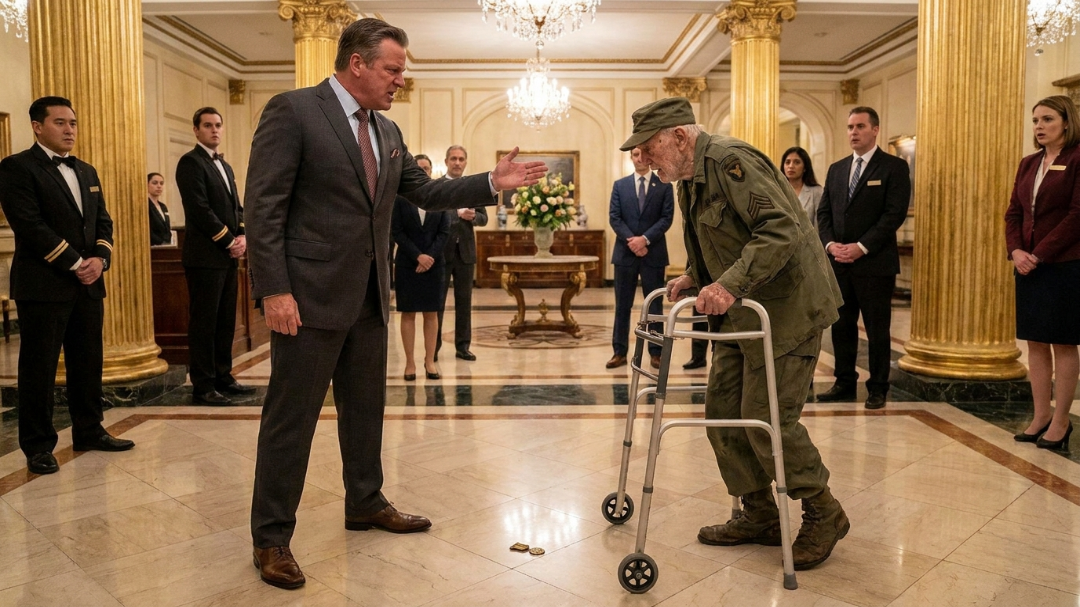
The heavy glass doors of the Sterling Hotel lobby shut behind Arthur with a soft, expensive hiss, sealing him inside a world of glittering chandeliers and polished marble.
He stood near the velvet ropes, feeling the immediate, biting chill of the air conditioning against his seventy-nine-year-old bones. The lobby was a sea of movement, filled with men in sharp black tuxedos and women in sweeping, silk evening gowns. The air smelled of roasted meats, expensive French perfume, and wealth.
Arthur did not belong here, and the room seemed to know it.
He was dressed in his only formal attire: an olive-green military jacket he had owned for decades. The fabric was faded at the elbows, the brass buttons had lost their original shine, and the collar was slightly frayed. But it was clean. He had spent an hour that morning brushing every inch of it, pressing the slacks, and polishing his old leather shoes until his arthritic hands ached.
He held a thick, gold-embossed invitation in his right hand. The edges of the thick cardstock were slightly bent from how tightly he was gripping it.
Arthur took a slow, deep breath, trying to steady his nerves. He only needed to find his seat. He only wanted to be part of the evening for a few quiet hours, to honor the charity that meant so much to him.
He took a step forward.
Before he could reach the reception desk, a shadow fell over his path.
Marcus, the general manager of the Sterling Hotel, stepped out from behind a towering floral arrangement and planted himself directly in front of the old man.
Marcus was a man who obsessed over perfection. His dark suit was tailored so tightly it looked like armor. His tie was perfectly knotted. His shoes reflected the crystal light from the ceiling. He spent his life catering to billionaires, politicians, and socialites. He viewed his hotel lobby as a carefully curated art gallery, and to him, Arthur was an ugly, muddy stain on a pristine canvas.
Marcus did not look at the old man’s face. He looked at the faded green jacket. He looked at the scuffed leather shoes.
His lip curled in immediate, unfiltered disgust.
“Excuse me,” Marcus said, his voice dropping low, carrying a dangerous, quiet authority. “You have made a mistake. The service entrance is around the back, in the alley.”
Arthur stopped. He looked up at the much younger, taller man. He straightened his shoulders, pulling on a lifetime of quiet discipline.
“I am not here for a delivery, sir,” Arthur said. His voice was raspy but calm. “I am here for the Sterling Foundation Charity Dinner.”
Marcus let out a short, breathy laugh. He looked around the lobby, making sure none of the VIP guests were standing too close. He stepped closer to Arthur, invading his personal space, forcing the elderly man to tilt his head back slightly.
“No, you are not,” Marcus said. He spoke slowly, the way one speaks to a slow child. “This is a closed event. It is a thousand dollars a plate. It is black-tie only. You are loitering, and you are leaving right now.”
Arthur held his ground. He did not raise his voice. He simply lifted his right hand, extending the gold-embossed invitation toward the manager’s chest.
“I have a ticket,” Arthur said. “My name is on the guest list.”
Marcus didn’t even glance at the heavy cardstock. He didn’t care what piece of paper the old man had found on the street or pulled out of the trash. He only cared about the optics. The main ballroom doors were scheduled to open for the reception in five minutes, and the billionaire host, David Sterling, was already in the building.
The last thing Marcus was going to allow was a filthy vagrant wandering around the champagne towers.
Marcus reached out and swatted the ticket out of Arthur’s trembling hand.
The heavy card fluttered in the cold air and landed face-down on the polished marble floor.
Arthur’s eyes dropped to the ticket. A flush of heat rose in his weathered cheeks. His chest tightened. It had been a long time since anyone had treated him with such blatant, casual cruelty.
“Pick it up,” Arthur said. His voice was quiet, but the steel underneath it was unmistakable.
Marcus’s eyes widened slightly, shocked by the sudden tone of defiance. Then, his shock turned into pure, arrogant anger.
“I am going to give you exactly three seconds to turn around and walk out those doors,” Marcus whispered, stepping so close Arthur could smell the sharp peppermint on his breath. “If you do not, I will have security throw you out into the street. And they will not be gentle.”
Arthur didn’t move. He stood over his dropped ticket, his jaw set.
“I am an invited guest,” Arthur repeated, locking eyes with the manager. “You will pick up my invitation, and you will let me pass.”
Marcus’s face flushed red. He was used to obedience. He was used to snapping his fingers and watching the staff jump. He could not tolerate being spoken to this way, especially not by someone wearing rags in the middle of his pristine lobby.
“That’s it,” Marcus hissed.
He didn’t call for security. He wanted the satisfaction of removing the trash himself.
Marcus lunged forward. His hand clamped down on Arthur’s left arm with brutal force. His fingers dug deeply into the thin muscle and fragile bone beneath the faded green fabric.
Arthur gasped softly, the sudden, sharp pain radiating up to his shoulder. He tried to pull his arm back, but Marcus was much younger, much heavier, and completely fueled by rage.
“Let go of me,” Arthur demanded, planting his feet on the marble.
“You’re leaving,” Marcus sneered.
He yanked the old man forward. Arthur stumbled, his bad knees buckling slightly under the sudden momentum. He dragged his shoes against the floor, trying to stop, trying to maintain his balance, but Marcus kept pulling.
The scuffle broke the polite quiet of the lobby.
The gentle murmur of high-society conversation died away.
Dozens of wealthy guests turned their heads. Women in expensive jewelry stopped mid-sentence. Men holding flutes of champagne stepped back to clear a path, their faces frozen in expressions of mild distaste.
Nobody stepped forward to help.
A woman in a red silk gown leaned toward her husband, whispering behind a manicured hand. A younger man in a silver tuxedo let out a short, cruel laugh, shaking his head as if watching a street performance.
Arthur felt the heat of their stares burning into his face. The public humiliation washed over him in waves. He was being dragged like a criminal, paraded in front of the wealthiest people in the city, treated like an animal simply because of the clothes on his back.
But he refused to beg. He refused to shout.
He set his jaw tighter, fighting the exhaustion in his legs, trying to pry the manager’s fingers off his arm.
“I said, take your hands off me,” Arthur gritted out, twisting his shoulder sharply.
The sudden resistance infuriated Marcus even more. The manager realized people were watching. He realized he was struggling with an old man in the middle of his flawless event. He needed this over, immediately.
Marcus let go of Arthur’s arm and grabbed something much worse.
He grabbed the old man by the collar of the faded military jacket.
Marcus twisted the fabric in his fist, pulling it tight against the back of Arthur’s neck, and shoved the elderly man violently toward the glass exit doors.
The force of the shove sent Arthur stumbling heavily across the floor. He threw his hands out to catch his balance, his chest heaving, his heart pounding erratically against his ribs.
During the violent shove, the worn, fragile stitching of the jacket gave way.
The sound was sharp and terrible in the suddenly quiet lobby.
Riiiip.
The left breast pocket of the olive-green uniform tore open, hanging by a few stray threads.
Arthur froze.
He stopped trying to pull away. He stopped looking at the exit doors. He stopped looking at Marcus.
His hands immediately flew to his chest. He desperately grabbed at the torn pocket, his eyes wide with sudden, absolute panic.
But he was too late.
Something heavy slipped out of the ruined pocket.
It fell through the air in slow motion.
It hit the polished marble floor with a sharp, heavy, ringing clatter.
The tiny object landed on the floor like a match dropped into dry grass.
It was a heavy, tarnished brass military medal.
It was attached to a frayed, faded ribbon. The brass was scratched, dull with age, and heavy with history. It rolled slightly before coming to a dead stop right in the center of the walkway, catching the reflection of the crystal chandeliers above.
The lobby went completely silent.
The clatter of the heavy metal seemed to echo off the walls long after it had stopped moving.
Arthur did not look at the wealthy guests staring at him. He didn’t look at the manager who was still breathing heavily, straightening his tie.
Arthur just stared down at the medal.
His hands fell slowly to his sides. His shoulders slumped. The quiet dignity he had maintained throughout the assault seemed to fracture. He looked incredibly old in that moment, incredibly tired.
Slowly, painfully, Arthur bent his knees. He lowered himself toward the floor, ignoring the sharp ache in his joints, ignoring the eyes of the crowd, reaching out with a trembling hand to pick up the brass medal.
“Leave it,” Marcus snapped, stepping forward, embarrassed by the old man crouching on his floor. “Don’t touch anything. Security is coming. Get up.”
Arthur didn’t listen. His fingers hovered inches away from the cold metal.
Then, a new sound cut through the silence.
The heavy, towering mahogany doors of the main ballroom suddenly clicked and swung open.
A tall man stepped out into the lobby.
The entire crowd immediately stiffened. People took half-steps backward. The murmurs died completely.
It was David Sterling.
The billionaire host of the evening. The man whose name was on the building, on the invitations, and on the massive charity checks sitting in the vault. David was in his late fifties, dressed in an immaculate, custom-tailored black tuxedo. His silver hair was perfectly swept back. He carried an aura of absolute control. He was known throughout the city as a brilliant, ruthless businessman who did not tolerate failure, noise, or public embarrassment.
David had stepped out to check on the delay in opening the doors. He looked annoyed.
Marcus instantly dropped his aggressive posture. The sneer vanished from his face, replaced by a polished, desperate smile. He quickly stepped away from Arthur, puffing out his chest, hoping to look like a hero who had just saved the party from a disaster.
“Mr. Sterling,” Marcus said smoothly, his voice echoing in the quiet lobby. “I apologize for the disturbance. We had a vagrant wander in from the street. He was harassing the guests and trying to sneak into the reception for free food. I am having him removed immediately.”
David Sterling did not answer.
He didn’t look at Marcus. He didn’t look at the wealthy guests shrinking back against the walls.
David stopped walking.
His eyes were locked on the floor.
He was staring directly at the tarnished brass medal resting on the white marble.
The billionaire’s face changed.
It didn’t happen slowly. It happened in a single, violent second.
The color completely drained from David’s face. His skin turned dead pale. The muscles in his jaw locked tight.
He stared at the old, scratched piece of metal as if a ghost had just walked through the lobby walls.
Marcus, still smiling, stepped closer, completely oblivious to the billionaire’s reaction. “I’ll have maintenance sweep the floor, sir. I’m very sorry for the mess—”
David held up a single hand.
He didn’t speak. He just raised his hand, freezing the manager in his tracks.
The air in the room changed before anyone said another word.
The silence hit harder than any scream.
David Sterling, a man who controlled thousands of employees and billions of dollars, slowly lowered himself. He ignored the crease in his expensive trousers. He knelt down on the cold marble floor, right next to the elderly man in the torn green jacket.
Arthur pulled his trembling hand back, watching the billionaire warily.
David didn’t look at Arthur yet. He reached out and gently, almost reverently, picked up the brass medal.
He held it in his palm. He brushed his thumb over the scratched surface. He turned it over, looking at the faded engraving on the back.
David’s hand began to shake.
He closed his eyes for a long, terrible second. He took a slow, deep breath, trying to steady his breathing.
When David opened his eyes, he slowly lifted his head.
He looked away from the medal. He looked at the torn pocket. He looked at the frayed collar. He looked at the bruised wrist where the manager had grabbed the old man.
Finally, David looked at Arthur’s face.
David stared into the elderly man’s tired, weathered eyes.
The billionaire did not speak. His lips parted, but no sound came out.
Marcus’s confidence finally cracked. He felt a cold drop of sweat slide down his spine. The smile melted off his face like wax. He didn’t understand what was happening, but he knew with absolute certainty that he had just made a catastrophic mistake.
“Mr. Sterling?” Marcus whispered, his voice trembling for the first time. “Sir… do you know this man?”
David didn’t answer the manager.
He kept his eyes locked on the old veteran in the torn jacket.
David slowly stood up, still holding the brass medal tightly in his fist. He turned his head slightly, looking over his shoulder toward the massive security detail standing by the ballroom doors.
The billionaire’s voice was unnervingly quiet when he finally spoke.
“Lock the main doors,” David ordered.
The head of security blinked. “Sir?”
“Lock every door in this lobby,” David said, his voice rising, vibrating with a sudden, terrifying rage. “Nobody leaves this room.”
CHAPTER 2
The heavy steel deadbolts of the main lobby doors slid into place with a sharp, mechanical thud that echoed off the high marble ceiling.
Then came the second click.
The security guards moved with swift, practiced precision, locking down the side exits, the coat check corridor, and the VIP elevators. In less than ten seconds, the most exclusive, expensive room in the city became a sealed vault.
Panic immediately rippled through the crowd.
These were wealthy, powerful people. They were politicians, CEOs, and socialites who were used to going wherever they wanted, whenever they wanted. The sudden realization that they were trapped inside the lobby sent a shockwave of fear through the room.
A woman in a red silk gown gasped, clutching her diamond necklace. A younger man in a silver tuxedo angrily demanded that the guards open the doors, but the security team ignored him completely, standing like statues in front of the glass.
Arthur stood frozen in the center of the walkway.
His heart was hammering painfully against his ribs. His bad knees ached from the sudden, violent shove. He reached up with a trembling hand and grabbed the torn edge of his olive-green jacket, trying uselessly to pull the ruined fabric together over his chest.
He just wanted to leave. The public humiliation was a heavy, suffocating weight. He was a proud man, a man who had lived his entire life with quiet honor, and now he was being stared at as if he were a violent criminal.
But there was nowhere to go. The doors were locked.
In front of him, David Sterling stood perfectly still, clutching the tarnished brass medal in his hand. The billionaire’s face was unreadable, pale and completely drained of its usual commanding warmth.
Marcus, the hotel manager, realized the situation was rapidly spinning out of his control.
The cold drop of sweat that had slid down Marcus’s spine was quickly replaced by a frantic, desperate need to protect himself. He looked at David. He looked at the heavy brass medal. He did not understand why the billionaire cared about a piece of old metal, but he knew he had to destroy Arthur’s credibility before the old man could speak.
Marcus took a step forward, placing himself between David and the elderly veteran.
“Mr. Sterling, you must step back!” Marcus said, raising his voice so the wealthy guests could hear him. He forced a tone of urgent, protective concern. “This man is dangerous. He is entirely unhinged.”
David slowly lifted his eyes from the medal. He looked at the manager, his gaze cold and flat. “Is that so?”
“Yes, sir,” Marcus lied smoothly, his confidence returning as he settled into his fabricated narrative. “I caught him loitering near the VIP cloakroom. He was trying to slip through the staff doors to steal from the coat check. When I politely asked to see his ticket, he became aggressive. He attacked me.”
Arthur’s eyes widened slightly at the sheer audacity of the lie. He opened his mouth to defend himself, but his throat was terribly dry. The stress of the physical assault had drained his limited energy.
Marcus didn’t stop. He pointed an accusatory finger at Arthur’s chest.
“That object you are holding, sir?” Marcus said, gesturing to the medal in David’s hand. “He likely stole it from one of the VIP guests. Or he found it in the trash. He used it as a weapon. He tried to strike me with it when I blocked his path.”
The crowd murmured in shock. The whispers grew louder, instantly turning against Arthur.
“Did you see his face?” a woman whispered loudly. “He looks like a madman.”
“They need to call the police,” another guest muttered. “He could have a weapon in that awful jacket.”
Arthur felt the walls closing in. The sheer volume of the lies, the disgusted stares of the wealthy crowd, the throbbing pain in his shoulder—it was all designed to break him down. He was a seventy-nine-year-old man surrounded by people who would rather believe a tailored suit than a faded uniform.
Marcus signaled sharply to a younger man standing near the reception desk.
It was Pierce, the assistant hotel manager. Pierce was fiercely loyal to Marcus and depended on him for his upcoming promotion.
“Pierce,” Marcus called out authoritatively. “Tell Mr. Sterling what you witnessed. Did you see this vagrant attack me?”
Pierce hesitated for only a fraction of a second. He looked at Arthur, his eyes flickering with a brief flash of guilt, before he stepped forward and nodded firmly.
“Yes, Mr. Sterling,” Pierce lied, keeping his hands politely folded behind his back. “I saw the entire thing. The old man became violent. Mr. Marcus was simply defending the guests and protecting the integrity of your event.”
Marcus stood taller, a triumphant, oily smile creeping back onto his face. He had a witness. He had the crowd. He was the general manager of the Sterling Hotel, and his word was law.
“You see, sir?” Marcus said, lowering his voice respectfully. “I am terribly sorry for the disturbance, but I handled it. I will have security throw him out the back entrance immediately, and we can open the ballroom for your guests.”
Marcus reached out, completely confident he had won, and grabbed Arthur by the arm again.
“Let’s go, old man,” Marcus sneered under his breath. “Your show is over.”
Before Marcus could pull Arthur forward, a quiet, steady voice cut through the tension.
“Take your hand off him.”
It was David Sterling.
The billionaire hadn’t shouted. He hadn’t raised his voice. But the absolute, chilling authority in those six words made Marcus drop Arthur’s arm as if the fabric were on fire.
Marcus stepped back, swallowing hard. “Sir, I am only trying to—”
“If you touch him again, I will personally throw you through that glass window,” David said.
The lobby went dead quiet.
The murmurs stopped. The wealthy guests froze. Nobody had ever heard David Sterling speak like that. He was a man of refined corporate cruelty, not physical threats.
Marcus’s face turned the color of ash. He stepped backward, holding his hands up defensively. He finally realized that the danger in the room wasn’t the old man.
The danger was the billionaire.
David turned his back on Marcus entirely. He stepped closer to Arthur.
Arthur stood tall, despite the pain in his knees. He looked directly into the eyes of the billionaire. He expected another accusation. He expected to be mocked by the man who owned the building.
But David’s eyes were not angry. They were wide, searching, and entirely overwhelmed.
“Are you hurt?” David asked quietly, his voice dropping so low only Arthur could hear it.
Arthur shook his head slowly. “I am fine. I only want my invitation. He knocked it out of my hand.”
“I will find it,” David promised.
The billionaire looked down at the brass medal in his hand. He held it up slightly, letting the crystal light catch the scratched surface.
“This man says you stole this,” David said, his voice carrying clearly across the silent lobby.
Arthur looked at the medal. His chest tightened with a fierce, protective pride. That piece of metal was the heaviest thing he had ever carried. It held the memories of men who had never come home.
“I did not steal it,” Arthur said. His voice was raspy, but it rang out with unmistakable truth. “I earned it.”
David stared at Arthur’s face. He seemed to be studying the deep lines around the old man’s eyes, the shape of his jaw, the way he held his shoulders despite his age.
Before David could ask another question, movement caught Arthur’s eye.
A young waitress wearing a crisp white uniform stepped out from the line of terrified staff members near the catering doors. She was trembling, holding a silver tray tightly against her chest, but she kept walking until she was standing just a few feet away from Arthur.
Marcus turned his head, his eyes widening in fury. He shot the young woman a look of absolute, lethal warning. He mouthed the word, Stop.
The waitress ignored him.
She reached into her apron, pulled out a clean, white linen napkin, and gently held it out to Arthur.
Arthur looked down. He hadn’t realized that when Marcus shoved him, the back of his hand had scraped against the marble floor. A small line of blood was trickling over his knuckles.
Arthur gently took the napkin. “Thank you, miss,” he whispered.
The young waitress looked Arthur directly in the eyes. Her voice trembled, but she spoke loudly enough for the billionaire to hear.
“He dropped his ticket,” she said, pointing a shaking finger at Marcus. “The manager slapped it out of his hand. Then he grabbed him and shoved him. The old man never raised a hand.”
The assistant manager, Pierce, immediately stepped forward, his face red with panic. “She’s lying! She wasn’t even in the room! Mr. Sterling, you cannot listen to—”
“Vance!” David barked, his voice suddenly exploding like a gunshot in the quiet room.
The towering head of security immediately stepped out from the main doors. “Yes, Mr. Sterling.”
“The lobby cameras,” David ordered, his eyes never leaving Marcus’s terrified face. “I want the raw footage from the last ten minutes pulled immediately. I don’t want it on a tablet. I want it sent to the massive display screens inside the main ballroom. Right now.”
Vance nodded sharply. “Right away, sir.”
Marcus stopped breathing. The floor seemed to drop out from underneath him. He knew exactly what those high-definition cameras would show. They would show him assaulting a polite, elderly man without a shred of provocation.
His career wasn’t just in danger. It was evaporating right in front of his eyes.
“Mr. Sterling, please,” Marcus stammered, his voice cracking into a high-pitched whine. He took a desperate step forward, his hands shaking violently. “That isn’t necessary. The cameras… they can be misleading. They don’t capture the audio. They don’t capture the threat I felt!”
David slowly turned his head to look at the manager. The disgust on the billionaire’s face was absolute.
“Do not speak again,” David said. “If you say one more word before that footage plays, I will make sure you never work in this city for the rest of your natural life.”
Marcus snapped his mouth shut. He stood paralyzed, sweating profusely under the expensive lights, completely trapped by his own arrogance.
Arthur watched the exchange in quiet disbelief. He had expected to be thrown out into the street. He had expected the billionaire to protect his own staff. Instead, the most powerful man in the room was burning his own event to the ground just to find the truth.
Arthur looked at the brass medal still resting in David’s hand.
Why did the billionaire care so much about a torn piece of military brass?
David turned his attention back to Arthur. The anger vanished from his face, replaced once again by that strange, overwhelming tension.
David slowly turned the heavy brass medal over in his hand. He stared at the back of it.
Arthur knew what was on the back. It was his name, his unit, and the date of the action that had earned him the commendation.
But there was something else on the back, too.
A deep, jagged scar in the center of the metal. A permanent dent where a piece of hot shrapnel had struck the brass exactly fifty-four years ago, stopping the metal fragment just a quarter of an inch before it could pierce his heart.
David’s trembling finger slowly traced the jagged scar in the brass.
“Valley of Ia Drang,” David whispered, his voice shaking so badly it barely sounded human. “November, nineteen sixty-five.”
Arthur froze.
A cold chill swept down the back of his neck. His breath caught in his chest. The lobby around him seemed to vanish. The wealthy guests, the cruel manager, the locked doors—none of it mattered anymore.
How did this man know that?
Arthur had never spoken about that valley to anyone in this city. He had never told anyone about the shrapnel that had ruined this medal. The only people who knew about that exact day were the men who had bled into the mud beside him. And all of those men were dead.
Arthur stared at the billionaire, his mind racing, trying to find a connection.
“Who are you?” Arthur asked, his voice suddenly tight with suspicion and buried grief.
David didn’t answer the question immediately. He kept his eyes fixed on the dented metal.
“My father died ten years ago,” David said quietly, his voice cracking. He wasn’t speaking to the crowd. He was only speaking to Arthur. “He was a hard man. He built this entire company from nothing. He never showed emotion. He never talked about his past.”
David slowly looked up, his eyes shining with unshed tears.
“But every single day of his life,” David continued, taking a slow step closer to the old man, “my father kept a framed photograph on his heavy mahogany desk. It was a picture of a young soldier. A soldier who refused to leave him behind in the mud. A soldier who took a bullet in the leg and carried my father on his back for three miles until they reached the extraction point.”
Arthur’s heart hammered against his ribs. The old war wound in his left leg suddenly throbbed, a phantom ache from a lifetime ago.
He stared into David’s face. He looked at the shape of the billionaire’s jaw. He looked at the sharp, dark eyes.
A ghost from the past suddenly materialized in Arthur’s mind. A young, terrified private named William Sterling. A boy who had sobbed in the dark, begging Arthur not to leave him to die in the jungle.
“William,” Arthur breathed, the name slipping out of his mouth before he could stop it.
David let out a sharp, choked gasp. The tears finally spilled over his eyelashes, running down his pale cheeks. He didn’t bother to wipe them away.
The billionaire reached inside the breast pocket of his immaculate black tuxedo. His hand was shaking so badly he struggled to pull out a small, folded piece of thick parchment paper. The paper was yellowed with age, bearing the heavy wax seal of the Sterling family crest.
“He didn’t just leave me a company, sir,” David whispered, his voice thick with emotion. He held the sealed letter out toward the old veteran. “He left me this. A letter addressed to the man who saved him.”
Arthur stared at the yellowed parchment, entirely paralyzed by the revelation.
“He made me promise,” David continued, his voice echoing in the absolute silence of the room. “He made me swear on his deathbed that if I ever found the man in the photograph, I would give him this letter.”
David stepped forward, closing the distance between them.
“And he told me,” David said, his voice rising, carrying a sudden, terrifying weight that made the entire crowd hold its breath, “that I was to give him absolutely everything.”
Arthur stared at the letter, his mind spinning, suddenly realizing that this entire charity, this entire event, and the building they were standing in, were all connected to a secret that had been buried for over fifty years.
And Marcus, the man who had just dragged him across the floor like garbage, had no idea what he had just exposed.
CHAPTER 3
The yellowed parchment paper hung in the air between the billionaire and the elderly veteran, trembling slightly in David Sterling’s hand.
The lobby of the Sterling Hotel was entirely silent. The faint, elegant classical music that had been drifting out of the ballroom moments earlier had been abruptly cut off. Dozens of wealthy guests, dressed in diamonds and silk, stood frozen in place, their eyes darting between the torn olive-green jacket of the old man and the immaculate black tuxedo of the billionaire host.
Arthur could not move.
He stared at the thick, heavy parchment. It was folded neatly, sealed with a dark crimson wax stamp bearing the ornate crest of the Sterling family. The edges of the paper were frayed and brittle with age, looking as though it had been kept in a desk drawer for decades, waiting for a day that might never come.
His mind was violently pulled backward through time. The polished marble floor beneath his worn leather shoes seemed to fade away. The cold air conditioning of the luxury hotel vanished, replaced by the suffocating, humid heat of the jungle.
Fifty-four years ago. The Valley of Ia Drang.
Arthur remembered the smell of burning cordite and wet earth. He remembered the deafening, endless roar of the artillery. And he remembered the terrified, agonizing screams of a nineteen-year-old private named William Sterling, whose leg had been shattered by shrapnel in the deep mud.
Arthur had been a sergeant then. He had already taken a piece of hot metal to the chest, the heavy brass medal in his pocket saving his heart but leaving him bruised and bleeding. He had taken a bullet through his left calf. But when the order to fall back was given, Arthur had refused to leave the boy behind. He had hoisted William onto his shoulders, ignoring his own blood soaking into his boots, and carried the young man for three agonizing miles through enemy fire to the extraction zone.
Arthur had never seen the boy again after the medevac chopper lifted off into the storm. He had assumed William had survived, but he had never known for sure.
Until this exact moment.
“Take it,” David whispered, his voice thick with unshed tears. The absolute authority of the billionaire had vanished, leaving only a desperate, grieving son standing in front of his father’s savior. “Please. He waited his entire life to thank you, and he never got the chance.”
Arthur’s breath hitched in his throat. His arthritic fingers shook violently as he reached out.
He gently pinched the edge of the yellowed parchment. He did not pull it immediately. He let the weight of the moment settle over him, his thumb brushing against the cold, hard wax of the crimson seal.
When Arthur finally took the letter from David’s hand, the entire crowd let out a collective, staggered breath.
Marcus watched the exchange with a feeling of absolute, paralyzing dread settling in his stomach.
The general manager was sweating profusely. His perfectly tailored suit suddenly felt like a straitjacket. He wiped a trembling hand across his forehead, smearing the cold moisture. His mind raced frantically, trying to piece together a reality where his career was not entirely destroyed.
Marcus could not accept what was happening. He had built his entire identity around power, status, and the flawless aesthetics of high society. To him, the old man in the faded green jacket was nothing but trash. The idea that this beggar was somehow connected to the Sterling empire was impossible. It had to be a mistake. It had to be a scam.
Desperation made Marcus reckless.
“Mr. Sterling,” Marcus interrupted, his voice cracking into a high, reedy pitch. He stepped forward, raising his hands in a placating gesture. “Sir, you must listen to reason. This is an incredible story, truly it is. But look at him!”
David slowly turned his head. His expression hardened into a mask of pure, lethal ice.
Marcus pointed a shaking finger at Arthur. “Look at his clothes! Look at his shoes! He is a vagrant. He probably read an article about your father’s service and stole that medal from a pawn shop. He is playing you, sir! He is a con artist!”
The silence in the lobby turned suddenly toxic.
Several of the wealthy guests gasped. The woman in the red silk gown, who had been whispering cruel jokes just minutes earlier, now looked horrified by the manager’s outburst.
Arthur did not defend himself. He simply stood tall, clutching the yellowed letter against his chest, refusing to let the desperate manager strip away his dignity.
David did not raise his voice. He did not scream. He simply stared at Marcus with a look of profound, chilling disgust.
“My father,” David said slowly, his voice echoing off the high marble walls, “had a private investigator search for this man for ten years. The military records were sealed. The unit was highly classified. My father spent millions of dollars trying to find the man who saved his life, and he died without ever succeeding.”
David took one slow step toward Marcus.
“The scar on that brass medal,” David continued, his voice dropping to a dangerous whisper, “is not public record. The engraving on the back matches the exact service number in my father’s locked vault. And you, a man who organizes catering trays and folds napkins for a living, think you know better?”
Marcus flinched as if he had been physically struck. His mouth opened and closed like a dying fish, but no words came out.
He looked frantically to his left, searching for an ally.
“Pierce,” Marcus hissed desperately. “Pierce, tell him. Tell him the man attacked me. Tell him I was only protecting the event!”
Pierce, the ambitious assistant manager, stood completely still. He looked at Marcus’s red, sweating face. Then, he looked at David Sterling’s terrifying gaze. Pierce knew exactly which way the wind was blowing. His loyalty to his boss evaporated in an instant.
Pierce took two large steps away from Marcus, physically distancing himself from the sinking ship.
“I saw nothing of the sort, sir,” Pierce said loudly, addressing David directly. “Mr. Marcus initiated the physical contact without provocation. The gentleman simply asked to be seated.”
Marcus’s eyes widened in absolute betrayal. “You lying coward!” he screamed, his professional facade completely shattering. “You told me to get him out of here! You agreed he was an eyesore!”
“Enough,” David commanded. The single word cracked through the air like a whip.
David signaled to Vance, the towering head of security.
“Mr. Sterling, the raw footage from the lobby cameras has been pulled,” Vance reported, holding an earpiece tight against his ear. “The tech crew has routed the feed directly to the main screens inside the ballroom, just as you asked.”
David nodded sharply. He looked at Marcus.
“You wanted to protect the integrity of my event,” David said coldly. “Then we are going to show every single guest exactly how you treat the people who bleed for this country.”
Marcus’s legs gave out. He stumbled backward, his back hitting the heavy glass of the locked exit doors. He scrambled against the glass, his hands leaving sweaty prints, desperately trying to push the heavy brass handles down. But the deadbolts were securely locked. There was no escape.
“Please, Mr. Sterling, I beg of you,” Marcus pleaded, tears of pure terror spilling down his face. “I will resign. I will pack my desk tonight. You don’t need to do this. Don’t ruin me in front of the board.”
“I am not ruining you,” David replied flatly. “You ruined yourself. You just did it in front of my cameras.”
David turned away from the sobbing manager. He looked at the wealthy guests huddled near the velvet ropes.
“Ladies and gentlemen,” David announced, his voice carrying effortlessly across the large room. “The main doors are now open. Please proceed into the ballroom and find your seats. The program is going to begin immediately.”
The guests moved quickly. They did not speak. They cast nervous, shameful glances toward Arthur as they filed through the massive mahogany doors. The arrogant laughter from earlier had completely vanished. They suddenly understood that they had been laughing at a man who held the absolute respect of the most powerful billionaire in the city.
David waited until the lobby was mostly clear. He stepped close to Arthur, his expression softening instantly.
“Sir,” David said gently. “Would you do me the honor of walking with me?”
Arthur looked at the grand entrance. He looked down at his faded, torn jacket. The frayed edges of his breast pocket were still hanging by a few stray threads. He felt deeply out of place.
“I am not dressed for this, son,” Arthur said quietly, his pride warring with his exhaustion. “Perhaps I should just go home.”
David shook his head firmly. “You are the only man in this building who is dressed properly. Everyone else is just wearing a costume. Please. Walk with me.”
Arthur took a deep breath. He tightened his grip on the yellowed letter in his hand. He nodded slowly.
As they walked toward the ballroom, Vance stepped in front of Marcus. The security chief grabbed the weeping manager by the back of his expensive collar, utilizing the exact same humiliating grip Marcus had used on Arthur just ten minutes prior.
“Move,” Vance growled, dragging the manager forward.
The transition from the cold lobby to the grand ballroom was staggering.
The room was massive, bathed in the warm, golden glow of three towering crystal chandeliers. Dozens of perfectly circular tables were draped in heavy black velvet, decorated with towering centerpieces of white orchids and silver candles. The scent of roasted pheasant and expensive wine filled the air.
But all of the opulence was overshadowed by the stage.
Behind the main podium stretched a massive, high-definition digital screen, forty feet wide and twenty feet tall. Currently, the screen was pitch black, a dark void waiting to be filled.
The wealthy guests had quickly found their seats, completely abandoning the usual cocktail hour mingling. They sat in absolute silence, their eyes fixed on the front of the room. The atmosphere was incredibly tense. Nobody touched their champagne. Nobody touched their silverware.
David guided Arthur past the rows of tables. He did not take the old man to a seat in the back. He did not take him to a side table.
David guided Arthur directly to the center of the head table, right in front of the stage.
It was the seat reserved for the guest of honor.
Arthur slowly lowered himself into the plush chair. His bad knees groaned in relief, but his heart was still pounding. He placed the heavy brass medal and the sealed parchment letter onto the black velvet tablecloth in front of him.
The young waitress who had handed Arthur the napkin suddenly appeared at his side. She poured a glass of ice water from a crystal pitcher, her hands shaking slightly, and offered him a warm, respectful smile before stepping back into the shadows.
David walked up the short wooden stairs to the stage. He stood behind the glass podium and tapped the microphone once.
The sharp thud echoed through the silent, massive room.
“Fifty years ago,” David began, looking out over the sea of wealthy faces, “my father came home from a war he rarely spoke about. He built this foundation, the Sterling Charity, with a very specific mission. We build homes for veterans. We pay medical bills for the forgotten. We fund scholarships for the children of the fallen.”
David grasped the edges of the podium.
“Many of you in this room are major donors,” David continued, his eyes sweeping over the crowd. “You give millions to this charity to have your names put on brass plaques. You buy these expensive plates to feel good about yourselves. But my father did not build this foundation for good PR. He built it to pay back a debt.”
The crowd was completely breathless. Even the clinking of ice in water glasses had stopped.
Off to the side of the stage, Vance stood holding Marcus tightly by the arm. The manager was trembling violently, his eyes darting frantically toward the massive black screen behind the billionaire.
“My father owed his life, his fortune, and my very existence, to one single man,” David said, his voice ringing with intense emotion. He pointed a steady finger down at the head table. “That man is sitting in this room right now.”
Every single head in the ballroom turned simultaneously.
Five hundred pairs of eyes landed on Arthur.
Arthur sat perfectly straight in his chair. He did not look away. He kept his hands folded on the black velvet table, resting right next to the red wax seal of the letter. The torn, frayed collar of his green jacket suddenly looked more regal than any tuxedo in the room.
“Tonight,” David said, his tone shifting from reverence to cold, unyielding anger. “That man arrived at this hotel to attend the charity built in his honor. And I want everyone in this room, especially the board of directors, to see exactly how my general manager welcomed him.”
David looked at the technical booth in the back of the room and gave a sharp nod.
“Play the footage.”
Marcus let out a pathetic, strangled whimper. He threw his hands over his face, unable to watch his own destruction.
The massive forty-foot screen behind the stage flickered to life.
It wasn’t a heavily edited, polished video. It was the raw, unblinking eye of the lobby security camera. The high-definition footage showed the pristine marble floor, the velvet ropes, and the exact moment Arthur walked through the doors holding his golden ticket.
The video had no sound, but the silence made the visual impact infinitely worse.
The crowd watched in horror as the giant screen showed Marcus marching aggressively toward the old man. They watched the manager slap the ticket out of the veteran’s hand. They watched, in crystal-clear detail, the brutal, unprovoked way Marcus grabbed Arthur’s arm and violently yanked him toward the doors.
A low rumble of absolute disgust rippled through the ballroom.
People who had laughed in the lobby were now staring at the screen with open shame. A prominent judge sitting near the front row shook his head in disgust. The CEO of a major tech firm glared at the sobbing manager standing near the stage.
The footage showed the cruel, final shove.
It showed the old green jacket tearing open.
It showed the heavy brass medal falling to the floor.
David held up his hand, signaling the tech booth. The giant screen froze exactly on the frame of Arthur slowly, painfully bending down to pick up his fallen honor, while Marcus stood over him with a smug, arrogant sneer.
The frozen image burned into the retinas of every single person in the room.
“That,” David said, his voice dripping with venom, pointing at Marcus’s frozen face on the screen, “is the man who has been running this hotel. That is the man greeting our guests.”
David turned away from the screen and looked directly at the weeping manager.
“You are fired,” David stated simply. The words echoed like a gavel strike. “You will be escorted off this property by the police. I am personally filing assault charges against you on behalf of this foundation. And I promise you, by tomorrow morning, this footage will be on the desk of every hospitality board in the country. You are done.”
Vance didn’t wait for another order. He forcefully turned Marcus around and began marching him toward the service exit. Marcus did not fight back. He dragged his feet, his head hanging in total, absolute ruin.
The room watched the villain disappear behind the heavy wooden doors. The threat was gone.
But the mystery was not over.
David turned back to the microphone. The anger faded from his face, replaced once again by the deep, heavy emotion that had taken over him in the lobby.
He stepped out from behind the podium and walked down the stairs, approaching the head table where Arthur sat.
The entire ballroom watched in dead silence.
“Sir,” David said softly, looking at the yellowed parchment resting on the black velvet. “For fifty years, my father kept that letter sealed. He told me it contained his final request. He told me it contained the absolute truth about this foundation.”
David stopped in front of the table. He looked into Arthur’s weathered eyes.
“I don’t know what it says,” David admitted, his voice trembling slightly. “But he wanted you to read it. He wanted you to know.”
Arthur looked down at the thick red wax seal.
He could feel the eyes of five hundred people burning into him. He could feel the ghost of the terrified nineteen-year-old boy reaching out from the past. The letter felt incredibly heavy, pregnant with a secret that had survived a war and half a century of silence.
Arthur’s arthritic hands reached forward.
His thumb pressed against the edge of the crimson crest.
With a sharp, cracking sound that echoed loudly in the silent room, Arthur broke the seal.
CHAPTER 4
The sharp, brittle crack of the crimson wax seal breaking sounded like a gunshot in the absolute silence of the grand ballroom.
Arthur’s arthritic hands trembled as he pulled the edges of the yellowed parchment apart. The thick paper was stiff with age, holding the deep creases it had been folded into fifty years ago.
Five hundred of the wealthiest people in the city sat completely paralyzed. The massive high-definition screen behind the stage still displayed the frozen image of Arthur being humiliated in the lobby, but no one was looking at the screen anymore. Every single eye in the room was locked on the elderly veteran sitting at the center of the head table.
David Sterling stood perfectly still beside him, his hands folded respectfully in front of his tailored tuxedo. The billionaire was breathing heavily, his own eyes shining with unshed tears, waiting to hear the words his father had left behind.
Arthur opened the letter fully.
The handwriting was neat, sharp, and written in fading black ink. It was the precise, disciplined penmanship of a man who commanded empires. But as Arthur’s eyes scanned the first few lines, the corporate power of the Sterling family vanished, replaced by the terrified ghost of a nineteen-year-old boy bleeding in the jungle.
Arthur did not read it out loud at first. He read it silently to himself.
His weathered face, which had remained stoic and dignified through the physical assault in the lobby, suddenly broke. His jaw tightened. His chest began to heave with short, jagged breaths.
A single, heavy tear escaped the corner of his eye. It tracked through the deep lines of his face and fell, landing softly on the black velvet tablecloth next to his tarnished brass medal.
The silence in the room stretched until it felt as though the air itself might snap.
David slowly leaned forward. He rested one hand gently on the table, not pushing, just offering a silent anchor.
“Please, sir,” David whispered, his voice thick with raw emotion. “The people in this room have believed a lie for too long. They believe this foundation was built out of corporate generosity. They need to know the truth. I need to know the truth.”
Arthur swallowed hard, trying to dislodge the heavy knot of grief in his throat. He looked up from the parchment. He looked at David, seeing the echoes of the young soldier in the billionaire’s sharp eyes.
Then, Arthur looked out at the massive crowd.
He saw the board of directors sitting at the front tables in their thousand-dollar suits. He saw the socialites who had laughed at him. He saw a room full of people who had spent their lives believing that wealth equated to worth.
Arthur slowly reached out and pulled the slender silver microphone closer to the edge of the table.
The speakers above hummed to life with a low, static crackle.
“The letter is dated October 14th, nineteen seventy-two,” Arthur said. His raspy voice echoed through the cavernous ballroom, carrying a quiet, undeniable authority. “Seven years after the Valley of Ia Drang.”
Arthur looked back down at the faded ink. He took a deep, shuddering breath, and began to read the words of a dead man.
“To Sergeant Arthur Hayes. If my son has found you, then he has kept the promise he made to me on my deathbed. And if you are reading this, it means you survived that terrible place, just as you promised me we both would.”
A woman in the second row pressed a manicured hand over her mouth, stifling a soft gasp.
Arthur’s voice steadied, anchored by the discipline of his past. He read the next paragraph, letting the brutal truth of the history wash over the wealthy crowd.
“You do not know the life I have lived since that day. I built a company. I built a fortune. I have buildings with my name on them. But every single night, when I close my eyes, I do not see boardrooms or bank accounts. I see the deep mud. I hear the artillery. And I feel the weight of your shoulders underneath me.”
David closed his eyes. A fresh tear slipped down his cheek, catching the golden light of the chandeliers.
“I was a boy, terrified and bleeding to death,” Arthur continued reading, the microphone picking up the slight tremor in his hands. “You had already taken a piece of shrapnel to the chest. Your own leg was wounded. The evacuation order was given. You could have left me. No one would have blamed you. The lieutenant told you I was already gone. But you looked at me, you picked me up, and you walked for three miles through hell because you refused to let my mother receive a folded flag.”
The ballroom was entirely breathless. The clinking of silverware, the rustling of silk dresses, the quiet whispers—everything had ceased to exist.
“I spent ten years trying to find you,” the letter read. “I hired investigators. I pulled military records. But you disappeared back into the world, asking for absolutely nothing in return for the life you gave me. You never sought glory. You never sought a reward.”
Arthur paused. The paper was shaking violently in his hands. He took a moment to steady himself, staring at the final paragraph.
When he spoke again, his voice dropped an octave, resonating with a profound, shocking weight.
“Because you asked for nothing, Arthur, I have decided to give you everything.”
The board of directors sitting in the front row suddenly stiffened. The CEO of the tech firm leaned forward, his eyes wide with sudden realization.
“This charity,” Arthur read, his voice filling the massive room, “does not belong to the Sterling family. I did not build it to clear my conscience. I built it as a holding trust. The initial endowment, the properties, and the operational control were legally placed into a blind trust fifty years ago. A trust waiting for its rightful owner.”
David stepped back from the table. He reached inside his tuxedo jacket and pulled out a thick, heavy leather folder. He placed it carefully on the black velvet next to the brass medal.
Arthur read the final lines of the letter.
“You carried me when I had nothing left, Arthur. Now, it is my turn to carry you. If you are reading this, the Sterling Foundation is no longer mine. It is yours. You are the sole primary benefactor, the absolute owner, and the Chairman of the Board. Use it to help the men who came home broken. Use it to fix the world we fought for. I will be waiting at the final rally point. Your brother, Private William Sterling.”
Arthur’s voice cracked on the final word. He slowly lowered the letter.
The silence that followed was absolute. It was not the tense, uncomfortable silence of a public scandal. It was the heavy, sacred silence of utter reverence.
Fifty years of secrets, billions of dollars, and the entire power structure of the city had just been completely rewritten by a single piece of yellowed paper.
David Sterling placed his hand flat on the leather folder.
“The legal documents are inside,” David said, speaking directly into the microphone so the entire room could hear him. “The board of directors was never informed of the blind trust. Only I knew. The moment you broke that wax seal, the transfer was legally executed. You own the building we are sitting in. You own the endowment. You hold absolute veto power over every single dollar this foundation spends.”
David stepped back. He looked at the old man sitting in the frayed, torn green jacket.
The billionaire did not offer a handshake. He did something much more powerful.
David Sterling, the most ruthless and respected businessman in the city, stood at full attention. He pressed his arms tightly to his sides, raised his chin, and delivered a crisp, perfect military salute to the elderly veteran.
“Welcome home, Chairman,” David said proudly.
The reaction from the crowd was instantaneous.
It started in the front row. The prominent judge pushed his chair back, stood up, and began to clap. The CEO of the tech firm immediately followed.
Within five seconds, all five hundred guests were on their feet.
The applause was not polite. It was deafening. It rolled through the ballroom like a wave of thunder. Men in expensive tuxedos and women in diamonds stood clapping until their hands burned. The people who had turned their noses up in the lobby, the people who had laughed at the faded green jacket, were now staring at Arthur with a profound, crushing sense of shame and respect.
They realized they had not been judging a beggar. They had been judging a king who had simply chosen to walk among them in his working clothes.
Arthur sat at the table, completely overwhelmed. He looked at the standing ovation. He looked at the blinding camera flashes from the press pool in the back of the room. He looked at David, who was still holding his salute, tears streaming down his face.
Slowly, carefully, Arthur pushed his chair back.
He stood up.
He ignored the pain in his knees. He ignored the tear in his pocket. He reached down to the black velvet tablecloth and picked up his heavy, tarnished brass medal.
He didn’t put it back in his pocket. He held it tightly in his right fist, grounding himself in the cool, heavy reality of the metal.
Arthur raised his left hand, signaling for quiet.
The applause died down instantly. The crowd remained standing, completely captivated by the old man’s presence.
Arthur leaned into the microphone. He did not gloat. He did not demand apologies from the crowd. He handled the absolute power he had just been handed with the exact same quiet dignity he had shown when he was being dragged across the floor.
“I did not come here tonight for money,” Arthur said, his voice steady and calm. “I did not come here for power. I came here because this foundation builds homes for the boys who come back missing pieces of themselves. I came here because the work matters.”
He looked directly at the board of directors standing in the front row.
“My jacket is torn,” Arthur said softly. “My boots are old. But my mind is sharp, and my memory is long. Private Sterling built this machine to save lives. And starting tomorrow morning, we are going to make sure that not a single penny is wasted on arrogance, and every single dollar goes exactly where it belongs.”
Arthur looked at David, offering the billionaire a small, genuine smile.
“Your father was a good man, David,” Arthur said quietly. “He didn’t owe me anything. We were just boys trying to survive the dark. But he kept his word. And I will keep mine.”
Arthur stepped back from the microphone.
The crowd erupted again. The standing ovation shook the crystal chandeliers above.
There was no more judgment. There was no more whispers about dress codes or high-society rules. The room belonged to Arthur entirely.
David stepped forward, gently placing a hand on Arthur’s shoulder. He guided the elderly veteran away from the head table, leading him toward the center of the room to formally begin the charity auction.
But this time, everything was different.
The event was no longer a superficial gathering of the elite. It was a room united by the raw, undeniable truth of sacrifice. The auction raised more money in a single hour than the foundation had raised in the previous three years combined. The wealthy guests stepped forward, not for vanity, but out of a desperate desire to earn the respect of the man in the torn green jacket.
Far away from the warmth of the ballroom, in the cold night air outside the hotel, Marcus stood on the curb.
His tailored suit was rumpled. His career was completely incinerated. Two police officers stood behind him, waiting for the transport van to arrive. Marcus stared up at the glowing lights of the Sterling Hotel, the building he had treated as his own personal kingdom just an hour ago.
He shivered in the cold, holding his bruised pride, finally understanding the catastrophic price of arrogance. He had tried to throw away a piece of trash, only to discover he had thrown himself out of the castle.
Back inside the grand ballroom, Arthur sat quietly at his table, watching the numbers climb on the massive screen.
He gently folded the yellowed parchment and tucked it safely inside his jacket. He rested his hand over his chest, feeling the heavy, tarnished brass medal resting exactly where it belonged, right over his heart.
The war was over. The debt was paid.
And for the first time in fifty years, Arthur finally felt like he had truly come home.
THE END.