
NEXT PART – THE ARROGANT BIKER SHATTERED THE ONE-LEGGED VETERAN’S WOODEN BOX ON THE CLUBHOUSE GARAGE FLOOR AND LAUGHED AT HIS WAR STORIES — UNTIL AN OLD UNIT PATCH SLID FROM THE SPLINTERS
He snatched the dark wooden box right out of my hands.
The movement was fast, vicious, and completely unearned. Chase stood there in the middle of the clubhouse garage, holding my property just out of my reach. He wore a mocking, arrogant grin that told the whole room he thought he was untouchable.
I swayed forward, my right hand instinctively gripping the edge of the greasy metal workbench. My left leg—the one that ended just below the knee—throbbed against the rigid carbon-fiber socket of my prosthetic. I forced myself to stay upright.
“Let me guess,” Chase announced loudly, turning to play to his audience. “More secret medals in here? More ghost stories for the new guys?”
Three of the younger prospects chuckled nervously from the shadows near the tool cages. A couple of the older members stood by the open bay doors, shifting their weight, looking anywhere but at me. No one stepped forward.
“Give it back, Chase,” I said. My voice was quiet, stripped of any anger, steady in a way that usually made men pause.
It didn’t work on him. Chase was twenty-six, flush with his new Vice President rocker, and convinced the world owed him a wide berth. He rode a thirty-thousand-dollar bagger that had never seen rain, and he ran his mouth like a man who had never been hit for it.
“Or what, old man?” Chase sneered, stepping closer. “You’re gonna limp over here and take it?”
I kept my hands flat on the workbench. The smell of two-stroke oil, stale exhaust, and cheap beer hung thick in the heavy afternoon air. This garage had been my sanctuary for nine years. I built engines here, trued wheels here, and kept my head down.
I never asked the club for anything. I paid my dues, turned my wrenches, and let the younger generation pretend they invented the highway. But Chase had been gunning for me for three months.
He didn’t like that the older guys still asked my advice on their motors. He didn’t like that I didn’t laugh at his jokes. Most of all, he didn’t like the silence I carried.
To a guy like Chase, quiet looked like a challenge. He thought respect was something you bought with loud pipes and leather. He thought my silence meant I was hiding something weak.
“I said give the box back,” I repeated. I didn’t raise my voice. I didn’t need to.
Chase held the box up to the fluorescent lights. It was dark walnut, bound at the corners with tarnished brass, locked with a heavy iron padlock. I had carried it from a dusty attic in North Carolina to this exact workbench. I hadn’t opened it in thirty-two years.
“I’m sick of your act, Hank,” Chase said, his voice echoing off the concrete walls. “You sit in the corner acting like you’re some kind of hardened war hero. You think we don’t see right through it?”
I stared at him. The metal edge of the workbench was biting into my palms. The phantom pain in my missing left foot flared, a sharp electrical burn shooting up into my hip.
“You tell these kids you lost the leg in the sandbox,” Chase continued, pacing back and forth. “You tell them you ran with the real operators. But I did my homework, old man.”
He stopped pacing and leveled a finger at my chest. The garage was entirely silent now. Even the compressor in the corner had clicked off.
“I pulled your name,” Chase lied smoothly, projecting his voice for the room. “I know guys. There is no record of you in any combat unit. Your war stories were all lies.”
He was pushing for a reaction. He wanted me to yell, to swing at him, to validate his dominance in front of the chapter. If I swung, I was the unstable old cripple. If I stayed silent, I was the exposed fraud.
I took a slow breath. The air tasted like rust and ozone. I looked at the dark wooden box in his hands.
It held the only things that survived a specific Tuesday in a desert valley that didn’t exist on any unclassified map. It held the weight of four men who hadn’t made it to thirty. It held the reason I woke up sweating three nights a week.
“You don’t know what you’re holding,” I told him quietly.
“I know I’m holding a box of garbage,” Chase snapped back. The mocking smile returned to his face, wide and cruel.
He drew his right arm back. The heavy leather of his riding jacket creaked.
I saw his shoulder dip. The military discipline ingrained in my spine recognized the kinetic shift before he even moved. But my prosthetic boot slipped slightly on a patch of spilled transmission fluid.
I jolted forward, my balance completely failing for a fraction of a second. I caught myself hard against the steel vise, my chest heaving. The humiliation of the stumble burned hotter than the physical pain.
Chase saw the stumble. His eyes lit up with pure, victorious amusement.
“Oops,” he said.
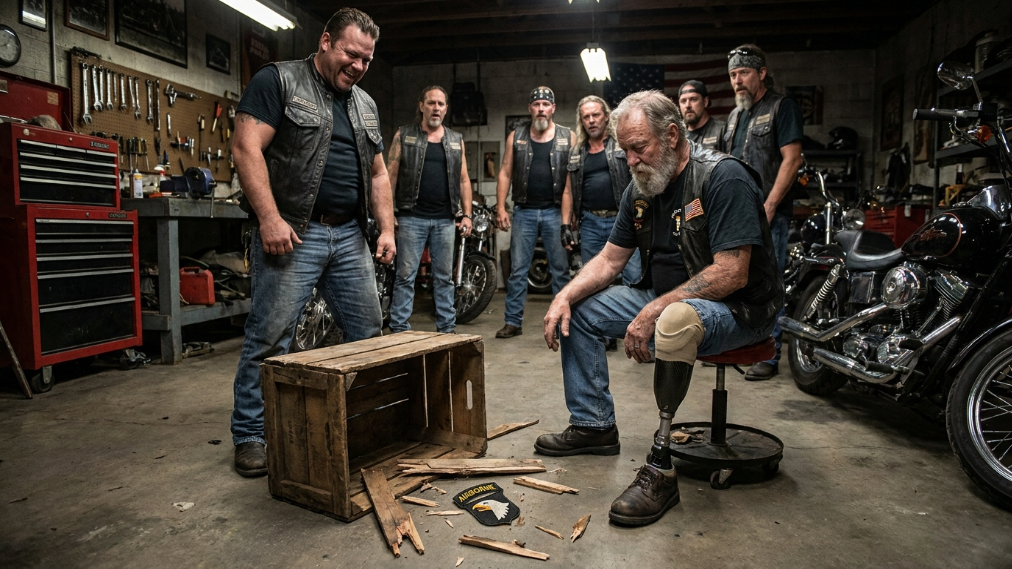
He violently hurled the wooden box straight down onto the concrete floor.
He didn’t just drop it. He threw it with every ounce of force in his shoulder, putting his entire weight behind the throw. The impact sounded like a gunshot going off inside the closed garage.
The dark walnut shattered instantly. The brass corners buckled and popped off like shrapnel. A cloud of ancient dust and splintered wood exploded across the oily concrete.
I froze. My breath caught in my throat. I didn’t move toward the wreckage. I just stood there, gripping the workbench, staring down at the scattered pieces of my past.
“There,” Chase said, dusting his hands off with a theatrical clap. “Mystery solved. Just a box of old junk for a fake veteran.”
He stepped forward, raising his heavy, steel-toed riding boot. He was going to kick the debris aside, to scatter whatever was left into the filthy grease trap near the drain.
A few of the younger guys laughed. It was an ugly, nervous sound. They were aligning themselves with the power in the room.
I didn’t answer him. I didn’t look at the crowd. My eyes were locked on the center of the shattered wood.
From between two jagged, broken splinters of walnut, something small and fabric slowly slid out into the harsh overhead light. It caught against the concrete, coming to rest right at the tip of Chase’s raised boot.
It was an old military unit patch.
It wasn’t pristine. It was deeply faded, the edges frayed, the stitching darkened by thirty years of stored time. More importantly, it was stained. The dark, rusted-iron color blooming across the bottom half of the fabric was unmistakable to anyone who had ever seen real trauma.
I noticed it instantly. The cold numbness in my chest vanished, replaced by a sudden, heavy stillness.
Chase lowered his boot, intending to kick it. He was still smirking. He glanced down to see what he was about to step on.
His eyes found the patch.
The movement of his foot stopped completely. He froze mid-step, his boot hovering two inches above the stained fabric.
I watched his face change. The mocking, arrogant grin didn’t just fade. It collapsed.
Chase went chalk-white. The blood drained from his cheeks so fast he looked physically ill. His jaw dropped open slightly, but no sound came out.
He knew what the patch was.
I knew he would. Six months ago, in this very garage, Chase had stripped off his shirt to show off a massive, fresh tattoo on his back. It was a tribute piece to his grandfather, a man the entire club spoke of with whispered, legendary reverence.
His grandfather had been part of a ghost unit. A unit so highly classified they didn’t officially exist. A unit identified only by the very specific, unique patch currently lying on the concrete floor.
Chase had the pristine version of that patch inked across his shoulder blades. The one at his feet was the real thing, worn, bloodied, and violently torn from a uniform.
One of the older bikers by the bay doors stepped forward, squinting. He recognized it too. The man stopped walking, his hands falling limply to his sides.
The garage atmosphere instantly turned heavy. The nervous laughter died abruptly. The silence that filled the room wasn’t the quiet of a paused conversation. It was the absolute, suffocating dead air of a bomb threat.
Chase slowly raised his head. His eyes met mine. The arrogance was entirely gone, replaced by a raw, unshielded terror.
I didn’t move. I didn’t break eye contact. I kept my hands flat on the workbench, balancing on my prosthetic leg, and let the silence absolutely bury him.
CHAPTER 2
The silence stretched out, thick and suffocating, like the air right before a thunderstorm breaks. Chase’s heavy steel-toed boot remained frozen just inches above the stained fabric. He stared at the faded unit patch as if it had just materialized from a nightmare.
I didn’t blink, and I didn’t shift my weight from my good leg. My right hand remained clamped on the greasy edge of the workbench. I could feel the rhythmic pulse of my own heartbeat in my fingertips.
“Where did you get that?” Chase finally whispered. His voice had lost all of its theatrical boom. It sounded thin, reedy, and suddenly very young.
He didn’t look at me when he asked the question. His eyes were glued to the rusted-iron stain blooming across the bottom half of the patch. He recognized the shape of the crest, the specific jagged angles of the embroidery.
It was the exact same design that spanned his shoulder blades in pristine, fresh ink. “I asked you a question, old man,” Chase said, his voice trembling slightly. He forced himself to look up from the concrete floor.
When his eyes met mine, the arrogant certainty was completely gone. He looked like a man who had just stepped off a ledge in the dark. He was waiting for me to give him an out.
He wanted me to say I bought it at a surplus store. He wanted me to laugh and admit it was a replica I found online. He desperately needed my silence to break so he could rebuild his reality.
I gave him nothing. I let the heavy, dead air of the garage press down on him. The compressor in the far corner suddenly kicked on with a loud, metallic shudder.
Chase flinched violently at the noise. He stumbled backward, his boot completely missing the patch. His heel caught on a stray socket wrench, and he awkwardly caught himself against a tool cabinet.
The metallic clatter of the wrench skittering across the concrete broke the spell over the room. The three younger prospects by the cages exchanged panicked, uncertain glances. They didn’t know what the patch meant, but they recognized their Vice President’s fear.
“You’re a liar,” Chase blurted out, his chest heaving under his leather cut. He pointed a shaking finger at me. “You bought that fake garbage on the internet to mess with me.”
I finally let go of the workbench. My prosthetic locked into place with a faint, mechanical click. I took one slow, deliberate step away from the bench and toward the shattered walnut box.
“Don’t touch it!” Chase yelled, his voice cracking. He lunged forward as if to block me. He didn’t make it two steps.
A heavy, calloused hand clamped down on Chase’s shoulder. It was Dutch, one of the older members who had been standing by the bay doors. Dutch was sixty-two, built like a brick wall, and wore a faded combat veteran rocker on his vest.
“Back up, kid,” Dutch said. His voice was a deep, gravelly rumble that demanded absolute compliance. He shoved Chase backward with a single, effortless motion.
Chase stumbled again, his face flushing crimson with a sudden surge of defensive rage. “Get your hands off me, Dutch!” Chase snapped, slapping at the older man’s arm. “He’s parading around stolen valor!”
Dutch didn’t look at Chase. His eyes were locked on the small, fabric patch resting among the wood splinters. He recognized the bloodstain for exactly what it was.
“I said back up,” Dutch repeated, stepping squarely between Chase and the wreckage. “You don’t know what you’re looking at. Keep your mouth shut.” Chase stood there, his fists clenched, vibrating with a toxic mix of humiliation and anger.
I ignored both of them. I lowered myself to the greasy concrete floor. It was a difficult, awkward movement with the carbon-fiber socket of my prosthetic.
I had to keep my left leg extended straight out while bending my right knee. The concrete was cold and gritty through the denim of my jeans. I reached out with a steady hand and picked up the faded patch.
The fabric was stiff, hardened by time and dried blood. My thumb traced the familiar, jagged embroidery of the ghost unit’s crest. For a fraction of a second, the smell of two-stroke oil faded from my senses.
It was replaced by the overwhelming scent of burning diesel, hot sand, and copper. I heard the chaotic, deafening roar of a rotor wash kicking up desert dust. I felt the dead weight of a man leaning against my shoulder, his breathing wet and shallow.
I closed my eyes, forcing the memory back into the dark corner where it belonged. I took a slow, measured breath. When I opened my eyes, the dusty, fluorescent-lit garage swam back into focus.
I held the patch in my palm. I carefully picked up the jagged, broken pieces of the dark walnut box. The brass hinges had been completely sheared off by the force of Chase’s throw.
Among the splinters, there were two other items that had spilled onto the floor. One was a heavy, silver Zippo lighter, deeply scratched and dented. The other was a small piece of folded, yellowed paper.
I scooped them up quickly, shielding them from the harsh overhead lights. I didn’t want Chase or anyone else to see the specific details engraved on the lighter. I slipped the items, along with the patch, deep into the inside pocket of my leather vest.
“Show everybody what you’ve got in your hand, Hank!” Chase yelled from behind Dutch. He was trying to rally his courage, trying to reclaim his audience. “Show ’em the fake prop you’ve been hiding to make yourself look tough!”
I stood back up, using the workbench to haul my weight upright. I brushed a smear of black grease off the knee of my jeans. Then, I finally turned to look at the young Vice President.
“It wasn’t a prop,” I said evenly. My voice was calm, utterly devoid of the aggression he desperately wanted to fight against. “It was a piece of my property. You destroyed it.”
“You’re disrespecting my family!” Chase shouted, stepping around Dutch’s broad shoulders. “My grandfather was a legend! He was in that unit!” He pounded his fist against his own chest, right over his heart.
“You’re a grease monkey who talks too much,” Chase sneered. “You bought that patch to mock him. To mock me.” His logic was frantic, spinning wildly to protect his fragile ego.
“Nobody is mocking anyone,” Dutch rumbled, crossing his massive arms over his chest. “But that patch ain’t fresh from an internet catalog, Chase. That’s field-worn.” Dutch had spent two tours in the jungle; he knew the difference between dirt and blood.
“He stained it himself!” Chase insisted, his voice echoing shrilly off the walls. “He’s a fraud! I’m calling a chapter vote tonight!” He pointed his finger at me again, his eyes wide and wild.
“I’m gonna strip your patches, Hank,” Chase threatened. “I’m gonna run you out of this club for stolen valor.” The three prospects by the cages nodded hesitantly, siding with the loudest voice in the room.
Before I could answer, the heavy steel door connecting the garage to the bar area swung open. The heavy, rhythmic thumping of classic rock spilled into the quiet room. Iron, the Chapter President, walked in.
Iron was a massive man in his early fifties, with a thick gray beard and sharp, calculating eyes. He carried a clipboard in one hand and a half-empty mug of coffee in the other. He stopped three steps into the garage, instantly reading the tension in the air.
He looked at me, then at Chase, and finally at the shattered pieces of walnut wood on the floor. “What the hell is going on in here?” Iron asked. His voice wasn’t loud, but it carried absolute authority.
Chase immediately jumped on the opportunity to control the narrative. “Hank’s flashing fake military gear, boss,” Chase said, stepping toward Iron. “He’s trying to pass himself off as a ghost unit operator.”
Chase pointed at the splintered wood by my boots. “He had a prop box filled with fake patches,” Chase lied smoothly. “He’s disrespecting the real heroes. He’s disrespecting my grandfather.”
Iron frowned, his thick eyebrows pulling together. He turned his sharp gaze to Dutch. “Is that true, Dutch?” Iron asked.
“Not even close to true,” Dutch said flatly. “Chase grabbed a locked box out of Hank’s hands.” “Then he smashed it on the concrete like a damn toddler throwing a tantrum.”
Chase’s face flushed red again. “He provoked me!” Chase argued, stepping closer to Iron. “He was holding it like it was some holy relic.”
Iron held up his hand, silencing Chase instantly. He walked over to where I was standing by the workbench. He looked down at the broken walnut and the twisted brass hinges.
“That box yours, Hank?” Iron asked quietly. I nodded once. “It was,” I said.
Iron sighed, rubbing his hand over his tired face. He was trying to hold together a club that was fracturing along generational lines. He had young guys who wanted to play gangster, and old guys who just wanted to ride in peace.
“Chase,” Iron said without turning around. “Go wait in the bar. Now.” Chase bristled, his shoulders tensing under his cut.
“Boss, he’s committing stolen valor right in our clubhouse,” Chase protested. “We have to deal with this.” “I’m not gonna let some fake veteran drag down our reputation.”
Iron turned around slowly. He fixed Chase with a cold, dead stare that had backed down much harder men. “I said, go wait in the bar, Vice President,” Iron repeated, emphasizing the title.
Chase clenched his jaw, but he didn’t dare challenge Iron directly. He shot me one last look of pure, unadulterated venom. “This isn’t over, old man,” he muttered.
Chase turned on his heel and stormed out of the garage. The three prospects immediately scrambled to follow him, eager to escape the heavy atmosphere. The heavy steel door slammed shut behind them, cutting off the classic rock music.
Iron took a sip of his coffee and looked at Dutch. “Give us a minute, brother,” Iron said. Dutch nodded, giving me a supportive clap on the shoulder before walking out to the alley.
Iron and I were alone in the greasy garage. He set his clipboard down on my workbench and leaned against the metal frame. He looked at the broken splinters of wood again.
“Chase has a big mouth, Hank,” Iron said quietly. “But he’s got a lot of influence with the younger guys.” “They look up to him because of his grandfather’s reputation.”
I kept my hands in my pockets, feeling the rough fabric of the patch. “His grandfather was a good man,” I said honestly. “But Chase isn’t his grandfather.”
Iron nodded slowly, staring at the floor. “What was in the box, Hank?” he asked. “I’ve known you for nine years, and I’ve never heard you brag about your service.”
“I don’t brag because there’s nothing to brag about,” I told him. “It was a job. We did it. Some of us came home.” I pulled my hand out of my pocket and showed Iron the heavy, silver Zippo lighter.
Iron looked at the scratched metal, his eyes narrowing slightly. “Chase thinks you’re faking it,” Iron said. “He’s already texting the whole chapter, telling them you’re a fraud.”
“Let him text,” I replied, slipping the lighter back into my vest. “The truth doesn’t need to yell to be heard.” “But if he pushes this, he’s not going to like what he finds.”
Iron studied my face for a long moment. He knew I wasn’t making an empty threat. “I don’t want a civil war in my club, Hank,” he said, his voice heavy with fatigue.
“Neither do I,” I agreed. “I just want to build my engines and ride.” “But Chase crossed a line today when he put his hands on my property.”
Iron picked up his clipboard and his coffee mug. “Pack up your tools for the day,” Iron told me. “Go home. Let things cool down.”
He turned to walk toward the bar door, then stopped and looked back over his shoulder. “He’s calling for a vote at church tomorrow night,” Iron warned me. “He wants to strip your patches. You’d better be ready.”
I watched Iron leave the garage. The heavy steel door clicked shut, leaving me alone with the smell of spilled oil and old dust. I reached down and picked up the largest remaining piece of the walnut box.
It was the lid, still bearing the faint, scratched initials of the man who had carved it. I traced the letters with my thumb. They were the same initials tattooed on Chase’s back.
I grabbed my canvas tool bag from the bottom shelf of the workbench. I methodically wiped down my wrenches and ratchets, placing them in their designated slots. The repetitive motion was calming, grounding me in the present moment.
I wasn’t the scared, bleeding kid I had been thirty-two years ago. I was a fifty-five-year-old man who had built a life out of discipline and grease. Chase thought he was hunting a fraud, but he had no idea what he was actually stalking.
I zipped up the canvas bag and slung it over my shoulder. My prosthetic leg felt stiff, but the phantom pain had subsided to a dull ache. I walked out the side door of the garage into the harsh glare of the late afternoon sun.
My truck was parked near the chain-link fence at the edge of the clubhouse lot. It was a faded blue ’87 Chevy pickup, meticulously maintained under the hood. I tossed my tool bag onto the passenger seat and climbed behind the wheel.
Before I put the key in the ignition, I reached into my vest pocket again. I pulled out the folded piece of yellowed paper that had fallen from the box. It was brittle to the touch, the creases fragile from decades of being sealed away.
I carefully unfolded it on the steering wheel. It was a handwritten letter, penned on official military stationary that had been discontinued in the nineties. The handwriting was sharp, hurried, and distinctly familiar.
I didn’t need to read the words. I had memorized them on a medevac flight while heavily sedated with morphine. I knew exactly what the letter said, and I knew exactly who had signed it.
Chase believed his grandfather died a hero’s death, leading a glorious charge. The club myth was that the old man had taken out a dozen enemies before falling. The letter in my hand told a very different, much uglier, and far more human story.
It was a confession, written hastily by a man who knew he had made a fatal tactical error. It was an apology to the men he had led into an ambush. And it explicitly named me as the one who pulled him out of the burning vehicle.
Chase’s grandfather had given me this box, this letter, and this patch in the field hospital. He had pressed them into my hands just hours before he succumbed to his burns. He told me to keep the truth safe, so his family would only remember the good man he tried to be.
I had kept that promise for thirty-two years. I had let his son, and then his grandson, build their identities on a polished myth. I folded the letter back up and slipped it safely into my wallet.
Through the dirty windshield of my truck, I saw the front door of the clubhouse swing open. Chase marched out, surrounded by a half-dozen younger members. He was holding his phone up, clearly recording a video for his social media.
He pointed the camera toward my truck, his mouth moving rapidly. I couldn’t hear him through the glass, but I knew exactly what he was saying. He was building his false narrative, painting himself as the righteous defender of true veterans.
He was spinning a web of lies to protect his own ego and solidify his power. He thought he could use the internet to shame me into leaving the club silently. He believed the stereotype he had assigned me: a broken, cowardly old man playing dress-up.
I started the engine of the Chevy. The old V8 roared to life with a smooth, perfectly tuned idle. I put the truck in gear and pulled out of the parking lot, completely ignoring Chase’s camera.
I drove the fifteen miles back to my small house on the edge of town. The ride was quiet, the radio off, my mind working through the tactical geometry of the situation. Chase was pushing for a public execution of my character tomorrow night.
He was going to bring the whole chapter together, demanding my vest and my dignity. If I didn’t defend myself, I would be branded a fraud in the community I had called home. If I did defend myself using the truth, I would destroy the legacy of a man I had bled for.
I parked in my driveway and walked up to the front porch. I unlocked the door and stepped into the quiet, orderly silence of my living room. I went straight to the small desk in the corner and turned on my laptop.
I didn’t log into Facebook or check the club’s group chat. I didn’t care what lies Chase was spreading at that exact moment. I logged into a secure, encrypted veteran database that required dual-factor authentication.
I typed in a specific, ten-digit service number. It wasn’t my number; it was the number belonging to the man who signed the yellowed letter. The screen populated with a heavily redacted service record.
I scrolled past the commendations and the medals that Chase bragged about so loudly. I went straight to the specific date of the ambush, looking at the declassified summary of the action. The official record matched the myth: a heroic stand, a tragic loss, a posthumous award.
I closed the laptop, the screen going black. Chase had absolute faith in that official narrative. He was going to use it tomorrow night as his primary weapon against me.
My phone buzzed on the desk. It was a text message from Dutch. Chase just posted a video. He’s calling out your name. Says he has proof you were never deployed.
I stared at the glowing screen for a few seconds. Chase was moving faster than I anticipated, burning bridges in a desperate bid for control. He was weaponizing the civilian world’s respect for the military to destroy a man he disliked.
I typed a short reply to Dutch. Let him talk. See you at church tomorrow. I put the phone face down on the desk.
I walked into my kitchen and poured myself a glass of cold water. I stood at the window, looking out at the fading evening light. The choice before me was stark, and neither option offered peace.
I could surrender my patches, walk away from the brotherhood, and let a lie stand as truth. Or I could walk into that clubhouse tomorrow night, drop a handwritten confession on the table, and shatter a young man’s entire worldview. I drank the water, the cold glass steady in my hand.
The next twenty-four hours passed with agonizing slowness. My phone buzzed constantly with notifications from the club thread. Some members were demanding answers, others were defending Chase, and a few were pleading for calm.
I ignored all of them. I spent the day in my home garage, meticulously rebuilding the carburetor on my old Shovelhead. The smell of gasoline and solvent was a welcome distraction from the impending storm.
By six o’clock the following evening, the sun was dipping below the horizon. I wiped the grease from my hands and went inside to change. I put on a clean black t-shirt, my heavy riding boots, and my leather cut.
The patches on my vest felt heavier than usual. The rocker on the back, the chapter location, the specific insignia of a full-patched member. I had earned the right to wear them through years of loyalty, miles ridden, and quiet respect.
I grabbed my keys and walked out to where my Shovelhead was parked. I swung my prosthetic leg over the seat, feeling the familiar, comforting weight of the machine. I turned the ignition, and the V-twin engine barked to life, shaking the frame with raw power.
I rode back toward the clubhouse, the cool evening air rushing past my face. The streets were mostly empty, the streetlights casting long, yellow shadows on the asphalt. I didn’t feel angry as I rode; I felt a cold, clinical focus settling over me.
When I pulled into the clubhouse parking lot, it was packed. Nearly every member of the chapter was there, their bikes lined up in perfect rows. The atmosphere in the lot was tense, charged with a strange, nervous energy.
I parked my Shovelhead near the back, cutting the engine. A few guys standing near the entrance watched me, their faces unreadable. No one stepped forward to greet me, and no one offered a handshake.
I walked toward the heavy steel doors of the main building. My gait was steady, the mechanical rhythm of my prosthetic completely masked by my stride. I pulled the door open and stepped into the main bar area.
The room was crowded, smelling of stale beer and cheap tobacco. All conversation stopped the moment I walked through the door. Sixty pairs of eyes turned to look at me, a silent jury waiting for the trial to begin.
Iron was standing at the head of the long, wooden table in the center of the room. He looked grim, his hands resting flat on the scarred wood. Dutch was standing near the back wall, his arms crossed, watching the room closely.
Chase was standing at the opposite end of the table. He looked incredibly smug, flanked by his loyal prospects. He had a thick manila folder resting on the table in front of him.
“Glad you could make it, Hank,” Chase said loudly, his voice dripping with condescension. “We were just about to start without you.” He tapped the manila folder with his knuckles, a theatrical gesture designed to draw attention.
I walked slowly across the room, ignoring the stares. I stopped halfway down the table, leaving a healthy distance between myself and Chase. I looked at Iron, waiting for the Chapter President to officially open the meeting.
“Church is in session,” Iron rumbled, his voice carrying over the silence. “We have one item on the agenda tonight.” He looked at Chase, nodding once. “You called this vote, VP. You have the floor.”
Chase stepped forward, puffing out his chest. He opened the manila folder and pulled out a stack of printed papers. “This club is built on respect,” Chase began, launching into a rehearsed speech.
“Respect for the road, respect for each other, and respect for those who served.” He paused, making sure everyone in the room was hanging on his words. “Yesterday, I caught Hank disrespecting the legacy of my grandfather.”
Chase held up one of the printed pages. “He was parading around with a fake unit patch, trying to act like he was part of a ghost unit.” “I called him out, and he couldn’t prove a damn thing.”
A low murmur rippled through the room. A few of the younger members nodded in agreement, glaring in my direction. I kept my expression completely blank, watching Chase perform his self-appointed role as prosecutor.
“But I didn’t just take his silence as proof,” Chase continued, his voice rising in volume. “I did the work. I ran his name through the national archives databases.” He slapped the stack of papers down on the wooden table.
“There is absolutely no record of Henry ‘Hank’ Miller ever serving in a combat zone,” Chase declared. “There is no record of him in any special operations unit.” “The man standing in front of you is a civilian playing dress-up to steal our respect.”
The murmur grew louder, edging toward anger. In the biker world, stolen valor is an unforgivable offense, a deep betrayal of trust. Chase was wielding that cultural trigger with terrifying effectiveness.
“I move that we strip his patches right now,” Chase demanded, pointing directly at me. “I move that we kick him out of this brotherhood permanently.” He leaned forward, a vicious smile playing on his lips. “Unless you have something to say, fake?”
Iron raised his hand, silencing the growing unrest in the room. He turned his gaze to me. “You’ve heard the accusation, Hank,” Iron said heavily. “What’s your defense?”
I looked at the stack of papers on the table. They were printouts from public records sites, basic civilian background checks that Chase had paid twenty bucks for. They wouldn’t show a classified deployment, let alone an operation wiped from the official books.
I reached into the inside pocket of my leather cut. The room went dead silent again as I slowly pulled out the faded, bloodstained patch. I tossed it onto the center of the wooden table.
It landed with a soft, dismissive thud. “I don’t need to defend my service to a kid who bought his bike with a trust fund,” I said quietly. “But you brought your grandfather into this, Chase.”
Chase sneered, looking at the patch. “That’s garbage, Hank. You stained it yourself.” “My grandfather was a real operator. His name is on the memorial wall in D.C.”
I reached into my pocket a second time. I pulled out the heavy, silver Zippo lighter. I placed it on the table, right next to the patch.
“Pick it up,” I told him. Chase frowned, his confidence wavering for a fraction of a second. He looked at the lighter, then back at me.
“Pick it up and read the engraving on the back,” I instructed. Chase hesitated, then reached out and snatched the lighter off the table. He flipped it over, holding it up to the dim bar lights.
I watched his eyes scan the scratched metal. The engraving wasn’t a standard military issue slogan. It was a highly specific, inside joke known only to the four men in that specific Humvee.
Chase went still. He read the engraving twice, his mouth moving silently. “Where did you get this?” he demanded, his voice suddenly sharp with real fear.
“He gave it to me,” I answered evenly. “In a medical tent, three hours before his heart stopped.” “He asked me to keep it safe, along with the patch.”
“You’re lying!” Chase shouted, slamming the lighter down on the table. “He died instantly in the blast! He died a hero, saving his whole squad!” Chase reached into his manila folder and pulled out a final, single sheet of paper.
He waved it in the air like a sword. “This is the official after-action roster!” Chase screamed, losing his composure completely. “This proves who was there! And your name is not on it!”
He threw the paper across the table toward me. It slid across the scarred wood, coming to rest near my hand. It was a heavily redacted photocopy of a military document, blacked out almost entirely.
I didn’t pick it up immediately. I looked at the single, unredacted line of text that Chase was using as his ultimate weapon. It was a signature line at the bottom of the page, authorizing the sanitized version of the event.
I recognized the looping, distinct signature instantly. It was the signature of the commanding officer who had covered up the tactical failure. It was the signature of the man who had ordered my name erased from the official record to hide his own mistake.
I looked up from the forged document and locked eyes with Chase. His chest was heaving, his face pale with a desperate need to win. He had just handed me the one piece of paper that proved the entire official story was a lie.
CHAPTER 3
The heavy, suffocating silence of the clubhouse bar pressed down on me as I stared at the photocopied document. Chase was practically vibrating with triumphant energy, his chest puffed out under his leather cut. He thought he had just delivered the killing blow to my reputation.
I kept my eyes locked on the single, looping signature at the bottom of the page. The black ink of the redaction blocks covered the names, the coordinates, and the casualty reports. But whoever had scrubbed the file thirty years ago had left the authorizing officer’s signature intact.
It was a catastrophic mistake on their part. That one signature proved exactly what this document really was. It wasn’t a factual record of heroism; it was a desperate cover-up.
“Well?” Chase demanded, slamming his hands flat on the wooden table. His voice echoed loudly off the tin ceiling of the bar. “Are you going to admit you’re a fake, or do we have to drag you out of here?”
I finally looked up from the paper. I didn’t reach for it, and I didn’t push it away. I simply let it sit there on the scarred wood between us.
“You paid twenty bucks to a public records site for this,” I said quietly. “You pulled a sanitized, declassified summary of an operation you don’t understand.” “And you think this piece of paper is your holy grail.”
“It’s an official military after-action report!” Chase shouted, his face turning a mottled red. “It proves my grandfather was there, leading the squad.” “And it proves you were nowhere near that valley.”
Iron, the Chapter President, stepped closer to the table. He looked down at the redacted page, his thick gray eyebrows furrowed in concentration. He was a fair man, but the evidence sitting on the table looked damning to a civilian eye.
“Hank,” Iron said, his voice heavy with authority. “That document doesn’t have your name on it.” “If you have an explanation, now is the time to give it.”
I looked at Iron, seeing the genuine conflict in his eyes. He didn’t want to believe I was a fraud, but he had to maintain order in the chapter. The younger members were restless, muttering curses and glaring at me from the edges of the room.
“My name isn’t on it because this report is a lie,” I told Iron evenly. “It was written three weeks after the ambush.” “It was written by a man who wasn’t even in the country when the fire-fight happened.”
Chase let out a loud, mocking laugh. He turned to his prospects, throwing his arms wide in a gesture of disbelief. “Listen to this guy!” Chase mocked. “Now he’s saying the military is lying!”
“That signature at the bottom,” I continued, ignoring Chase completely. I pointed a grease-stained finger at the looping script. “That belongs to Major Gregory Mitchell.”
The name hung in the air, meaning nothing to anyone in the room except me. “Mitchell was the logistics officer sitting behind a desk four hundred miles away,” I explained. “He was the man who transmitted the wrong extraction coordinates to our unit.”
The room grew slightly quieter. The absolute certainty in my voice was causing a few of the older members to hesitate. Dutch shifted his weight against the back wall, his eyes narrowing as he listened.
“When things went wrong, Mitchell panicked,” I said, my voice dropping to a hard, cold register. “He falsified the official timeline to cover his own incompetence.” “He scrubbed the names of the men who survived, because our survival proved his mistake.”
“Shut up!” Chase screamed, his composure finally cracking entirely. He lunged across the table, grabbing the photocopied document. “You’re making this up to disrespect my family!”
“I’m telling you the truth,” I replied, standing my ground. “Your grandfather was a brave man, but he followed a bad order into a blind canyon.” “This paper you’re waving around is the very lie that killed him.”
Chase’s face twisted with pure, unadulterated rage. He reached out with his other hand and snatched the silver Zippo lighter off the table. He held it up, his knuckles white with tension.
“This is stolen property!” Chase declared wildly. “You probably stole this from a pawn shop to build your little fantasy life.” “I’m keeping it. It belongs to my family.”
He moved to shove the lighter into his pocket. My right hand shot out across the table with a speed that surprised even me. I clamped my fingers around Chase’s wrist like a steel vise.
My grip was built from decades of wrestling engine blocks and tightening torque specs. Chase gasped, his eyes widening in shock as the bones in his wrist ground together. He tried to pull away, but I held him locked in place over the center of the table.
“Drop it,” I said. I didn’t yell. The command was barely above a whisper, but it carried the weight of a loaded weapon.
Chase gritted his teeth, trying to project strength in front of his audience. “Get your hands off me, you crippled old fake,” he hissed. He tried to pry my fingers off his wrist with his free hand.
I applied a fraction more pressure, digging my thumb into the nerve cluster just below his palm. Chase let out a sharp, involuntary hiss of pain. His fingers spasmed, and the heavy silver Zippo dropped onto the wooden table with a loud clack.
“Enough!” Iron roared, slamming his massive fist down on the wood. The sound was like a thunderclap, silencing the entire room instantly. “Both of you, step back right now.”
I released Chase’s wrist and took one deliberate step back. I picked up the Zippo and the faded unit patch, slipping them safely into my vest pocket. Chase stumbled backward, cradling his wrist and breathing heavily.
“He assaulted an officer of this club!” Chase yelled, pointing at me. “That’s an automatic expulsion! Call the vote, Iron!” The younger members started shouting in agreement, the mob mentality taking over.
Iron raised both hands, signaling for quiet. It took ten long seconds for the shouting to die down. The tension in the room was a physical weight, suffocating and volatile.
“There will be no expulsion vote tonight,” Iron declared firmly. Chase’s mouth dropped open in outrage. “You’re protecting a fraud!” Chase accused.
“I am protecting the integrity of this chapter,” Iron corrected him sharply. He turned his sharp gaze back to me. “But Chase brought a document, Hank. You brought a story.”
“In this club, paperwork speaks louder than ghosts,” Iron continued. “Until you can prove that signature means what you say it means, your standing here is compromised.” He looked around the room, making sure every member heard his next words.
“Hank Miller’s voting rights are officially suspended,” Iron announced. “He is barred from wearing the chapter rocker until this is resolved.” “We will reconvene in forty-eight hours.”
The ruling was a severe blow. In the biker world, stripping a man of his voting rights was the ultimate humiliation. It meant you were no longer considered a trusted brother; you were a suspect on probation.
“Forty-eight hours?” Chase protested angrily. “He’s just gonna pack up and run away!” “He knows he’s been caught.”
“If he runs, he’s out for good,” Iron said, looking directly into my eyes. “Are you going to run, Hank?” I held his gaze, my face a mask of absolute calm.
“I’ve never run from a fight in my life, Iron,” I said quietly. “I’ll be here.” “And I suggest Chase brings a better lawyer next time.”
I turned my back on the table and walked toward the exit. The crowd of bikers parted for me, but nobody met my eyes. The silence as I walked out was far worse than the shouting had been.
It was the cold, clinical silence of excommunication. I pushed open the heavy steel doors and stepped out into the cool night air. The parking lot was dark, illuminated only by the flickering neon sign of the bar.
I heard the door open again behind me. I turned and saw Dutch stepping out into the shadows. He didn’t walk all the way over to my bike, keeping a respectful distance.
“You need to give Iron something real, Hank,” Dutch rumbled softly. “Chase is going to whip these kids into a frenzy.” “If you don’t bring absolute proof, they’re going to vote you out, and it’s going to get ugly.”
“I know,” I replied, pulling my leather gloves out of my saddlebag. “But proving my service means exposing what really happened in that valley.” “It means destroying the hero myth Chase built his entire life around.”
Dutch sighed, rubbing his hand over his gray beard. “Sometimes myths need to die so the truth can breathe,” Dutch said. He turned and walked back inside the clubhouse, leaving me alone in the dark.
I swung my prosthetic leg over the Shovelhead and fired up the engine. The ride home was a blur of highway lights and cold wind. My mind was racing, running through the tactical geometry of the trap Chase had set.
He had effectively weaponized the civilian world’s simplistic view of military records. Because the true operation was scrubbed, the official lie stood as historical fact. Chase was using that lie to paint me as a monster who stole valor for social clout.
I woke up the next morning to the sound of my phone vibrating relentlessly against the nightstand. I sat up, the phantom pain in my missing foot throbbing with a dull, familiar ache. I picked up the phone and looked at the screen.
There were fourteen missed calls and over thirty text messages. Most were from numbers I didn’t recognize. I opened the club’s group chat first.
Chase had been busy overnight. He had posted a long, emotionally manipulative message to the entire chapter. He detailed the “evidence” he had brought to church and accused me of physically attacking him to avoid the truth.
But he hadn’t stopped at the club’s private chat. I opened Facebook and searched his public profile. There, pinned to the top of his page, was a highly produced, dramatic post.
It was a picture of his grandfather’s pristine ghost unit patch, placed next to the redacted roster. The caption was a masterclass in performative outrage. “It breaks my heart to discover a man I trusted has been faking military service. Stolen valor is a crime against every real hero.”
He hadn’t used my full name in the public post, but he had included enough details. He mentioned a “local mechanic” who rode an “old blue Shovelhead.” In a community this size, that was a neon sign pointing directly at my driveway.
I set the phone down on the kitchen counter and stared out the window. The false narrative was no longer contained within the walls of the clubhouse. Chase had unleashed it into the civilian world, weaponizing the community’s righteous anger against me.
I needed parts for a carburetor rebuild, so I decided to test the waters. I grabbed my keys and drove my faded blue Chevy pickup into town. I pulled into the parking lot of Sullivan’s Custom Parts, a shop I had patronized for eight years.
Old man Sullivan was a Vietnam veteran, a former Marine who ran a tight, respectful business. I walked through the glass doors, the familiar chime announcing my arrival. The smell of rubber tires and degreaser hit me, usually a comforting scent.
Sullivan was standing behind the counter, reading a local community newsletter on his tablet. He looked up when the chime rang. His normally welcoming smile vanished the second he saw my face.
“Morning, Sully,” I said, walking toward the counter. “I need a rebuild kit for an S&S Super E.” I placed my hands on the glass display case, waiting for him to turn to the parts bins.
Sullivan didn’t move. He set his tablet down slowly, his eyes hard and unreadable. He looked at the patches on my leather vest, then looked me dead in the eye.
“I can’t help you today, Hank,” Sullivan said, his voice flat and cold. I stopped. “You out of stock?” I asked calmly.
“No,” Sullivan replied. “I’m just choosing not to do business with you.” He didn’t raise his voice, but the absolute disgust in his tone was unmistakable.
I looked down at the tablet on the counter. The screen was open to the local American Legion’s Facebook group. Someone had shared Chase’s post, and the comment section was hundreds of lines deep.
“You read the post,” I stated flatly. Sullivan crossed his arms over his chest. “I read that a guy I thought was a solid brother has been playing dress-up with a dead man’s legacy,” Sullivan said.
The social pain of the moment was sharp and unexpected. Being attacked by an arrogant kid like Chase was one thing. Being quietly condemned by a fellow veteran I respected was entirely different.
“Sully, you’ve known me for eight years,” I said gently. “You know I don’t run my mouth, and I don’t wear medals I didn’t earn.” “That post is a lie, spun by a kid who doesn’t know his own history.”
“The kid brought paperwork, Hank,” Sullivan countered heavily. “He brought a roster. He posted the link to the archives.” “If you have proof to the contrary, you need to show it. Otherwise, you need to leave my shop.”
He wasn’t shouting, which made the eviction final. Sullivan was protecting his own moral code, acting on the false information Chase had expertly deployed. The trap was closing around me, isolating me from every support structure I had built.
“I understand,” I told him respectfully. I didn’t argue, and I didn’t raise my voice in protest. I simply turned around and walked out of the store, the glass door chiming behind me.
I sat in the cab of my Chevy for a long time, watching the traffic roll by on the main street. Chase’s strategy was brilliantly destructive. He was using the truth of the redacted document to sell a massive, career-ending lie.
I pulled my phone out of my pocket and looked at the clock. I had thirty-six hours left before the chapter vote. It was time to make the one phone call I had sworn I would never make.
I drove back to my house, locking the front door and pulling the blinds. I went into my small home office and opened a locked metal filing cabinet. Inside was a secure, encrypted satellite phone I kept charged for absolute emergencies.
I dialed a ten-digit number with a Washington D.C. area code. The line clicked and hummed with heavy encryption routing before it finally began to ring. A voice answered on the third ring.
“Federal Courts Administration, Office of the Chief Counsel,” the voice said briskly. “I need to speak with David Holloway,” I replied. “Who may I say is calling?” the assistant asked.
“Tell him it’s call sign Mako,” I said. There was a long pause, followed by the sound of a line being transferred. A few seconds later, a deep, familiar voice came on the line.
“Hank?” David Holloway asked, his tone laced with genuine surprise. “It’s been twelve years, brother. I thought you were dead.” “Not yet, David,” I replied. “But I’m currently standing on the tracks.”
David had been a JAG officer attached to our division during the scrubbed operation. He was the one who had quietly processed my medical discharge after the cover-up. He was now a senior federal counsel, carrying a security clearance high enough to read the president’s mail.
“What do you need?” David asked immediately, recognizing the urgency in my voice. “I need an unredacted copy of an after-action report from August 1994,” I told him. “Operation Sand Viper. Authorized by Major Gregory Mitchell.”
I heard David exhale slowly through his nose. “Hank, that file was sealed under a Level Four classification directive,” David warned. “Mitchell buried that disaster under a mountain of national security red tape.”
“I know he did,” I said. “But a kid with a public records account just pulled the sanitized cover sheet.” “He’s using the scrubbed roster to publicly accuse me of stolen valor.”
“Jesus,” David muttered. “He brought it to my motorcycle club,” I explained, the exhaustion finally creeping into my voice. “He posted it online. They’re trying to strip my patches and run me out of town.”
“Who is the kid?” David asked. “Chase Vance,” I answered. “Sergeant Thomas Vance’s grandson.” The silence on the encrypted line stretched out for a full ten seconds.
“The grandson,” David finally said, his voice heavy with realization. “He doesn’t know, does he? He doesn’t know his grandfather was the one who called in the bad strike.” “No,” I said. “He thinks his grandfather died a flawless hero. He thinks I’m a fraud trying to steal the glory.”
“Hank, if I pull that unredacted file, it’s going to destroy the Vance family’s entire legacy,” David warned softly. “It’s going to prove that Sergeant Vance made the error, and that Mitchell covered it up to save his own career.” “It’s going to prove that you were the only one who actually did your job that day.”
“I kept the secret for thirty-two years, David,” I said quietly. “I let them have their hero. I let them have their medals.” “But I am not going to let this kid destroy my life using a lie I helped protect.”
“I understand,” David replied, his tone shifting back to pure professional focus. “The file is over thirty years old. I can legally request it through a closed congressional oversight channel.” “I can have a digitally certified, unredacted copy sent to your secure email in twelve hours.”
“Do it,” I said. “I’ll send it, Hank. Be careful. Once that paper sees the light, you can’t put the ghost back in the box.” The line clicked dead.
I set the satellite phone down on the desk. The adrenaline of the decision was fading, leaving a cold, heavy knot in my stomach. I was about to detonate a truth that would shatter a young man’s reality.
I spent the rest of the day preparing the physical evidence. I placed the heavy silver Zippo lighter and the bloodstained patch into a small, clear evidence bag. I took the yellowed, handwritten confession letter and placed it in a rigid plastic sleeve.
When my secure email chimed at midnight, I opened the file from David. There it was. The unredacted Annex B of the after-action report.
The black boxes were gone, revealing the true names, the true coordinates, and the true casualty list. My name was listed clearly under the medical evacuation summary. It noted severe trauma, a catastrophic lower-leg amputation, and a commendation for retrieving a fallen officer under fire.
I printed the document, the printer whirring loudly in the quiet house. I placed the pristine, certified pages into a heavy leather binder. The trap was fully set, but I had one more gauntlet to run before the chapter meeting.
The next afternoon, just hours before the scheduled vote, I rode the Shovelhead to the local grocery store. I needed coffee, and I refused to hide in my house like a guilty man. I parked near the entrance, swinging my bad leg carefully to the pavement.
As I walked out of the sliding glass doors with my groceries, I saw them. Chase was leaning against the fender of my old Chevy pickup, which I had left parked near the back of the lot earlier that week. He was flanked by two of his largest, most aggressive prospects.
They were waiting for me. This wasn’t a club meeting; this was a public ambush. Chase wanted to break me before we ever stepped foot inside the church room.
I didn’t alter my stride. I walked straight toward them, the plastic grocery bag swinging gently from my hand. The two prospects puffed out their chests, trying to look intimidating.
“Going shopping, old man?” Chase mocked, pushing himself off the fender. “Stocking up for the road? Because you’re definitely leaving town tonight.” He stepped directly into my path, forcing me to stop or collide with him.
“Move, Chase,” I said, my voice completely devoid of emotion. “Or what?” he challenged, jutting his chin out. “You gonna assault me again in the middle of a parking lot?”
He glanced around, noting the few civilian shoppers walking to their cars. He was playing the victim card perfectly, trying to bait me into a public altercation. If I hit him here, the cops would be called, and his false narrative would be cemented forever.
“I’m not going to touch you,” I told him quietly. “I’m just going to ask you a question.” I locked eyes with him, letting my gaze strip away the tough-guy facade.
“Why are you here, Chase?” I asked softly. “If you have the proof. If you know I’m a fake.” “Why are you standing in a grocery store parking lot trying to intimidate me into leaving?”
Chase blinked, momentarily thrown by the psychological pivot. “I’m not intimidating you,” he stammered defensively. “I’m telling you how it is.” “No,” I corrected him, taking one slow, deliberate step closer.
“You’re here because you’re terrified,” I said, my voice dropping to a whisper that only he could hear. “You pulled that public record, and you thought it was a kill shot.” “But when I dropped that patch on the table, something inside you realized you made a mistake.”
I saw the pupils of his eyes dilate slightly. I was hitting the exact nerve of insecurity that drove his entire arrogant persona. “You’re here because you want me to quit,” I continued relentlessly.
“If I quit, you never have to find out what’s in my binder,” I said. “If I ride away, your grandfather’s myth stays perfectly intact.” “You are begging me to leave so you don’t have to face the truth.”
“Shut up!” Chase hissed, his hands balling into fists at his sides. His face was pale, the bravado cracking visibly under the pressure of my words. The two prospects looked at each other, confused by their Vice President’s sudden lack of confidence.
“I’ll see you at church, Chase,” I said. I stepped smoothly around him, unlocking my truck and tossing the groceries inside. He didn’t try to stop me.
He stood frozen in the parking lot, watching me walk back toward my motorcycle. I swung onto the Shovelhead and fired it up, leaving him standing in a cloud of exhaust. The psychological high ground belonged entirely to me now.
I rode home, changed into a fresh black shirt, and picked up the heavy leather binder. I placed the evidence bag with the patch, the lighter, and the letter into my vest pocket. The sun was setting, casting a blood-red glow over the horizon as I rode back to the clubhouse.
Tonight, the regional officers were attending. Iron had called them in to oversee the expulsion vote, ensuring everything was done by the book. The parking lot was overflowing with bikes from three different chapters.
This wasn’t just a local dispute anymore; it was a regional spectacle. Chase had escalated this to the highest possible level. If I failed to prove my case tonight, I wouldn’t just lose my local patch; I would be blacklisted from the entire American biker community.
I parked the Shovelhead in the front row. I pulled the heavy leather binder from my saddlebag. The weight of the unredacted truth felt heavier than a loaded pistol in my hand.
I walked toward the heavy steel doors of the clubhouse. The muffled sound of dozens of deep voices drifted out into the night air. I reached out and gripped the iron handle of the door.
CHAPTER 4
I gripped the heavy iron handle of the clubhouse door. The metal was cold against my palm, a sharp contrast to the humid night air pressing against my back. I pulled it open and stepped over the threshold into the main hall.
The noise hit me like a physical wave. Over a hundred bikers were crammed into the room, creating a deafening roar of overlapping conversations. The air was thick with the smell of stale beer, damp leather, and cheap cigar smoke.
When the heavy steel door slammed shut behind me, the sound echoed like a gunshot. The conversations nearest the door died instantly, the silence rippling outward in a rapid wave. Within ten seconds, the entire room was dead quiet, every eye turned toward me.
I didn’t pause in the doorway. I walked forward with a slow, measured stride, keeping my weight perfectly balanced over my prosthetic leg. The heavy leather binder was tucked securely under my left arm.
The crowd parted for me, a sea of black leather and denim folding back to create a narrow aisle. Nobody offered a handshake, and nobody spoke my name. I felt the weight of their judgment, the collective suspicion of a brotherhood that had been poisoned against me.
I reached the center of the room, where the long, scarred wooden church table sat under harsh fluorescent lights. Iron was already standing at the head of the table. He wasn’t alone tonight.
Two regional officers were seated to Iron’s right, their cuts displaying the rockers of the national oversight committee. One was a massive man named Brick, a former Marine with a face like weathered granite. The other was a lean, sharp-eyed older rider named Silas, who served as the regional enforcer.
Dutch was standing near the back wall, his arms crossed over his chest. He gave me a single, barely perceptible nod. It was the only sign of support in a room actively looking for an execution.
Chase was standing at the far end of the table, surrounded by his loyal prospects. He was practically vibrating with nervous, aggressive energy. He wore a fresh, perfectly pressed black shirt under his cut, his Vice President patch gleaming under the lights.
“He actually showed up,” Chase said, his voice loud and dripping with theatrical disbelief. “I thought for sure you’d be halfway to the state line by now, Hank.” A few of the younger members snickered, emboldened by the presence of the regional officers.
I ignored Chase completely. I stopped halfway down the table and placed the heavy leather binder down on the scarred wood. I rested both my hands flat on either side of it, looking directly at Iron.
“I’m here, President,” I said quietly. “I stand ready for the chapter vote.” Iron nodded slowly, his face a mask of absolute, unreadable neutrality.
“Church is officially in session,” Iron announced, his deep voice carrying easily to the back of the crowded room. “This is an extraordinary disciplinary hearing, overseen by Regional.” He gestured to the two men sitting beside him.
“Brother Brick and Brother Silas are here to ensure transparency,” Iron continued. “The charge on the table is stolen valor, brought by our Vice President.” “The accused is Hank Miller, currently suspended from voting rights.”
Iron looked down the length of the table at Chase. “VP, you called this hearing, and you escalated it to the regional level,” Iron said. “You have the floor to state your case. Make it brief, and make it factual.”
Chase stepped forward, puffed out his chest, and slapped his manila folder onto the table. He looked around the room, making eye contact with as many members as possible. He was playing to the jury, soaking up the attention like oxygen.
“Brothers, we are built on a foundation of absolute truth and respect,” Chase began. His tone was rehearsed, slick, and entirely performative. “We honor the men who bled for this country, and we protect their legacy with our lives.”
He pointed a rigid finger at me. “That man has been living a lie inside our walls for nine years.” “He’s claimed to be a combat veteran, a survivor of a classified ghost unit.”
Chase reached into his folder and pulled out the redacted photocopy of the after-action roster. He held it up for the regional officers to see. “I did the research that no one else was willing to do,” Chase boasted.
“I accessed public military archives and pulled the official, declassified records for that specific operation.” “Hank Miller’s name is nowhere on the deployment manifest.” “He is not on the casualty list, and he is not on the survivor list.”
Silas, the regional enforcer, leaned forward in his chair. “Let me see that document, son,” Silas requested, his voice like dry sandpaper. Chase eagerly walked the paper over and handed it to Silas.
Silas adjusted his glasses and looked over the heavily blacked-out page. Brick leaned over to look at it as well, his massive shoulders blocking the overhead light. The room held its breath, waiting for the regional officers to render an initial judgment.
“This is a heavily redacted summary,” Silas noted flatly. “Most of the tactical data and personnel names are completely blacked out.” “How does this prove he wasn’t there?”
Chase smiled, a predatory, arrogant grin. “Look at the authorizing signature at the bottom, Brother Silas,” Chase instructed. “That’s Major Gregory Mitchell. The commanding officer of the operation.”
“I ran his name, too,” Chase continued, pacing back and forth like a trial lawyer. “Mitchell submitted this final roster after the unit was ambushed.” “If Hank was there, the commanding officer would have included him in the unredacted sections of the final casualty report.”
Silas handed the paper back to Iron, his expression unreadable. “It’s thin, but it’s an official government document,” Silas admitted. “In the absence of a DD-214 or a verified service record, it carries weight.”
Chase turned back to the crowd, his confidence swelling to a fever pitch. “But he didn’t just lie about his service,” Chase declared loudly. “When I confronted him with this proof two days ago, he physically assaulted me to shut me up.”
A low, angry murmur rolled through the packed clubhouse. Assaulting a club officer was a severe violation of the bylaws. Chase was stacking the charges, ensuring my expulsion would be absolute and humiliating.
“And worse than that, he’s been parading around with a fake, bloodstained unit patch,” Chase yelled over the murmur. “A patch that belongs to the exact same ghost unit my grandfather died in.” “He is mocking the real heroes, and he’s mocking this entire brotherhood.”
Chase slapped his hand down on the table for final emphasis. “I demand that his patches be stripped immediately.” “I demand that he be blacklisted from every chapter in this state.”
The younger prospects cheered, stamping their heavy boots on the floorboards. Several full-patched members joined in, shouting their agreement. The mob was primed, fueled by the righteous indignation Chase had so carefully manufactured.
Iron let the noise roll for a few seconds before raising his hands. “Quiet down!” Iron roared, his voice cutting through the chaos. The room slowly settled back into a tense, vibrating silence.
Iron turned his gaze to me. “You’ve heard the charges, Hank,” Iron said heavily. “You have one chance to answer them before the regional officers call a vote.”
I looked at the hostile faces surrounding the table. I looked at Chase, who was practically glowing with triumphant satisfaction. I slowly unzipped the front of my leather cut.
I reached into the inner pocket and pulled out the small, clear evidence bag. Inside it sat the heavy silver Zippo lighter and the faded, bloodstained ghost unit patch. I tossed the bag onto the center of the wooden table.
“You’re right about one thing, Chase,” I said, my voice calm and perfectly steady. “That patch belongs to the ghost unit your grandfather died in.” “But I didn’t buy it online, and I didn’t stain it myself.”
I pointed at the evidence bag. “That is Sergeant Thomas Vance’s personal deployment patch.” “He tore it off his own uniform and handed it to me while he was bleeding to death on a medevac chopper.”
The silence that followed was absolute. It was a heavy, shocked quiet that seemed to suck the oxygen out of the room. Chase’s smug smile froze on his face, rapidly turning into a grimace of pure rage.
“You lying son of a bitch,” Chase whispered, his voice trembling. He lunged forward, but Iron slammed his hand against Chase’s chest, stopping him instantly. “Stand down, VP!” Iron barked. “Let him speak.”
“He’s making up sick fantasies about my family!” Chase protested, straining against Iron’s arm. “He’s a desperate fraud trying to save his own skin!” “Look at the official document! His name isn’t on it!”
I rested my hand on the cover of the heavy leather binder. “The document you bought online is a sanitized public summary,” I explained to the room. “It was heavily redacted under a Level Four classification directive to hide a catastrophic tactical failure.”
I looked directly at Silas and Brick, the regional officers. “I spent twelve hours yesterday navigating a closed congressional oversight channel through a federal counsel.” “I requested the unredacted, digitally certified version of Annex B.”
I flipped open the heavy leather cover of the binder. Inside, resting in clear plastic sleeves, were crisp, white pages bearing the official seals of the Department of Defense. There were no black redaction boxes on these pages.
I pulled the stack of papers out of the binder and slid them across the table toward Iron. “Be careful with those,” I said quietly. “They are certified, authenticated, and they contain the truth your Vice President is so desperate to ignore.”
Iron picked up the stack of papers. Brick and Silas immediately leaned in, their eyes scanning the top page. I watched their faces as they processed the unbroken, unredacted text.
Iron’s thick gray eyebrows shot up toward his hairline. He flipped to the second page, his eyes darting back and forth across the detailed tactical summary. The color slowly drained from his weathered face.
“Good God,” Iron breathed, his voice barely audible. He looked up at me, his eyes wide with a mixture of shock and profound respect. He handed the papers to Silas without another word.
Silas took the documents, his sharp eyes narrowing as he read through the casualty roster. He flipped to the medical evacuation logs, tracing a line of text with his calloused finger. He read the line twice, then set the papers down gently on the table.
Silas looked at me, a profound gravity settling over his features. “It’s here,” Silas announced to the dead-silent room. “The unredacted casualty and medical evacuation roster for Operation Sand Viper.”
Silas tapped the paper with his index finger. “Listed under catastrophic trauma and emergency amputation.” “Corporal Henry Miller.”
A collective gasp ripped through the crowded clubhouse. The sound of sixty men simultaneously realizing they had been completely wrong was overwhelming. Dutch let out a long, heavy sigh of relief from the back wall.
Chase stood frozen, his eyes wide and panicked. “No,” Chase stammered, shaking his head violently. “No, that’s impossible.” “He forged that! He printed that off his own computer!”
“This document carries a digital federal authentication seal, son,” Silas said coldly, shutting Chase down. “It’s cross-verified with a congressional oversight tracking number.” “This is as real as it gets. Hank Miller was there. He lost his leg in that valley.”
Chase backed away from the table, his chest heaving as he struggled for air. His entire reality, his entire justification for his arrogance, was crumbling in real-time. But the unredacted file contained more than just my medical records, and I knew what was coming next.
“Read the tactical summary, Brother Silas,” I instructed softly. “Read the unredacted section detailing how the ambush happened.” “Read what Major Gregory Mitchell actually covered up.”
Silas picked the papers back up, his eyes scanning the detailed paragraphs. The room was so quiet I could hear the faint hum of the beer coolers behind the bar. Silas stopped reading, his jaw tightening visibly.
He looked at Chase, and for the first time, there was a flash of genuine pity in the old enforcer’s eyes. “You don’t want me to read this out loud, kid,” Silas warned Chase. “Let it go. Hank proved his service. The matter is settled.”
“Read it!” Chase screamed, his voice cracking with hysterical desperation. “You’re all lying to protect him! Read the damn paper!” “Read how my grandfather died saving his squad!”
Silas sighed, a heavy, tired sound. He looked down at the unredacted tactical summary and began to read aloud. “At 0400 hours, Sergeant Thomas Vance initiated an unauthorized forward advance against direct orders.”
Chase physically flinched, as if he had been struck with a baseball bat. “No,” Chase whispered. Silas continued reading, his voice entirely devoid of emotion.
“Sergeant Vance mistakenly identified a civilian compound as an insurgent stronghold.” “He transmitted incorrect coordinates to logistics command, overriding the unit’s designated route.” “This direct navigational error led the primary convoy into a fortified ambush.”
“Stop it!” Chase yelled, covering his ears with his hands. “That’s a lie! My grandfather was a hero!” He looked wildly around the room, begging someone to agree with him.
No one met his eyes. The older veterans in the room stared at the floor, recognizing the ugly, chaotic reality of war. The younger prospects looked terrified, watching their idol completely break down.
“Major Gregory Mitchell authorized the scrub of the final report to protect his own command structure,” Silas read from the summary. “Sergeant Vance’s tactical error was redacted to preserve morale.” “The survival of Corporal Henry Miller was omitted from public records, as his testimony contradicted the sanitized timeline.”
Silas set the papers down. “The official report says your grandfather died a hero to save the military a public relations nightmare, Chase,” Silas said gently. “He made a mistake. A fatal one. And Hank here paid the price for it.”
Chase was trembling violently, tears of pure, furious denial spilling down his cheeks. “It’s a deep fake,” Chase sobbed, pointing a shaking finger at the papers. “Hank paid someone to type that up! It’s a conspiracy to ruin my family!”
He was completely unmoored, detached from reality. He couldn’t accept that his grandfather was human, flawed, and responsible for the loss of his own men. He needed the myth too badly to survive without it.
I reached into the very bottom of my leather binder. I pulled out a rigid plastic sleeve. Inside the sleeve was the yellowed, brittle piece of handwritten stationary.
“I knew you wouldn’t believe the government document, Chase,” I said quietly. “You’ve convinced yourself that anything that contradicts your myth is a conspiracy.” “So I brought the one piece of evidence you can’t deny.”
I slid the rigid plastic sleeve across the wooden table. It stopped exactly in front of Chase. “Look at the handwriting,” I told him.
Chase stared down at the yellowed paper, his breath hitching in his throat. He recognized the looping, distinctive cursive instantly. He had seen it on old birthday cards, on letters his grandmother kept in a shoebox, on the back of faded photographs.
“It’s his,” Chase whispered, his voice completely broken. “It’s his handwriting.” “Where did you get this?”
“I told you,” I said. “He gave it to me.” “He wrote it in the field hospital, an hour after the surgeons told him he wasn’t going to make it.” “He gave me his patch, his lighter, and this letter.”
“Read it,” I commanded softly. Chase didn’t move. He couldn’t. His eyes were locked on the paper, scanning the words his grandfather had written with a dying, shaking hand.
I knew the words by heart. I didn’t need to look at the page. “It says, ‘To the families of the men I led into the fire,'” I recited aloud, my voice echoing in the dead-silent room. “‘I made a catastrophic error in judgment. I misread the map, and I ignored the warnings.'”
Chase let out a strangled, agonizing sob. “‘The ambush was my fault entirely,'” I continued reciting. “‘My arrogance killed my brothers. I cannot die with this lie on my soul.'”
I paused, letting the weight of the old man’s guilt settle over the crowded bar. “‘Corporal Hank Miller defied orders to drag my burning body out of the wreckage,'” I quoted. “‘He lost his leg saving a man who didn’t deserve it.'”
I looked directly into Chase’s bloodshot, terrified eyes. “‘Hank is the only hero who survived today,'” I finished. “‘Tell my family the truth. Do not let them build a legacy on my mistake. Signed, Sergeant Thomas Vance.'”
Chase collapsed backward against the wall, sliding down until he hit the floorboards. He pulled his knees to his chest, burying his face in his hands. The arrogant, untouchable Vice President was gone, replaced by a shattered, weeping child.
The silence in the clubhouse was profound, heavier than grief. No one moved to comfort Chase. They all understood the magnitude of what had just happened.
Chase hadn’t just attacked a brother; he had weaponized a lie to destroy a man who had sacrificed everything for his family. He had dragged the club’s name through the mud on social media based on his own blind arrogance. He had forced the ugliest truth into the light because he refused to respect the quiet dignity of an older rider.
Iron picked up the rigid plastic sleeve containing the handwritten letter. He looked at it for a long, reverent moment, then handed it back to me. “I am profoundly sorry, Hank,” Iron said, his voice thick with emotion.
“We failed you as a brotherhood by letting this kid’s mouth dictate our actions,” Iron continued. “We owe you a debt we can never repay.” He turned to face the crowded room, his posture rigid with fury.
“Chase Vance,” Iron barked, his voice cracking like a whip. Chase flinched on the floor, slowly lifting his tear-streaked face. “Stand up and face the table,” Iron ordered.
Chase struggled to his feet, leaning heavily against the wall for support. He looked completely destroyed, his perfectly pressed black shirt wrinkled, his Vice President patch mocking him. He couldn’t look at me, and he couldn’t look at Iron.
“You violated the core principles of this brotherhood,” Iron declared mercilessly. “You publicly slandered a patched member on the internet without proof.” “You used your grandfather’s name as a weapon to bully a veteran who literally saved his life.”
Iron reached across the table and pointed a massive finger at Chase’s chest. “Take off the cut,” Iron commanded. “You are stripped of your Vice President rank, effective immediately.”
Chase hesitated, his hands shaking as they hovered over the snaps of his leather vest. “Iron, please,” Chase begged weakly. “I didn’t know.” “Ignorance is not an excuse for malice,” Silas, the regional enforcer, interrupted coldly. “Take it off.”
With agonizing slowness, Chase unsnapped his leather cut. He pulled it off his shoulders, the heavy leather slipping from his grasp and falling to the floor. He stood there in his black t-shirt, completely stripped of his identity and his power.
“Your voting rights are permanently revoked,” Iron continued. “You are suspended from this chapter for one year.” “During that time, you will not wear our patches, you will not attend our events, and you will not speak for this club.”
Iron leaned forward, his eyes burning with disgust. “If you ever post another word about Hank Miller or this brotherhood online, I will personally see you expelled globally.” “Now get the hell out of my clubhouse.”
Chase didn’t argue. He didn’t say a word. He turned and stumbled blindly toward the exit. The crowd of bikers parted for him again, but this time, the silence was laced with pure contempt.
The heavy steel doors slammed shut behind him, sealing his exile. The atmosphere in the room shifted instantly, the oppressive tension breaking like a fever. Dutch walked forward from the back wall and stopped right in front of me.
The massive, gray-bearded veteran reached out and gripped my shoulder tightly. “I should have trusted you, Hank,” Dutch rumbled, his voice full of genuine regret. “I let the kid’s noise cloud my judgment. I’m sorry.”
I looked at Dutch, seeing the honest remorse in his eyes. “We all have blind spots, Dutch,” I said quietly. “It’s over now.”
Iron picked up my evidence bag containing the lighter and the patch. He handed it back to me with the utmost respect. “Your voting rights are fully restored, Hank,” Iron announced to the room.
“And as long as I am President, no one in this chapter will ever question your history again.” A murmur of agreement washed through the room. A few members stepped forward, offering nods and quiet apologies.
I didn’t want a celebration, and I didn’t want a parade. I took the evidence bag, placed it securely back into my vest pocket, and gathered my heavy leather binder. “I appreciate that, Iron,” I said. “I’m going home.”
I turned and walked back down the center aisle of the clubhouse. This time, the men clapped me on the shoulder as I passed. The respect wasn’t forced; it was earned in the hardest way possible.
I pushed through the heavy steel doors and stepped out into the cool night air. The parking lot was quiet, the rows of motorcycles gleaming under the streetlights. Chase’s expensive bagger was already gone.
I walked over to my Shovelhead and strapped the heavy leather binder onto the passenger pillion. I swung my prosthetic leg over the seat, the mechanical joint moving smoothly. I took a deep breath of the humid air, letting the weight of the last thirty-two years finally slide off my shoulders.
Three days later, I drove my faded blue Chevy pickup back into town. I pulled into the parking lot of Sullivan’s Custom Parts and killed the engine. I walked through the glass doors, the familiar chime announcing my arrival.
Old man Sullivan was standing behind the counter, organizing a box of spark plugs. He looked up, and his face instantly softened. He walked out from behind the counter and extended his hand.
“I owe you a massive apology, Hank,” Sullivan said, his grip firm and sincere. “Iron called me yesterday. He explained what happened at church.” “I was a fool to believe an internet post over a man I’ve known for eight years.”
“The internet makes it easy to believe the worst,” I replied, shaking his hand. “You were protecting your own code, Sully. I can’t fault you for that.” Sullivan nodded gratefully, stepping back behind the counter.
“I’ve got that rebuild kit for the S&S Super E,” Sullivan said, pulling a box from the shelf. “It’s on the house today.” “Thanks, Sully,” I said, taking the box.
I walked out of the shop and tossed the parts onto the passenger seat of my truck. The sun was shining brightly, reflecting off the chrome bumpers of the cars in the lot. The false narrative was dead, the truth was documented, and my dignity remained exactly where I had left it.
That evening, I stood in my home garage, staring down at my greasy workbench. I had built a new box. It wasn’t dark walnut, and it didn’t have brass corners.
It was made of solid, polished oak, sturdy and unpretentious. I placed the heavy silver Zippo lighter inside, letting it rest on a piece of soft velvet. I laid the faded, bloodstained ghost unit patch next to it.
Finally, I took the yellowed, handwritten confession letter and placed it gently on top. I didn’t lock this box. I closed the lid, the smooth wood sliding perfectly into place.
I didn’t need to hide the past anymore. The ghost of Sergeant Thomas Vance was finally laid to rest, his true legacy acknowledged, his debt paid. I grabbed my helmet from the hook on the wall.
I walked out to the driveway, swinging my leg over the old Shovelhead. I fired up the V-twin engine, the deep, rhythmic rumble echoing off the walls of my house. I shifted into first gear and rolled out onto the empty county road, the single headlight cutting a bright, clean path into the dark.