
NEXT PART – “DON’T LET THEM TAKE ME,” THE LITTLE GIRL SOBBED AS SHE CLUTCHED THE BIKER’S JACKET OUTSIDE THE PEDIATRIC WARD — UNTIL THE NURSE SAW THE FADED NUMBER ON HER WRISTBAND
The impact of tiny knees hitting my denim jeans was sharp enough to make me stumble a half-step backward.
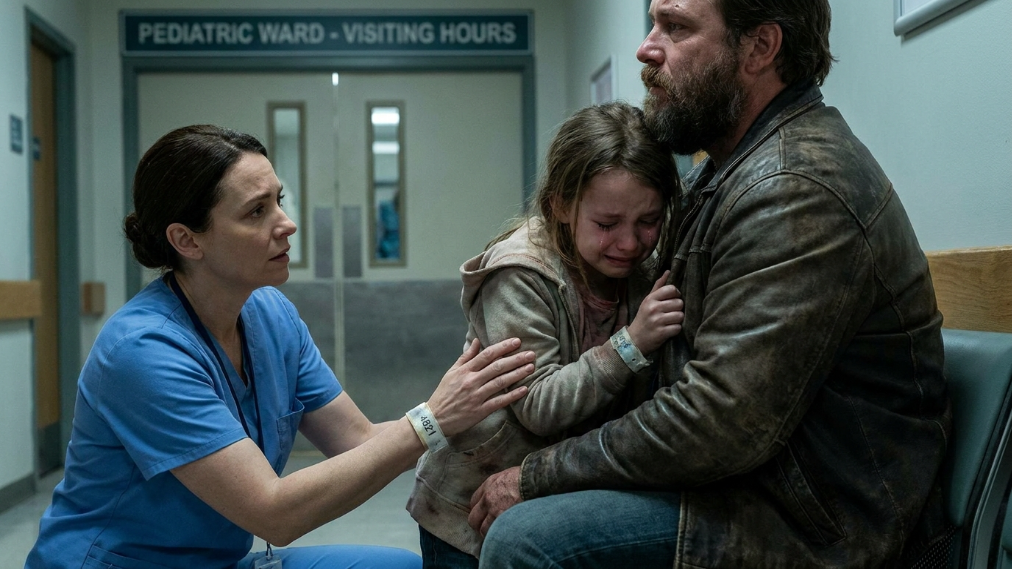
I looked down. A little girl, maybe seven years old, was burying her face into the heavy leather of my riding vest. Her small fists were knotted in the fabric, holding on like I was the only solid object left on earth.
“Don’t let them take me,” she sobbed.
Her voice was muffled against my chest. The English was broken, thick with an accent I couldn’t immediately place, but the absolute terror in her tone needed no translation. Her narrow shoulders shook violently under a hospital gown that was two sizes too big.
I froze. You don’t expect to become a human shield in the middle of a brightly lit pediatric corridor on a Thursday afternoon.
I am not a small man. The heavy boots, the graying beard, the tattoos bleeding down my forearms, and the weathered road vest usually make civilians give me a wide berth. I was only at the hospital to drop off a stuffed bear for a chapter brother’s kid in room 412.
I didn’t grab the girl. I didn’t try to peel her off me.
I just lowered my right hand, hovering it inches from her back, letting her anchor herself. Then I looked down the polished tile hallway to see what had sent her running blind.
Two adults were speed-walking toward us. They did not look like frantic parents searching for a lost child.
The man wore a tailored navy suit that probably cost more than my transmission. The woman beside him was dressed in sharp, expensive beige silk, her heels clicking a rapid, angry rhythm against the floor. They looked wealthy, polished, and furious.
Neither of them called out a name. Neither of them showed an ounce of relief at seeing the child safe.
They just marched straight toward me, their eyes locked on the little girl with a cold, calculating intensity. The man reached us first, not even bothering to look me in the eye.
“Come here immediately,” he snapped at the girl.
He reached out, his manicured hand extending past my elbow to grab her shoulder. He didn’t ask me to excuse him. He just treated me like a piece of furniture that happened to be in his way.
I shifted my weight, turning my right shoulder just enough to break his line of access. His hand hit empty air.
“Watch it,” he snapped, finally looking up at me.
His eyes were pale blue and utterly dead. “Step aside. You’re frightening our daughter.”
“She doesn’t look frightened of me,” I said. My voice was low, flat, and carrying the specific cadence I had learned over twenty years of riding the highways. “She looks frightened of you.”
The woman stepped up next to him, forcing a tight, plastic smile. “Please,” she said, her tone dripping with forced patience. “She’s having a severe panic attack. It’s a medical condition. You’re making it worse by interfering.”
The little girl whimpered, digging her face deeper into my vest. I could feel her heart hammering against my ribs like a trapped bird.
“If she’s your daughter,” I said, keeping my hands visible and perfectly still, “what’s her name?”
The man’s jaw tightened. “I don’t have to explain my family to a biker in a hospital hallway. Move out of the way before I call security.”
“Call them,” I said. I didn’t raise my voice. “Call the local PD while you’re at it. I’ll wait.”
That made him hesitate. It was just a micro-second, a tiny flicker of calculation behind his eyes, but I saw it. A father dealing with a medical episode wants all the help he can get. This man explicitly did not want the police.
Before he could answer, the heavy double doors of the pediatric wing swung open. A nurse in blue scrubs hurried out, her rubber-soled shoes squeaking on the wax.
She took one look at the scene—a massive, tattooed man in leather, a crying child clinging to him, and a wealthy, respectable-looking couple standing in opposition—and her institutional bias made the decision for her.
“Sir,” the nurse said, directing her sharp tone entirely at me. “You need to let go of that patient right now.”
“I’m not holding her,” I replied, keeping my arms wide. “She’s holding me.”
The man in the suit immediately seized the narrative. “Nurse, thank God,” he said, smoothing his tie. “Our daughter slipped out of her room. This man is blocking us from taking her back to bed. He’s being completely unreasonable.”
The nurse frowned, looking at my boots, then at the patches on my vest. The stereotype was working perfectly in their favor. To her, I was the disruption. They were the victims.
“Sir, please step away from the child,” the nurse ordered. “This is a restricted ward. You’re violating hospital policy by interfering with a patient.”
“I’m not interfering,” I said steadily. “I’m standing still. The kid asked me not to let them take her. So I’m not moving until we figure out why.”
“There is nothing to figure out!” the woman in beige snapped, her plastic smile finally breaking. “She is sick. She belongs with us.”
The nurse moved closer, her body language tense, ready to call a Code Gray for security. She reached out toward the little girl.
“Sweetheart,” the nurse said, softening her voice. “It’s okay. Let go of the nice man. Let’s look at your wristband and get you back to your room.”
The little girl shook her head violently, refusing to detach from my jacket.
“Just grab her,” the man hissed to the nurse. “We know her room. She doesn’t need to be scanned. Just hand her to me.”
That was the second mistake. In a hospital, the wristband is the absolute law of identity. Nobody bypasses the scanner unless they have something to hide.
I looked down at the top of the girl’s head. “Hey,” I said quietly. “It’s okay. Show the nurse your wrist. Nobody is grabbing you. I’m right here.”
The deep rumble of my chest seemed to ground her. She stopped shaking for a fraction of a second. Slowly, terrified, she loosened her right hand from my vest and extended her arm toward the nurse.
The loose sleeve of the hospital gown slid back.
The nurse reached out to take the tiny wrist, turning it to scan the barcode. But there was no barcode.
There wasn’t even a standard white pediatric admission band.
It was a faded, thick red plastic band. The edges were worn smooth, as if it had been on her wrist for a very long time, not just an afternoon admission. There was no name printed on it.
There was only a string of numbers, stamped in black ink that was beginning to rub off.
The man in the suit lunged forward. “Don’t look at that, it’s a mistake from triage—”
I blocked him with a hard step forward, dropping my shoulder. The sudden movement forced him to jump back to avoid a collision. “Let the nurse read the band,” I told him. The heat was finally rising in my blood.
The nurse leaned in closely, squinting to read the worn, faded digits printed across the red plastic.
I watched the nurse’s face.
It happened in an instant. The annoyance and institutional authority vanished from her features, replaced by a sudden, total absence of color. Her jaw went slack.
Her hand, still holding the little girl’s wrist, stopped in midair. She stopped breathing.
She stared at the faded number as if she had just found a ghost haunting her hallway.
“Where…” the nurse whispered, her voice trembling so badly the word barely formed. “Where did you get this band?”
The woman in the beige suit took a hurried step backward, her eyes darting toward the emergency exit doors at the end of the hall.
The nurse slowly looked up from the little girl’s faded wristband. She looked at the wealthy, polished adults. The institutional respect she had given them two minutes ago was gone, replaced by a profound, unmistakable terror.
I didn’t know what the number meant. But I knew what fear looked like.
I squared my shoulders, dropping my hands to my sides, planting my boots firmly into the hospital tile.
“Nurse,” I said, my voice cutting through the dead silence of the corridor. “Whose number is that?”
CHAPTER 2
The nurse did not answer my question. She couldn’t. Her eyes remained locked on the faded red plastic around the little girl’s wrist, her mouth opening and closing without producing a sound.
The terrified woman in the blue scrubs took a slow, trembling step backward. Her rubber soles squeaked against the polished floor. She bumped into a heavy metal medicine cart and just stayed there, leaning against it for support.
“I asked you a question,” I said, keeping my voice low and steady. “Whose number is that?”
The man in the tailored navy suit didn’t wait for her to find her voice. He moved with a sudden, vicious speed. He lunged forward, ignoring me entirely, his hands snapping out like a trap toward the little girl’s exposed arm.
He wanted that wristband. He wanted it covered, or he wanted it ripped off her wrist right then and there.
I didn’t throw a punch. I didn’t need to. I simply shifted my boots, dropped my right shoulder, and stepped directly into his path.
His chest slammed into my leather vest. The impact was entirely his own doing, but it stopped him dead in his tracks. He bounced off my heavy frame with a sharp gasp, stumbling backward in his expensive leather shoes.
“Don’t touch her,” I said. The rumble in my chest vibrated against the little girl’s cheek. “Don’t even try it again.”
“You assaulted me!” the man shouted, his face flushing a deep, dangerous crimson. He pointed a shaking finger at my face. “You all saw that! This biker just assaulted a father trying to comfort his sick child!”
The woman in the beige silk suit immediately joined his performance. She let out a practiced, dramatic gasp and clutched her husband’s arm. “Call security!” she screamed down the hallway. “He’s trying to kidnap our daughter! He’s hurting my husband!”
It was a brilliant, terrifying pivot. In less than ten seconds, they had taken their own aggressive lunge and reframed it as an unprovoked biker attack. They were counting on the leather, the tattoos, and the beard to sell their lie.
The nurse, finally snapped out of her paralyzed shock by the screaming, slapped her hand against the wall. She hit a large blue emergency button near the nurses’ station.
A high-pitched, rhythmic chime echoed down the corridor. The overhead lights flashed twice. A Code Gray had been called.
“You’ve made a terrible mistake,” the man in the suit hissed at me. He had dropped the volume of his voice so only I could hear him. “You have no idea who you’re dealing with.”
“I know exactly what I’m dealing with,” I replied softly. “A guy wearing a two-thousand-dollar suit who is terrified of a piece of red plastic.”
His pale blue eyes twitched. For a fraction of a second, the polished, wealthy facade cracked, revealing something purely feral underneath. He hated that I wasn’t intimidated by his money or his volume.
The little girl whimpered, her small fingers twisting tighter into the heavy denim of my jeans. She buried her face into my stomach, trying to make herself as small as possible. I kept my right hand hovering over her back, offering a shield without restricting her movement.
“I’m right here,” I told her quietly. “Nobody is taking you anywhere until the police arrive.”
“We don’t need the police!” the woman in beige snapped quickly. Too quickly. “This is a hospital matter. Security will handle this.”
Heavy footsteps pounded around the corner of the corridor. Four hospital security guards in dark gray uniforms sprinted into the pediatric wing. They slowed down as they took in the scene.
Their eyes landed on the crying child, the wealthy couple pointing fingers, and then me. I saw the immediate shift in their posture. The stereotype did the heavy lifting for the rich couple before a single word was spoken.
The guards spread out, their hands resting on their utility belts. The lead guard, a tall, broad-shouldered man with a tight buzzcut, stepped directly toward me.
“Sir, I need you to step away from the child,” the lead guard ordered. His voice was hard, leaving no room for negotiation. “Take your hands off her and step back to the wall.”
“My hands aren’t on her,” I said calmly. I raised both of my empty hands to shoulder height, keeping my palms open and visible. “She’s holding onto me. I’m not holding her.”
The guard frowned, looking down. He could see my hands were in the air, but the little girl was practically glued to my waist. Her knuckles were white from gripping my belt loops so hard.
“He grabbed her!” the man in the suit yelled, stepping behind the line of security guards. “He blocked us from her room, assaulted me, and now he’s using her as a human shield!”
“That’s a lie,” I said, my voice remaining entirely flat. “I was walking to room 412. She ran out of nowhere and grabbed me. Ask the nurse.”
All four guards turned to look at the nurse in the blue scrubs. She was still leaning against the medicine cart, her face the color of spoiled milk. She looked like she was going to be sick.
“Nurse?” the lead guard asked. “Is that what happened?”
The nurse opened her mouth, but the woman in the beige suit cut her off instantly. “The nurse is in shock!” the woman declared. “This massive thug just terrorized the entire hallway. Look at her, she’s terrified of him!”
It was a smart, manipulative move. The rich woman was feeding the security guards the exact narrative they were already primed to believe. A biker in a vest was causing chaos, and everyone else was a victim.
“Ma’am, let the nurse speak,” the lead guard said. He turned back to the nurse. “Did this man assault the father?”
The nurse swallowed hard. She looked at the man in the suit, then at me, and finally down at the little girl trembling against my legs.
“He… he didn’t hit him,” the nurse stammered. Her voice was weak. “The gentleman in the suit tried to grab the patient. The man in the vest stepped in the way.”
The man in the suit glared at the nurse with such intense, cold fury that she actually flinched. “I was trying to secure my daughter!” he barked. “She’s having a psychotic break!”
“Then why did you try to hide her wristband?” I asked. I didn’t yell. I just let the question hang in the bright, sterile air of the corridor.
The lead guard narrowed his eyes, turning his attention back to me. “What wristband?”
“The one on her right arm,” I said, nodding my chin toward the child. “The nurse checked it. And the second she saw the number, this guy tried to rip it off the kid’s arm.”
The guards looked at the father. His posture had stiffened. He adjusted his expensive silk tie, trying to project absolute authority.
“This is absurd,” the father said smoothly. “Her admission band has a typo. It’s a clerical error. I was simply trying to point that out before this biker went crazy.”
“It wasn’t a typo,” the nurse whispered.
The entire hallway went dead silent. Even the security guards stopped shuffling their feet. The nurse pushed herself away from the medicine cart, her hands shaking as she smoothed her scrubs.
“It wasn’t a typo,” the nurse repeated, her voice gaining a tiny fraction of strength. She looked directly at the lead security guard. “It’s a red band, Mike.”
The lead guard, Mike, froze. The professional, authoritative stance he had taken completely evaporated. I watched his shoulders drop, his eyes widening in sudden, profound confusion.
“A red band?” Mike asked. His voice had lost all its harshness. “Are you absolutely sure?”
“I saw the number, Mike,” she said, tears suddenly welling in her eyes. “It’s an old sequence. It’s a Restricted Red.”
I had spent my life around systems, rules, and codes, both inside the riding club and out in the civilian world. I didn’t know hospital protocol, but I knew what a panic word sounded like. “Restricted Red” had just changed the temperature in the room.
The woman in the beige suit scoffed loudly. “This is ridiculous! We are taking our daughter and leaving. Right now.”
She stepped forward, reaching for the child.
Mike, the lead guard, moved faster than I expected. He stepped his large frame directly between the wealthy woman and me. He held up a firm, flat hand, stopping her advance.
“Ma’am, you need to step back,” Mike said. His tone was completely different now. It wasn’t customer-service security anymore; it was law enforcement.
“Excuse me?” the woman gasped, her face twisting in pure outrage. “Do you know who my husband is? We are Platinum Circle donors to this hospital!”
“I don’t care if you built the hospital,” Mike replied bluntly. He looked over his shoulder at me. “Sir, I need you to walk with me. Slowly. Bring the child.”
“Where are we going?” I asked, keeping my hands visible.
“Room 400. It’s an isolation room at the end of the hall. It has a heavy door,” Mike said quietly. “Nobody goes in or out without my key.”
The man in the suit lost his temper. “You cannot lock my daughter in a room with a biker!” he roared. “I am calling our attorneys! I will have all of your jobs by five o’clock!”
“You do that, sir,” Mike said, keeping his back to them. He gestured for me to move. “Walk, buddy. Nice and slow.”
I looked down at the little girl. She was still gripping my jeans, her face hidden. “Hey,” I said softly. “We’re going to take a short walk. You just hold on. I’ve got you.”
She didn’t speak, but she nodded against my stomach. She shifted her grip, holding my jacket with one hand and my belt with the other. We began a slow, awkward shuffle down the polished corridor.
The three other security guards formed a human wall between us and the wealthy couple. I could hear the man in the suit screaming threats, demanding a phone, demanding the hospital administrator. He was throwing every ounce of his class and privilege at the wall, hoping it would break.
But the guards didn’t budge. Whatever a “Restricted Red” band was, it trumped a Platinum Circle donation.
We reached the heavy wooden door of Room 400. Mike swiped his badge, and the lock clicked with a heavy, magnetic thud. He pushed the door open and ushered us inside.
The room was sparse. A single hospital bed, a chair, and a monitoring machine. There were no windows to the hallway, only a reinforced glass pane looking out over the city parking lot.
Mike stepped inside with us and let the door close. It locked automatically behind him.
The heavy door cut off the sound of the screaming father instantly. The room was deathly quiet, filled only with the hum of the air conditioning and the ragged, shallow breathing of the little girl.
“Alright, buddy,” Mike said, letting out a long breath. He looked at my vest, reading the single rocker on the back. “You can put your hands down now. I know you’re not the threat.”
I lowered my arms slowly, rolling my shoulders to release the tension. “You want to tell me what’s going on?” I asked. “What’s a Restricted Red band?”
Mike ran a hand over his buzzed scalp. He looked exhausted, older than his badge photo suggested. “Five years ago, this hospital had a specialized trauma ward on the sixth floor,” he said quietly. “It was exclusively for children placed in protective custody by the state.”
I felt a cold knot form in my stomach. I looked down at the little girl, who was finally pulling her face away from my jacket. She looked up at me with massive, tear-filled brown eyes.
“The state shut the ward down after a funding scandal,” Mike continued, his voice tight. “The red wristbands were only issued to Jane and John Does in that specific unit. They were highly restricted.”
“So?” I asked, keeping my voice gentle so I wouldn’t spook the kid. “Maybe she got an old band by mistake.”
“They destroyed the red bands, man,” Mike said, shaking his head. “They burned the remaining stock when the ward closed. It is physically impossible for a patient today to be wearing one.”
I looked at the child’s right arm. The faded red plastic hung loosely around her thin wrist. The black numbers stamped onto it were barely legible, worn down by time and friction.
It wasn’t a new band. It had been on her wrist for a very, very long time.
“So who are the people in the hallway?” I asked, my jaw tightening.
“They’re registered in the system as her legal guardians,” Mike said. He pulled a small radio from his belt. “They checked her in two hours ago for a severe allergic reaction.”
“They didn’t look like worried parents,” I said. “They looked like people trying to catch an escapee.”
“I know,” Mike agreed. He keyed his radio. “Dispatch, this is Unit Four. I need the Nursing Supervisor and the on-call hospital administrator down to Room 400 immediately. And get me the police liaison.”
The radio crackled. “Copy, Unit Four. Be advised, the father is currently threatening to sue the hospital and is demanding the release of the child against medical advice.”
“Tell the desk to delay him,” Mike ordered. “Do not let them leave the floor.”
I reached into my leather vest, moving slowly so Mike wouldn’t jump. I pulled out my cell phone. “I need to make a call,” I told the guard. “I’m going to need witnesses here who don’t care about their paychecks.”
Mike watched me for a second, then nodded. “Make it fast. Once the admin gets here, they might try to force us to hand her over. Hospital politics are ugly.”
I dialed a number I knew by heart. It rang twice before a deep, gravelly voice answered.
“Yeah,” the voice said. It was Frank, the president of my riding club, and a man who spent his days running a heavy equipment logistics company.
“It’s me,” I said. “I’m at Mercy Hospital. Pediatric wing. Room 400. I need you down here, and I need you to bring Dave.”
Dave was our road captain. He was also a senior partner at a very aggressive family law firm downtown.
Frank didn’t ask if I was hurt. He didn’t ask if I was in trouble with the cops. He just listened to the tone of my voice. “How many bikes do you need?”
“Just you and Dave for now,” I said. “But tell the chapter to stay close to their phones. There’s a situation with a kid. Some rich folks are trying to force a narrative, and they’re using my cut as their excuse.”
“Give us twenty minutes,” Frank said. The line went dead.
I put the phone back in my pocket. I looked down at the little girl. She was watching me intently, her dark eyes darting between my face and the patches on my chest.
Slowly, she let go of my belt. She took a half-step back, creating a tiny sliver of space between us. She pointed a small, trembling finger at the center patch on my vest.
“Are you in a gang?” she whispered. Her voice was raspy, like she hadn’t had water in a day.
“No, sweetheart,” I said, crouching down slowly so I was eye-level with her. My knees popped loudly in the quiet room. “I’m in a riding club. We ride motorcycles together. That’s all.”
She studied my face. Children who have been through hell have a specific way of looking at adults. They don’t listen to words; they look for the lie in your eyes.
“They told me to say my name is Chloe,” she whispered, her voice barely carrying over the hum of the AC.
“Is that your name?” I asked gently.
She shook her head slowly. Her unbrushed brown hair fell into her eyes. “No.”
Mike, the security guard, stepped closer. “What’s your real name, sweetie?”
The little girl flinched and stepped back, hiding behind my knee again. She didn’t trust the uniform. She only trusted the guy who had stood between her and the suit in the hallway.
“It’s okay,” I told Mike, holding up a hand to stop him from pressing her. I looked back at the girl. “You don’t have to tell us anything you don’t want to. But I need to know one thing.”
She peeked out from behind my knee, watching me warily.
“The man and the woman out there,” I said, keeping my voice incredibly soft. “Are they your mom and dad?”
She shook her head again. A fresh tear spilled over her eyelashes, cutting a clean track down her dusty cheek. “They bought me.”
The words hit the sterile room like a physical blow.
Mike cursed under his breath, turning away to pace the length of the room. He ran his hands over his face, entirely out of his depth.
I didn’t react. I kept my face perfectly still, projecting nothing but absolute calm. If I showed anger, I would scare her.
“Okay,” I said quietly. “Thank you for telling me that. Nobody is going to let them take you.”
Before she could say anything else, the heavy door clicked and swung open.
Three people walked in. The first was a tall, severe-looking woman in a white doctor’s coat, a stethoscope draped around her neck. The second was a man in a sharp gray suit holding a tablet—clearly the hospital administrator.
The third person made my blood run cold.
It was a uniformed police officer. But he wasn’t looking at the little girl, and he wasn’t looking at Mike. He was glaring directly at me, his hand resting casually on his duty belt.
“Step away from the child,” the police officer commanded, his voice echoing loudly in the small room.
“Officer,” Mike started, stepping forward. “You need to understand the situation here. This man is protecting—”
“I said step away from her,” the cop barked, talking right over the security guard. He unclipped the retention strap on his holster. “The parents outside are filing kidnapping and assault charges against this biker. We have a clear perimeter.”
The hospital administrator stepped forward, nervously adjusting his glasses. “Sir, we have to follow protocol. The legal guardians are demanding her immediate release. If you do not step aside, you will be arrested.”
They were doing it. The wealthy couple outside had leveraged their money and their status to rewrite reality. They had bypassed the nurse, bullied the administration, and found a cop willing to look at my leather vest and see a criminal.
I stood up slowly, keeping my hands visible. “Admin,” I said, addressing the man in the gray suit. “Has anyone checked the number on her red wristband yet?”
The severe-looking doctor frowned. She stepped past the cop and looked at the child’s arm. When she saw the faded red plastic, she stopped short, her professional demeanor shattering just like the nurse’s had.
“Who issued this?” the doctor demanded, turning to the administrator. “These bands were destroyed five years ago.”
“I don’t know,” the administrator stammered, looking at his tablet. “I tried to run the number in the main system before we came in. It’s an archived sequence.”
“Run it again,” I said. My voice was hard now. “Run it while the officer stands here.”
“I don’t take orders from you,” the cop sneered. He pulled out a pair of handcuffs. “Turn around and put your hands behind your back.”
“Run the damn number!” Mike suddenly yelled, shocking everyone in the room. The security guard stepped directly in front of the cop, blocking his path to me. “Run the restricted red code on that tablet right now, or I’m calling the state medical board myself!”
The administrator panicked. His hands shook as he typed the faded black digits from the girl’s wristband into his secure tablet.
The room was painfully silent except for the clicking of his fingers on the glass screen.
The cop hesitated, his hand still on his cuffs. He looked at Mike, sizing up the larger security guard, deciding whether to escalate.
The tablet chimed loudly. A green light flashed on the screen, indicating a successful database query.
The administrator stared at the screen. He blinked, pulled his glasses off, and rubbed his eyes. He put the glasses back on and read the screen again.
“Well?” the doctor demanded impatiently. “Who is the band registered to?”
The administrator slowly looked up from the screen. He looked at the little girl, then at the cop, and finally at me. He looked like a man who had just watched the sky fall down.
“It’s impossible,” the administrator whispered.
“Read the file,” I demanded, taking a single step forward.
The administrator swallowed hard. He turned the tablet around so the doctor and the cop could see the screen.
“The wristband doesn’t belong to a child,” the administrator said, his voice completely hollow. “It was issued five years ago to an adult male. A John Doe.”
He looked nervously toward the heavy wooden door that led back to the hallway, where the wealthy couple was waiting.
“The system says the number belongs to the man standing outside in the navy suit,” the administrator said. “And the file says he died in this hospital four years ago.”
CHAPTER 3
The administrator’s words hung in the sterile, chilled air of Room 400 like a physical weight.
For five straight seconds, no one in the room took a single breath. The hum of the medical monitor in the corner suddenly sounded deafeningly loud.
“That’s impossible,” Officer Davis finally snapped, his voice breaking the spell. He stepped away from the door, pointing a rigid finger at the administrator’s tablet. “You read it wrong. It’s a computer glitch.”
“It is not a glitch,” the administrator whispered, his face entirely devoid of color. His hands were shaking so badly that the tablet rattled against his suit buttons. “This is an archived, closed-loop database. These files cannot be accidentally merged.”
Dr. Evans snatched the tablet out of the administrator’s trembling hands. She shoved her stethoscope over her shoulder and stared at the glowing screen. Her professional composure began to fracture right in front of us.
“The admission band on this child’s wrist,” Dr. Evans said, reading the screen rapidly. “It belongs to a John Doe admitted to the trauma ward exactly four years and two months ago. He arrived via life flight after a catastrophic highway collision.”
I kept my hands at my sides, my body positioned entirely between the little girl and the police officer. “And the man outside?” I asked.
“The man outside is registered in our primary donor database as Richard Sterling,” the doctor replied, her eyes scanning the digital file. “He checked this child into the ER two hours ago under his own insurance profile.”
“So where is the overlap?” Mike, the security guard, asked heavily. He moved slightly closer to me, realizing the uniform with the badge wasn’t the safest person in the room anymore.
“The biometric scan,” Dr. Evans said, her voice dropping to a horrified whisper. “When John Doe died in surgery four years ago, they ran his fingerprints to locate next of kin. They found a match in the state registry.”
She looked up from the tablet, her eyes wide behind her glasses.
“John Doe’s real name was Richard Sterling,” she said. “The real Richard Sterling died in Operating Room Four. The man outside our door is a ghost.”
Officer Davis shook his head violently, his hand dropping back to the butt of his service weapon. He was a man who relied on simple narratives, and his brain was actively rejecting the complex horror of what the screen was telling him.
“It’s identity theft,” Davis argued, his voice rising in volume. “Or a bureaucratic screw-up in the state system. It happens all the time.”
“It doesn’t happen with restricted medical bands,” Mike countered sharply. “And it sure as hell doesn’t explain why a seven-year-old girl is wearing a dead man’s hospital tag.”
“I don’t care about a plastic bracelet!” Davis barked, losing his temper. He turned his aggressive glare back to me. “I care about this biker holding a child hostage while the legal guardian is outside threatening a lawsuit!”
“I’m not holding her,” I reminded him quietly. “And you just heard the doctor. The man outside isn’t her legal guardian. He isn’t even Richard Sterling.”
“You don’t get to interpret the law, patched-trash,” Davis sneered. He took two fast, heavy steps toward me. “I am ordering you to step away from the girl right now, or you are going to the pavement.”
I didn’t blink. I didn’t tense my shoulders or shift my stance into a fighting posture. I simply remained a two-hundred-and-fifty-pound wall of denim, leather, and bone.
“If you touch me, you have to move me,” I told the officer, my tone conversational. “If you try to move me, you’ll terrify the child holding onto my belt. Do you really want that in your report?”
The little girl whimpered at the sound of the officer’s shouting. She pressed her face harder into my leg, her small fingers twisting the fabric of my jeans until her knuckles turned stark white.
“Officer, stand down,” Dr. Evans ordered sharply, stepping between me and the angry cop. “This is a pediatric isolation room. You are escalating a situation that requires extreme delicacy.”
“He is obstructing a police investigation!” Davis yelled, pointing over the doctor’s shoulder at my face. “I have a distraught father outside demanding his daughter back!”
“He is not her father,” a tiny, raspy voice whispered.
The sound was so quiet I almost missed it. Everyone in the room froze.
I looked down. The little girl had turned her head just enough to look past my heavy leather vest. Her massive, tear-filled brown eyes were fixed on the police officer.
“What did you say, sweetheart?” Dr. Evans asked, dropping to a slow crouch. She kept her hands open and non-threatening.
The girl looked up at me first, seeking permission. I gave her a single, slow nod. I didn’t smile, because a smile would have been a lie in this room, but I kept my eyes entirely steady.
“He is not my dad,” she repeated, her voice shaking but undeniably clear. “My dad is gone. The bad man bought me.”
The silence in the room was absolute. Even Officer Davis stopped breathing for a second. The sheer, unvarnished truth of a terrified child carries a weight that no badge or bureaucratic policy can easily dismiss.
“Sweetheart,” Dr. Evans said gently, her voice cracking slightly. “Where did you get the red bracelet?”
The little girl sniffled, wiping her nose with the oversized sleeve of her hospital gown. She carefully touched the faded red plastic circling her thin wrist.
“I took it,” she whispered. “Before the bad man locked me in the big car. I took it off my daddy’s arm.”
My jaw locked so hard my teeth ached. Four years. This child had been hiding her dead father’s hospital admission band for four years. She had worn it high on her arm, hidden beneath long sleeves, preserving the only piece of her real identity she had left.
“She’s lying,” Officer Davis said, though his voice lacked its previous venom. He looked deeply uncomfortable. “Kids make things up when they’re traumatized.”
“She kept a restricted hospital band hidden for four years?” Mike asked in disbelief, staring at the cop. “You think a three-year-old orchestrated a long con just to frame a millionaire?”
“I don’t know what I think!” Davis snapped defensively. “But I know I have a Platinum Donor outside who can have my badge by tomorrow morning if I don’t give him his kid!”
Before anyone could answer, a massive, echoing thud rattled the heavy wooden door of Room 400. Someone was kicking the base of the door from the hallway.
“Open this door right now!” the man in the navy suit screamed from the other side. His voice was muffled by the thick wood, but the pure, unhinged panic in his tone cut right through. “Administrator! If you don’t open this door, I am buying this wing and firing every single one of you!”
The administrator flinched, clutching the tablet to his chest as if it could protect him. The corporate instinct to obey wealth was warring visibly with the terrifying medical reality he had just uncovered.
“He called the Chief of Staff,” the administrator whispered to Dr. Evans. “The Chief just texted me. He’s on his way up with the precinct captain.”
“Let them come,” I said quietly.
“You don’t understand,” the administrator pleaded, looking at me with wild, desperate eyes. “Mr. Sterling—or whoever he is—funds half our pediatric oncology program. The hospital board will bury this. They will hand her back just to avoid the PR nightmare.”
“No, they won’t,” I replied. I reached down and rested my heavy, calloused hand gently on top of the little girl’s head. “Because I’m not moving.”
The heavy metal handle of the isolation door suddenly clicked. Someone on the outside was overriding the electronic lock with a master keycard.
Mike, the security guard, stepped back from the door, his hand dropping to his radio. “Here we go,” he muttered.
The door burst open. The man in the navy suit shoved his way into the room, his face twisted in a mask of absolute rage. He was flanked by his wife in the beige silk suit, who was already crying performative, theatrical tears.
Behind them stood a gray-haired man in an expensive tailored suit—clearly the hospital’s Chief of Staff. And behind him, filling the doorway, was a police lieutenant with gold bars on his collar.
“Arrest him!” the man in the navy suit screamed, pointing directly at my chest. “He kidnapped my daughter and locked himself in this room!”
The police lieutenant stepped into the room, his eyes scanning the scene. He saw me, the leather vest, the patches, and the little girl hiding behind my legs. His face hardened instantly into a mask of institutional authority.
“Step away from the child,” the lieutenant ordered. It wasn’t a request. It was a command backed by the full weight of the state.
“Lieutenant,” Dr. Evans started, holding up her hands. “You need to look at this medical file before you do anything. There is a massive discrepancy with the father’s identity.”
“I don’t care about a paperwork error,” the lieutenant barked, cutting her off completely. “Mr. Sterling has provided digital copies of her birth certificate and his guardianship papers. This man is a stranger interfering with a medical crisis.”
The man in the suit—the impostor—smirked. It was a tiny, fleeting expression, but I caught it. He knew the system was built to protect men who wore suits and to punish men who wore leather.
“Grab the girl,” the lieutenant ordered Officer Davis. “And put the biker in cuffs. If he resists, drop him.”
Davis stepped forward, pulling his handcuffs from his belt with a metallic rattle. He looked relieved to finally have an order that fit his worldview.
“Come here, sweetie,” the impostor’s wife said, stepping forward with her arms outstretched. Her voice dripped with fake, sugary sweetness. “Mommy’s here. Let’s get away from the scary man.”
The little girl let out a sound I will never forget. It wasn’t a cry. It was a high, thin wail of pure, primal despair.
She wrapped both her arms around my right leg, burying her face into my knee. She was trembling so violently that my entire leg shook with her.
“I am not resisting,” I said loudly, ensuring every person in the room heard me clearly. I slowly raised my hands and placed them flat against the back of my own head, interlacing my fingers.
I locked my eyes on the police lieutenant. “I am submitting to your arrest. But I am not moving my feet. If you want her, you’re going to have to physically tear her off my body.”
The lieutenant’s jaw tightened. He didn’t want a scene, and he certainly didn’t want his officers wrestling a screaming child off a compliant suspect in front of a doctor and an administrator.
“Davis, cuff him where he stands,” the lieutenant ordered. “Then we’ll separate them.”
Davis stepped behind me. He grabbed my left wrist, pulling it roughly behind my back. The heavy steel of the handcuff bit sharply into my skin as he ratcheted it tight.
He grabbed my right arm and forced it backward. I didn’t fight him. I let him lock the cuffs, keeping my breathing slow and even. The cold metal pinched my wrists together, securing me completely.
“He’s secured, sir,” Davis reported, stepping back with a satisfied huff.
The impostor took a step toward me. The smirk was fully visible now, a look of arrogant, untouchable triumph. He reached his manicured hand down toward the little girl’s shoulder.
“Get your hands off her,” a voice boomed from the hallway.
The voice was so deep, so thick with absolute, undeniable authority, that the impostor actually snatched his hand back as if he’d been burned.
Everyone turned toward the open doorway. The police lieutenant frowned, stepping back to see who had bypassed the security perimeter outside.
Two men walked into the pediatric isolation room. The air in the room seemed to vanish the second they crossed the threshold.
The first was Frank. My club president was sixty years old, built like a brick smokestack, and possessed a quiet, terrifying stillness. He wore his heavy leather cut over a faded black t-shirt, his president’s rocker clearly visible.
The second man was Dave.
Dave was our chapter’s road captain. He was also wearing a bespoke charcoal-gray suit that cost twice as much as the impostor’s navy one. A silk tie was perfectly knotted at his throat, but the cuffs of his tailored shirt couldn’t entirely hide the heavy, faded ink wrapping around his wrists.
“Who the hell are you?” the police lieutenant demanded, resting his hand on his weapon. “This is a restricted area. Get out before I lock you both up.”
Dave didn’t even look at the lieutenant. He walked straight past the angry cops, past the terrified administrator, and stopped directly in front of the impostor.
Dave reached into the inner pocket of his suit jacket. The cops tensed, but Dave smoothly produced a thick, cream-colored business card. He pressed it flat against the impostor’s chest, forcing the man to take it.
“My name is David Calloway,” Dave said. His voice was incredibly smooth, lacking any trace of anger, which somehow made it infinitely more intimidating. “I am the senior managing partner at Calloway, Reed, and Vance Family Law. And as of sixty seconds ago, I represent the child in this room.”
The impostor stared at the business card. His arrogant smirk faltered, replaced by a sudden, sharp flicker of uncertainty. “You can’t represent her. I am her legal father.”
“No, you are Richard Sterling,” Dave replied, his voice dropping an octave. “And Richard Sterling has been legally dead for four years. We pulled the county death certificate on the ride over.”
The Chief of Staff gasped loudly, stepping back until his shoulder hit the wall. The police lieutenant looked rapidly between Dave, the impostor, and the doctor.
“What is he talking about?” the lieutenant demanded, looking at the administrator. “I thought you said this was a clerical error.”
“It’s not an error, Lieutenant,” Dr. Evans said firmly, finding her courage now that the cavalry had arrived. She held up the hospital tablet. “The child is wearing a restricted trauma band belonging to a John Doe. That John Doe’s fingerprints match the real Richard Sterling.”
Dave turned his cold, calculating gaze onto the police lieutenant. “Lieutenant, under state family code section four-zero-two, if there is a documented discrepancy regarding the identity of a guardian, the child cannot be released to the disputing party.”
“He provided digital papers,” the lieutenant argued, though his voice had lost its absolute certainty. “Birth certificate and guardianship records.”
“Digital papers can be bought,” Dave countered smoothly, taking a step toward the lieutenant. “But a dead man’s fingerprints in a closed-loop hospital server cannot. If you hand that child over to an unidentified impostor, my firm will sue this precinct into the bedrock.”
The impostor’s wife let out a panicked sob. “Richard, do something!” she hissed, pulling on his sleeve. “They’re ruining everything!”
“Shut up,” the impostor snapped at her, his polish completely gone. He glared at Dave with pure, venomous hatred. “You’re a biker. You’re trying to extort me. Lieutenant, this man is clearly part of the same gang as the thug you just arrested!”
Dave smiled. It wasn’t a warm expression. It was the smile of a shark that had just smelled blood in the water.
“I am a patched member of a riding club, yes,” Dave said, adjusting his expensive silk tie. “I am also a former federal prosecutor. And right now, I am looking at a man who is actively committing felony identity theft and federal child abduction.”
The word ‘abduction’ hit the room like a grenade.
The little girl, still clinging to my leg, looked up at Dave. She didn’t know what the words meant, but she understood the tone. She understood that the man in the suit was fighting for her.
“Take the cuffs off my client,” Dave ordered, looking at Officer Davis. He didn’t ask. He commanded it.
“He resisted a lawful order,” Davis argued stubbornly, looking to his lieutenant for support.
“He stood completely still while you assaulted him,” Dave corrected, his eyes locking onto the young cop. “I have the hallway security footage downloading to my paralegal’s laptop as we speak. Remove the cuffs, Officer. Now.”
The lieutenant gave Davis a short, sharp nod. The young cop swallowed hard, stepped behind me, and unlocked the heavy steel cuffs.
I brought my hands forward, rubbing the deep red lines etched into my wrists. I looked at Frank, who was standing quietly near the door, his massive arms crossed over his chest. Frank gave me a single, slow nod. The brotherhood was holding the line.
“Administrator,” Dave said, turning his attention to the terrified man in the gray suit. “I need you to read the admission notes for the John Doe who died four years ago. Read them aloud for the police lieutenant.”
The administrator looked at the Chief of Staff, who silently nodded his permission. The corporate fear of a lawsuit had suddenly been eclipsed by the terrifying reality of harboring a kidnapper.
The administrator cleared his throat, his hands trembling as he scrolled down the tablet’s screen.
“Patient admitted on October twelfth, four years ago,” the administrator read, his voice shaky. “Brought in by MedEvac after a catastrophic collision on County Road Nine. The patient’s motorcycle was struck by a large SUV that fled the scene.”
My blood ran completely cold. I looked at the little girl, then looked up at the impostor. The pieces were starting to slam together in my mind with horrifying clarity.
“Keep reading,” Dave commanded gently.
“Patient suffered massive internal trauma,” the administrator continued, wiping a bead of sweat from his forehead. “Patient was traveling with a female child, approximately three years old, seated in a specialized sidecar. The child survived the impact with minor abrasions.”
The impostor took a slow step backward toward the door. Frank effortlessly shifted his massive frame, completely blocking the exit.
“What happened to the child after the father died in surgery?” Dave asked, his eyes pinned to the impostor’s pale, sweating face.
The administrator scrolled further down. He frowned, tapping the screen to refresh the page. “The notes say… the notes say the child was released to the biological mother.”
“And who signed the release forms?” Dave pressed.
“A woman named Sarah Sterling,” the administrator read. He looked up, pointing a shaking finger at the woman in the beige silk suit. “Her.”
The room spun with the gravity of the lie. The impostor and his wife hadn’t just bought a fake identity. They had orchestrated the entire nightmare from the very beginning.
The lieutenant finally stepped forward, his hand resting firmly on his duty belt. “Ma’am,” he said to the woman in the beige suit. “If your husband died in surgery four years ago, who is the man standing next to you?”
The woman broke. She let out a loud, terrifying wail and collapsed against the wall, sliding down to the floor in a heap of expensive silk.
“It was an accident!” she screamed, burying her face in her hands. “It was dark! He swerved in front of us! Richard said we couldn’t stop, he said the company would be ruined!”
The impostor grabbed his wife by the shoulder, hauling her violently upward. “Shut your mouth!” he roared, his eyes wide and frantic. “You’re hysterical!”
“She’s confessing,” Dave said smoothly, turning to the police lieutenant. “You have a spontaneous confession to a fatal hit-and-run, Lieutenant. I suggest you read them their rights.”
The little girl finally let go of my leg. She took one small step forward, standing between me and the screaming woman on the floor.
The child reached out her tiny hand and pointed her index finger directly at the impostor. Her hand was perfectly steady.
“He hit my daddy,” the little girl said, her raspy voice carrying an old, heavy grief that no child should ever know. “He hit my daddy with his big car. And then he put me in the back seat so I couldn’t tell the police.”
I looked down at the faded red hospital band on her wrist. The numbers weren’t just an admission code. They were the last physical proof of a murdered man’s existence.
Dave took a slow step toward the impostor. He didn’t look like an expensive lawyer anymore. He looked like a road captain who had just found the man who ran a brother off the highway.
Dave looked at the tablet in the administrator’s hand, then looked back at the terrified man in the navy suit.
“You didn’t just steal his life, did you?” Dave asked quietly. His voice carried a cold, lethal promise that filled the entire room. “You stole his identity so you could drain his trust fund. But you made one fatal mistake when you signed those hospital papers four years ago.”
CHAPTER 4
The silence that followed Dave’s words was heavy enough to crush bone. The man in the tailored navy suit stood frozen in the center of the sterile isolation room. His face had drained of all color, leaving his skin a sickly, translucent gray under the harsh fluorescent lights.
He looked at his wife, who was still sobbing hysterically on the linoleum floor. He looked at the hospital administrator, who was clutching the digital tablet like a shield. Finally, his panicked eyes darted toward the heavy wooden door.
Frank didn’t say a word. The president of my riding club simply shifted his massive, leather-clad shoulders and widened his stance. He became a human eclipse, entirely blocking the only exit from Room 400.
“You can’t prove any of this,” the impostor stammered, his voice cracking violently. He took a staggering step backward, his polished leather shoes slipping slightly on the waxed floor. “She’s a hysterical woman, and this is a shakedown by a biker gang!”
“It’s a riding club, actually,” Dave corrected him smoothly. He casually buttoned the center button of his bespoke charcoal suit. “And I don’t need to prove it today. The state police investigators will do that when they pull the wreckage report from four years ago.”
The police lieutenant had heard enough. The institutional deference he had shown this wealthy man just ten minutes ago had completely vanished. He unclipped his radio from his duty belt, his eyes locked on the sweating impostor.
“Dispatch, this is Lieutenant Harris,” he said, his voice hard and professional. “I need Major Crimes down to Pediatric Room 400 immediately. Send two detective units and a crime scene tech.”
The radio crackled back instantly. “Copy that, Lieutenant. What is the nature of the emergency?”
“We have a spontaneous confession to a fatal hit-and-run,” Harris said flatly, never taking his eyes off the man in the navy suit. “We also have felony kidnapping, identity theft, and fraud in progress. Secure the perimeter.”
The impostor let out a sound like a trapped animal. He lunged toward the hospital bed, his manicured hands reaching blindly for the little girl. He wasn’t trying to hug her; he was trying to grab a hostage.
I didn’t even have to throw a punch. I stepped directly into his path, bracing my boots against the floor tiles.
He slammed into my chest with the force of a desperate man, but it was like a bird hitting a windshield. I didn’t budge an inch. I simply locked my heavy arms around his shoulders and threw my weight forward.
We hit the floor hard, but I made sure he took the brunt of the impact. I pinned him to the linoleum, pressing my forearm across his shoulder blades to keep him flat. He thrashed wildly, his expensive suit tearing at the seams, but he couldn’t break my leverage.
“Give me your cuffs, Davis,” the lieutenant barked.
Officer Davis scrambled forward, his hands shaking slightly as he pulled his heavy steel handcuffs from his belt. He knelt beside me, grabbing the impostor’s flailing wrists. He wrenched the man’s arms behind his back, ratcheting the steel cuffs down tight.
“Get off me!” the impostor screamed, his face pressed sideways into the cold floor. “I know the mayor! I know the hospital board!”
“You’re going to need to know a very good defense attorney,” Dave noted dryly from above us. “Though I doubt anyone at my firm will take your calls.”
I stood up slowly, brushing the hospital floor dust off my denim jeans. I didn’t look at the man on the ground. My only concern was the little girl standing near the medical monitor.
She was trembling, her large brown eyes wide with a mixture of terror and overwhelming relief. I crouched down so I was back on her level. I didn’t reach out to touch her, wanting to let her control the space.
“They’re not going to hurt you anymore,” I told her quietly. “The police are taking them away. You’re safe now.”
She looked at the impostor, who was now being dragged to his feet by Lieutenant Harris and Officer Davis. Then she looked at the woman in the beige silk suit, who was still weeping on the floor. Neither of them looked powerful anymore.
“Are they going to jail?” she whispered, her raspy voice barely carrying over the sound of the AC unit.
“They are going to a very dark, very small room,” Frank rumbled from the doorway. His deep voice surprised everyone. “And they are never, ever going to be allowed near you again.”
She looked at Frank’s imposing figure. She saw the heavy leather vest, the gray beard, and the crossed arms. Instead of looking frightened, a tiny, exhausted sigh escaped her lips.
The heavy door opened again, and a swarm of blue uniforms flooded the narrow corridor outside. Two detectives in plainclothes pushed their way into Room 400. They took one look at the weeping woman and the cuffed man in the torn suit.
“Lieutenant,” the lead detective said, flashing a gold shield. “What exactly are we looking at here?”
Dave stepped forward, instantly taking control of the narrative before the hospital administration could try to spin it. He handed the detective his cream-colored business card. “You are looking at a four-year-old cold case that just thawed out, Detective.”
Dave pointed at the administrator, who was still clutching his tablet in silent horror. “That man is holding the digital medical records of a John Doe who died in this hospital four years ago. The child in this room is wearing the deceased man’s restricted identification band.”
The detective frowned, pulling a notepad from his inner jacket pocket. He looked at the little girl, his eyes landing immediately on the faded red plastic around her wrist. “Where has she been for four years?”
“Held captive in plain sight,” Dave answered flawlessly. “These two individuals struck the real Richard Sterling’s motorcycle on County Road Nine. When he died in surgery, they stole his identity to access his estate and took his surviving daughter to ensure no one asked questions.”
The woman on the floor let out another wailing sob. “We didn’t mean to!” she cried, rocking back and forth. “We just wanted the money! We didn’t want to hurt her!”
The detective didn’t even blink at the confession. He simply wrote it down in his notebook with methodical precision. He nodded to the uniformed officers.
“Get them out of here,” the detective ordered. “Separate cruisers. Read them their rights on tape as soon as they’re in the backseats.”
Lieutenant Harris and Officer Davis grabbed the impostors by their arms. They hauled them roughly out of the room, dragging them past Frank, who didn’t move an inch until they squeezed by. The hallway outside erupted into a frenzy of radio chatter and rapid footsteps.
The hospital administrator tried to quietly slip out behind them. Dave’s arm shot out, his hand clamping firmly onto the administrator’s shoulder.
“You aren’t going anywhere, friend,” Dave said. His voice was pleasant, but his grip was like an industrial vice. “We need a full download of those server logs before the hospital board accidentally deletes them.”
“I… I can’t authorize that without a court order,” the administrator stammered, sweating profusely. “Patient privacy laws.”
“I am her attorney,” Dave stated coldly, pointing to the little girl. “She is the sole surviving heir of the deceased patient. You will print those logs right now, or I will have a federal judge lock down this entire building by sunset.”
Dr. Evans stepped forward, pulling the tablet from the administrator’s shaking hands. “I’ll print them, Mr. Calloway,” she said firmly. She looked disgusted with her own colleague. “I’ll print every single keystroke from that night.”
“Thank you, Doctor,” Dave said, finally releasing the administrator. He turned back to the lead detective. “We’ll need a child advocate and a CPS liaison down here immediately. But under no circumstances is she leaving this hospital until her identity is officially re-established.”
The detective nodded, writing down Dave’s demands. He looked at me, taking in my leather cut and the road grime on my boots. “And what’s your involvement in all this?”
“I was delivering a stuffed bear to a kid in room 412,” I said simply. “She ran into my legs. I decided not to move.”
The detective offered a rare, genuine smile. “Good decision. We’ll need a full statement from you, but you can give it here in the room.”
Dr. Evans knelt beside the little girl, producing a small penlight from her pocket. “Sweetheart, I need to check you out,” the doctor said gently. “I need to make sure you’re healthy. Can I look at your eyes?”
The little girl looked at me again. She was using me as her emotional anchor in a room full of strangers. I nodded to her, stepping slightly to the side to give the doctor room.
She allowed Dr. Evans to examine her. The doctor worked quickly and quietly, checking her vitals, listening to her heart, and looking for signs of physical abuse. When the doctor reached for her right arm, the child flinched violently.
“It’s okay,” Dr. Evans murmured, looking at the faded red wristband. “I’m not going to take it from you. But the police are going to need it eventually. It’s very important evidence.”
The little girl’s lower lip trembled. She covered the red plastic with her left hand, protecting it fiercely. “It’s my daddy’s,” she whispered.
“I know it is,” I said, crouching down next to her again. “But right now, that piece of plastic is the key that locks the bad people in a cage. If you let the detective hold onto it, he can use it to punish them for what they did to him.”
She looked at the detective, who had squatted down to our eye level. He held out a clear, sterile evidence bag. He didn’t rush her.
“I promise you,” the detective said gently. “I will guard this with my life. And when the trial is over, you will get it back.”
She hesitated for a long time. The silence in the room stretched out, thick with the weight of a child making an impossible choice. Finally, she nodded.
Dr. Evans carefully slid a pair of medical shears under the faded plastic. She snipped it cleanly, making sure not to cut through any of the black numbers. The band fell away from the child’s thin wrist.
The doctor placed it gently into the detective’s plastic evidence bag. He sealed it with a sharp click, initialed the label, and tucked it safely into his jacket. The physical proof of a four-year nightmare had finally been secured.
“What’s your real name?” I asked her, my voice barely a whisper. “You said it wasn’t Chloe.”
She looked down at her bare wrist, rubbing the pale skin where the plastic had rested for so long. She took a deep, shuddering breath.
“Lily,” she said softly. “My daddy called me Lily.”
“It’s an honor to meet you, Lily,” I said. I held out my large, calloused hand.
She looked at my hand for a second. Then, slowly, she reached out and placed her tiny fingers into my palm. We shook hands. It was the firmest, most meaningful handshake of my life.
Over the next three hours, the pediatric isolation room transformed into a chaotic command center. Uniformed officers guarded the door while detectives interviewed everyone on the floor. Dave took meticulous notes, cross-referencing everything the hospital administration provided.
I stayed in the room the entire time. I sat in the uncomfortable plastic visitor’s chair, while Lily sat on the hospital bed, wrapped in a warm blanket. She refused to let me leave her line of sight.
Frank stood by the door, an immovable mountain of leather and silent authority. He didn’t speak much, but his presence kept the hospital staff from trying any more aggressive administrative maneuvers. Every time a new suit walked into the room, they looked at Frank and decided to be polite.
Around six o’clock, the door opened and Officer Davis walked back in. The young cop looked utterly exhausted. He had shed his aggressive arrogance, leaving behind a young man who realized how badly he had been manipulated.
He walked directly over to my chair. He didn’t look at Dave, and he didn’t look at Frank. He looked me dead in the eye.
“Sir,” Davis said, his voice tight with genuine regret. “I owe you a massive apology. I looked at your vest and I made an assumption. If you hadn’t stood your ground, I would have handed that child right back to her kidnapper.”
I didn’t smile. I didn’t offer him immediate absolution. I just looked at him, letting the weight of his admission hang in the air.
“You didn’t just make an assumption, Officer,” I said calmly. “You let a man’s wealth dictate your protocol. You need to remember this feeling the next time you pull a rider over on the highway.”
“I will,” Davis said, nodding stiffly. He swallowed hard. “I won’t forget this. None of us will.”
He turned and walked out of the room, his shoulders slumped. It wasn’t a perfect victory, but it was a crack in the armor of institutional prejudice. The badge had been forced to acknowledge the truth behind the leather.
Shortly after seven, the CPS liaison arrived. She was a kind, soft-spoken woman who immediately sat down with Lily to explain the next steps. Because Lily had no known living relatives in the state, she was going to be placed in an emergency foster home.
Lily immediately grabbed my sleeve, her eyes widening in renewed panic. She shook her head violently at the CPS worker. “No! I want to stay with him!”
The CPS worker offered a sympathetic smile. “I know he kept you safe, Lily. But he isn’t family. We have to follow the state guidelines for placement.”
“Actually,” Dave interrupted, stepping smoothly in front of the CPS worker. He held up a thick manila folder he had requisitioned from the hospital’s legal department. “State guidelines allow for emergency placement with documented community support networks.”
The CPS worker frowned. “He’s not a licensed foster parent, sir.”
“No, he isn’t,” Dave agreed. “But my firm has already filed an emergency injunction with the county judge. We are establishing a court-monitored protective perimeter around this child until permanent, safe housing can be vetted.”
He handed the worker a signed, legally binding document. “She goes to the state-approved group home tonight. But a patched member of our riding club will be stationed in the lobby twenty-four hours a day until the trial.”
The CPS worker looked at the document, then looked at the three of us. She saw the absolute, uncompromising determination in Dave’s eyes. She nodded slowly.
“I’ll notify the group home director,” she said. “They’ve worked with biker advocacy groups before. They won’t object to the extra security.”
I knelt down beside the bed one last time. I looked Lily straight in the eyes. “You hear that? You’re going to a safe place. And one of us will be right outside your door, every single minute.”
Lily looked at me, then at Frank, then at Dave. She saw the leather vests, the tattoos, and the heavy boots. But she didn’t see threats. She saw the only wall that had ever held up against the monsters in her life.
“Will you be there?” she asked me softly.
“I’ll take the first shift,” I promised her. “I’ll be sitting right in the lobby when you wake up tomorrow.”
She finally let go of my sleeve. She laid back against the hospital pillows, exhaustion finally overtaking her adrenaline. For the first time in four years, Lily closed her eyes and actually slept.
The fallout over the next month was absolute and merciless.
Dave’s law firm unleashed a tidal wave of litigation that paralyzed the hospital board. The media got wind of the story within forty-eight hours. The headline “Kidnapped Child Hidden in Plain Sight by Wealthy Donors” dominated the regional news cycle for weeks.
The hospital administrator who tried to force Lily’s release was fired and placed under criminal investigation for gross negligence. The triage nurse who initially tried to hand Lily back to the impostors resigned before she could face a disciplinary hearing. The hospital was forced to completely overhaul its pediatric security protocols.
The criminal case against the impostors was an avalanche of irrefutable evidence. Major Crimes pulled the four-year-old wreckage report from County Road Nine. The physical evidence matched the real Richard Sterling’s wrecked motorcycle perfectly.
The impostors had intentionally struck his bike on a dark stretch of highway. When they realized he was dead, they panicked. But when they found his wallet, they discovered he was a wealthy, isolated software developer with no immediate family and a massive trust fund.
They had taken his identity, his money, and his child. They used their stolen wealth to build an impenetrable wall of social status, assuming no one would ever question a rich couple in a tailored suit. They assumed their money made them invisible.
They were wrong.
The family court hearings were swift and brutal. Dave stood in the center of the courtroom, dissecting the impostors’ defense with clinical, terrifying precision. He entered the faded red hospital band into evidence, sealing their fate completely.
The judge stripped them of all legal rights to Lily’s estate and remanded them entirely to criminal custody. They were indicted on multiple felony charges, carrying a combined maximum sentence of over sixty years in a federal penitentiary. Their wealth was frozen, their assets seized, and their polished reputation burned to ash.
I attended every single court hearing. I sat in the front row of the gallery, wearing my heavy leather vest, my boots planted firmly on the polished wood floor. Officer Davis was often assigned to courtroom detail, and every time he saw me, he offered a quiet, respectful nod.
Our club kept our promise to Lily. For thirty straight days, a patched brother sat in the lobby of her state-approved group home. We didn’t cause trouble, we didn’t raise our voices, and we didn’t intimidate the staff.
We simply sat there. We read books, drank bad coffee, and provided a visible, unbreakable wall of security. The staff quickly realized that having a rotating guard of bikers was the greatest deterrent against unwanted visitors they could ever ask for.
Six weeks after the incident in Room 400, Lily’s legal status was fully resolved. Her father’s stolen trust fund was completely recovered and placed into a highly protected account managed by Dave’s firm. She was officially placed with a thoroughly vetted, deeply loving foster family who had experience with trauma recovery.
But there was one final piece of business that needed to be handled. It wasn’t a legal matter, and it wasn’t a police issue. It was a matter of the code of the road.
On a crisp, clear Saturday morning in late October, our entire chapter gathered in the staging lot of our clubhouse. Sixty heavy V-twin engines idled in perfect, synchronized harmony. The air smelled of hot exhaust, worn leather, and high-octane fuel.
We weren’t riding for a charity run. We weren’t riding to a rally. We were riding to reclaim a ghost.
Frank stood at the front of the pack, straddling his massive touring bike. He raised his heavy, gloved hand in the air. The sixty engines revved in unison, a deafening roar of mechanical thunder that shook the pavement beneath our boots.
I was positioned right behind Frank, riding near the front of the column. My passenger seat wasn’t empty.
Lily sat securely behind me, wearing a DOT-approved helmet that was a little too big for her head. She was strapped into a specialized child-safety harness that Dave had custom-ordered for my bike. She wore a tiny, custom-made leather vest over a heavy flannel shirt.
She wasn’t shaking. She wasn’t terrified. Her small hands were wrapped tightly around my waist, and I could feel her leaning comfortably into the rhythm of the idling engine.
Frank dropped his hand. The formation shifted into gear with a heavy, collective clunk. We rolled out of the clubhouse lot, moving in a tight, disciplined two-by-two column onto the open highway.
We rode for forty-five miles. The autumn air was sharp and cold against my face, but the heat radiating from the massive engine block kept us warm. Lily rested her helmet against my back, watching the trees blur past us in a wash of gold and brown.
We didn’t take the interstate. We took the back roads, winding our way out toward the rural county lines. We rode with the absolute precision of a military convoy, owning our lane, our presence demanding respect from every car we passed.
Eventually, Frank signaled a right turn. The column slowed down, banking smoothly onto County Road Nine.
It was a quiet, desolate stretch of asphalt, surrounded by dense pine forests and deep ravines. There were no houses, no streetlights, and no witnesses. It was exactly the kind of place where a terrible lie could be buried in the dark.
We rode for two miles down the winding road until Frank raised his left fist. The entire formation began to decelerate. We pulled off the asphalt onto a wide, gravel shoulder overlooking a steep, wooded embankment.
Sixty bikes rolled to a stop. Sixty riders hit their kill switches at the exact same moment. The sudden silence that fell over the forest was profound, broken only by the ticking of cooling metal pipes and the crunch of boots on gravel.
I unstrapped Lily from her safety harness and lifted her gently off the bike. I set her down on the gravel shoulder, holding onto her hand. She looked around at the silent forest, her small face serious and thoughtful.
Frank walked to the edge of the embankment. He carried a heavy, solid oak cross that one of our brothers had carved in his woodshop. At the center of the cross was a small, polished brass plaque.
The plaque read: Richard Sterling. A Brother of the Road. Ride Free.
Frank drove the sharpened end of the cross deep into the rocky soil. He hit it twice with a heavy rubber mallet, securing it firmly into the earth. It stood tall and unyielding against the backdrop of the dark pines.
Dave walked over, carrying a small, sealed plastic evidence bag. He had used every ounce of his legal leverage to retrieve it from the police impound earlier that morning. He handed the bag to Lily.
She took it carefully with both hands. Inside the bag was the faded red hospital wristband. The black numbers were still barely visible against the worn plastic.
I walked Lily over to the wooden cross. The entire formation of sixty riders removed their helmets. They stood at perfect parade rest, their hands clasped in front of them, their heads bowed in silent respect.
“It’s his now,” I told Lily softly, pointing to the base of the cross. “He doesn’t have to be a secret anymore. Everyone knows his name.”
Lily knelt down in the gravel. Her tiny leather vest creaked as she moved. She opened the plastic evidence bag and gently pulled out the faded red band.
She wrapped the plastic band around the base of the wooden cross, pulling it tight. It sat there, a bright splash of color against the dark oak, anchoring the memorial to the earth.
She stood up and took a step back. She didn’t cry. She just looked at the cross for a long, quiet minute, processing a grief that was finally allowed to exist in the daylight.
Then, she turned around and walked back to me. She reached up and grabbed my large, calloused hand, her small fingers wrapping tightly around mine.
I looked down at her. She wasn’t a hostage anymore. She wasn’t a secret kept by wealthy monsters. She was a little girl standing in the middle of sixty bikers, and she was the safest person on the planet.
Frank stepped forward. He didn’t offer a long, sweeping prayer. He didn’t preach a sermon about justice or the cruelty of the civilian world. He just looked at the cross, then looked at the little girl holding my hand.
“He was on two wheels,” Frank said, his deep voice carrying through the quiet trees. “That makes him family. And family doesn’t get left in the dark.”
Frank put his helmet back on. The rest of the club followed his lead. Sixty riders swung their legs back over their saddles.
I lifted Lily back onto my passenger seat. I secured her harness, making sure the straps were perfectly tight against her tiny leather vest. She gave my waist a firm squeeze, signaling she was ready.
I turned the ignition key. The heavy engine roared to life beneath us, joining the mechanical thunder of sixty other bikes.
We pulled back onto the asphalt of County Road Nine, leaving the dark woods and the wooden cross behind us. We didn’t look back at the past. We owned the lane, the sunlight flashing off the chrome, as we rode the little girl forward into the rest of her life.